

Labia majora surgery is a cosmetic procedure used to change the size or shape of the outer labia. This can mean reducing excess tissue, restoring lost volume with fat grafting, or tightening loose, sagging skin to improve both comfort and appearance.
Understanding the Motivations for Labia Majora Surgery
The decision to consider labia majora surgery is deeply personal, often stemming from a desire for greater physical comfort, improved confidence, or simply a feeling of being more at home in one's own body. It’s important to remember that anatomical variation is completely normal—there is no single “correct” way to look.
Even so, for many women, the shape and size of their labia majora can cause real physical or emotional distress. The reasons for wanting a change are diverse and valid, typically falling into two key categories: functional and aesthetic.
Here’s a quick look at the most common reasons patients seek this procedure.
Common Motivations for Labia Majora Surgery
| Category | Common Concerns and Goals |
|---|---|
| Functional | Resolving chafing, irritation, or pulling during exercise (cycling, running). Reducing discomfort from tight-fitting clothing like yoga pants or swimwear. Making hygiene feel easier and more manageable. |
| Aesthetic | Restoring volume lost due to aging, childbirth, or weight loss. Correcting a deflated or "saggy" appearance for a fuller, more youthful contour. Achieving better symmetry or a smoother silhouette in clothing. |
Ultimately, whether the reasons are practical or personal, the goal is to feel more comfortable and confident.
Functional Reasons for Surgery
For some women, the issues are entirely practical and interfere with daily life. Enlarged or elongated labia majora can cause persistent irritation, chafing, or a pulling sensation during certain activities. This can turn everyday actions into a source of discomfort.
Common complaints include:
- Discomfort in Clothing: Tight-fitting clothes like yoga pants, workout gear, or swimsuits can cause friction, making you feel self-conscious.
- Exercise-Related Issues: Activities like cycling, running, or horseback riding may become painful due to constant rubbing or tugging.
- Hygiene Concerns: Some individuals feel that excess tissue makes it harder to maintain proper hygiene in the area.
Aesthetic Reasons for Surgery
Aesthetic motivations are just as important and are often tied to natural changes in the body over time. Major life events like childbirth, significant weight fluctuations, and the aging process can all alter the appearance of the labia majora, causing a loss of volume and skin elasticity.
This can lead to a deflated or sagging look that doesn't align with how a woman feels inside. For many, the goal is simply to restore a fuller, smoother, and more youthful contour that feels more like their own.
The decision to pursue surgery is often about reclaiming a sense of self. It's about aligning one's physical body with their internal sense of identity and well-being, moving past discomfort to feel more at home in their own skin.
This procedure has seen a massive surge in interest. Labiaplasty, which includes surgery on the labia majora, saw a dramatic 217.3% increase in popularity between 2012 and 2017. Its appeal spans a wide demographic, with 55.3% of patients aged 19-34 and 34.2% aged 35-50. This shows that these concerns are shared by women across different stages of life.
You can learn more about these global plastic surgery statistics from the International Society of Aesthetic Genital Surgery and Gynaecology.
Exploring Your Surgical Options and Techniques
Once you've decided to consider labia majora surgery, the next step is figuring out which specific procedure is right for you. A skilled surgeon has a few different techniques in their toolkit, each designed to address a particular concern—from excess tissue that causes chafing to age-related volume loss. The key is to match the right technique to your unique anatomy and aesthetic goals.
This decision is deeply personal, often balancing a desire for physical comfort with aesthetic preferences. This flowchart helps visualize the common paths patients take when thinking about their surgical options.
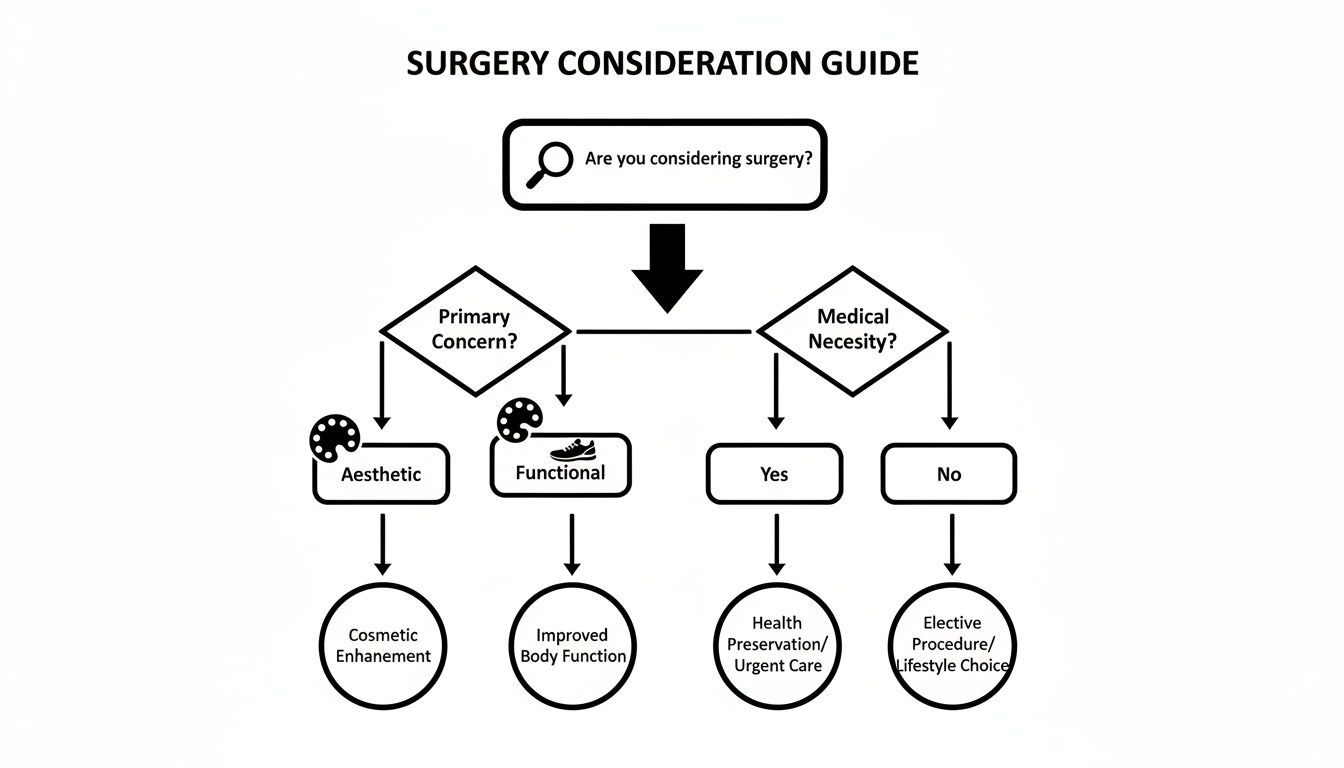
As the chart shows, whether your reasons are driven by function or appearance, there are established surgical routes designed to meet those specific needs.
The growing interest in these procedures isn't just anecdotal. The global demand for labiaplasty has climbed dramatically. Between 2015 and 2018, worldwide rates jumped 28%, followed by another 24% increase in just one year. Research shows that women’s motivations are pretty evenly split, with one study finding 32% sought surgery for functional issues and 31% for appearance.
Let's break down the three primary surgical techniques for the labia majora.
Labia Majora Reduction
A labia majora reduction, sometimes called a majoraplasty, is designed for women who feel they have excess skin or tissue in the outer labia. This can be a natural trait or the result of significant weight changes. The goal here is to create a smoother, more streamlined contour that gets rid of physical discomfort.
This procedure is a great fit for anyone who experiences:
- Chafing or irritation from tight clothing, leggings, or exercise.
- A sense of bulkiness or protrusion that makes them feel self-conscious.
- Noticeable asymmetry where one side is larger than the other.
During the surgery, the surgeon makes precise incisions, usually hidden in the natural creases, to remove the extra tissue. The remaining skin is then carefully sutured to create a smaller, more refined shape.
Labia Majora Augmentation with Fat Grafting
On the other end of the spectrum is labia majora augmentation. This procedure addresses a "deflated" or hollowed appearance, which is often caused by volume loss from aging, childbirth, or major weight loss. The goal is to restore a fuller, more youthful look.
The go-to method for this is autologous fat grafting. It's a two-step process:
- Harvesting: Fat is gently removed via liposuction from another part of your body where you have a little extra, like the abdomen or thighs.
- Transfer: That fat is then purified and strategically injected into the labia majora to add volume and shape where it's needed most.
Think of this technique as using your body's own natural filler to plump and rejuvenate the area. Because it uses your own tissue, the results feel completely natural, and there's no risk of an allergic reaction.
This option is perfect for those looking to reverse volume loss and achieve a softer, more rounded appearance.
Labia Majora Lift
A labia majora lift is all about tightening loose, sagging skin rather than adding or removing volume. You can think of it as a mini-facelift for the area. This is an excellent choice if you have good underlying volume but are bothered by skin laxity that creates a wrinkled or drooping look.
During a lift, the surgeon removes a crescent-shaped or elliptical piece of skin from the labia majora. By excising this excess skin and tightening the tissue, the procedure effectively lifts and smooths the entire area.
To help you see how these options stack up, here’s a quick comparison.
Comparison of Labia Majora Surgery Techniques
This table provides a simple, at-a-glance overview of the three main surgical techniques, making it easier to see which one might align with your goals.
| Surgical Technique | Primary Goal | Ideal Candidate | Basic Approach |
|---|---|---|---|
| Labia Majora Reduction | Reduce size and bulkiness | Has excess skin/tissue causing discomfort or a prominent appearance. | Excess tissue is surgically removed, and the incision is closed in a natural crease. |
| Labia Majora Augmentation | Restore volume and fullness | Has a "deflated" or hollowed look due to aging, childbirth, or weight loss. | Fat is harvested from another body area and injected to add volume. |
| Labia Majora Lift | Tighten loose, sagging skin | Has good volume but is bothered by skin laxity, wrinkles, or drooping. | A piece of excess skin is removed to lift and smooth the area. |
While each technique has a distinct purpose, it’s important to remember that they can also be combined. For example, a surgeon might perform a lift and some subtle fat grafting at the same time to create the most harmonious result.
Ultimately, the best approach depends entirely on your anatomy and what you want to achieve. For a deeper look into how different labiaplasty methods work, check out our guide on the top labiaplasty techniques explained. This will arm you with the knowledge you need for a productive conversation with your surgeon.
Navigating Your Recovery and Aftercare
Knowing what to expect after your labia majora surgery is absolutely key to a smooth, comfortable healing process. Your body needs time to recover, and being prepared mentally and physically makes all the difference. A clear aftercare plan helps manage discomfort, reduces the risk of complications, and ensures you get the best possible outcome.
Think of the initial recovery phase as laying the foundation for your final result. Following your surgeon’s instructions to the letter during this time isn't just a suggestion—it's essential for your health and the quality of your healing.
The First Week: Your Immediate Recovery
The first 24 to 72 hours are when you’ll notice the most significant swelling, bruising, and tenderness. This is completely normal; it’s just your body's natural response to surgery. Your only job right now is to rest and keep activity to an absolute minimum.
Managing discomfort is the top priority during this initial window. Your surgeon will give you specific instructions, which almost always include:
- Pain Medication: Take your prescribed pain relievers on schedule to stay ahead of the discomfort.
- Cold Compresses: Applying a cold pack (wrapped in a clean cloth, of course) to the area for short periods can work wonders for reducing swelling.
- Rest and Elevation: Lying down with your hips propped up on a few pillows helps decrease both swelling and pressure on the area.
It’s crucial to avoid any strenuous activity. Even things that seem simple, like a long walk or lifting groceries, are off-limits for now. This is your time to let your body focus all its energy on healing. Having a friend or family member around to help for the first day or two can be a huge relief.
Weeks Two Through Six: Returning to Normalcy
As you move into the second and third weeks, you should notice a real improvement. The swelling and bruising will start to fade, and you’ll likely feel much more comfortable. Most of my patients feel ready to return to a desk job or light daily activities within one to two weeks, but it's vital to listen to your body and not push it.
This phase is all about a gradual return to your routine. Even though you're feeling better, your body is still healing on the inside. Protecting the delicate incisions means continuing to avoid certain activities.
A common mistake I see is patients feeling better and immediately trying to do too much, too soon. Patience during this stage is your greatest asset. Rushing back to the gym or other high-impact activities can put strain on your incisions and set your recovery back.
Key restrictions during this time almost always include:
- No Strenuous Exercise: High-impact workouts, heavy lifting, running, and cycling are off the table for now.
- Avoid Submerging in Water: Stay out of baths, hot tubs, and swimming pools to prevent any risk of infection.
- No Sexual Activity: You must wait for your surgeon to give you the all-clear, which is typically around the six-week mark.
For a more detailed day-by-day look at what to expect, our labiaplasty recovery guide offers a comprehensive timeline.
Aftercare Essentials for a Smooth Recovery
Proper aftercare is every bit as important as the surgery itself. A few simple guidelines will help you heal faster, stay comfortable, and dramatically lower the risk of complications like infection.
Your daily care should focus on gentle hygiene and creating a low-stress environment for the healing tissues. Here’s a practical checklist to help you prepare.
Your Post-Surgery Care Checklist
- Gentle Cleansing: Clean the area exactly as your surgeon directs, usually with just mild, unscented soap and water. When you're done, gently pat the area dry with a clean towel—no rubbing.
- Loose-Fitting Clothing: Your wardrobe choices matter. Opt for loose cotton underwear and soft, comfortable pants or skirts to avoid any friction or pressure on the surgical site.
- Stay Hydrated and Eat Well: A healthy diet and plenty of water are fundamental to supporting your body’s natural healing processes.
- Attend All Follow-Up Appointments: These check-ins are crucial. They allow your surgeon to monitor your progress and make sure everything is healing exactly as it should.
By following these aftercare steps and giving your body the time it needs, you create the perfect conditions for a successful and comfortable recovery after your labia majora surgery.
Breaking Down the Costs of Surgery
Let's talk about the financial side of labia majora surgery. It’s a critical step in your planning, and while thinking about the numbers can feel a bit overwhelming, breaking it down turns a daunting topic into a manageable part of your journey. The final price tag isn't just one number; it's a combination of several key components that form the total investment.
Think of it like building a house—you don't just pay for the materials. You also pay for the architect and the workshop where everything comes together. Surgery costs work in a very similar way.
What Is Included in the Total Price
When you receive a quote for your procedure, it will almost always be an all-inclusive price that covers these three essential elements:
- Surgeon's Fee: This is the largest part of the cost, and it pays for your surgeon's expertise, time, and skill. This fee reflects their years of training, specialized experience, and the complexity of your specific procedure.
- Facility Fee: This charge covers the use of the accredited surgical center or hospital where the surgery is performed. It includes the cost of the operating room, dedicated nursing staff, and all necessary surgical supplies.
- Anesthesia Fee: This fee pays for the services of a board-certified anesthesiologist or nurse anesthetist who is responsible for your safety and comfort throughout the entire surgery.
This bundled pricing model is designed to be completely transparent, helping you avoid unexpected bills after your procedure is complete.
Insurance Coverage and Why It Is Unlikely
A very common and important question is whether health insurance will cover labia majora surgery. In almost all cases, the answer is no. Insurance companies classify this procedure as cosmetic, meaning it’s performed to improve appearance rather than to correct a documented medical problem.
Even if you experience functional issues like chafing or discomfort, it is extremely rare for an insurer to deem the surgery a medical necessity. You should absolutely plan for this to be an out-of-pocket expense.
It's essential to approach the financial planning for this procedure with the firm expectation that you will be responsible for the full cost. This mindset allows for realistic budgeting and a smoother process from the start.
Financing Options for Your Procedure
Because this surgery is an investment, most plastic surgery practices offer financing options to make it more accessible. These plans allow you to pay for the procedure over time with manageable monthly payments, rather than all at once.
One of the most popular options is through third-party medical credit companies like CareCredit. These plans function much like a credit card but are used exclusively for healthcare expenses. They often feature promotional periods with deferred interest, which can be a significant advantage if you can pay off the balance within the specified timeframe. To get a better sense of typical price ranges, our article on the average cost of labiaplasty provides valuable context.
The demand for procedures like this has become notable in global statistics. In 2018 alone, a total of $16.5 billion was spent on 17.7 million cosmetic surgeries in the United States, highlighting a significant trend. For those exploring their options, understanding these financial aspects is a key part of making an informed decision. You can discover more insights about global statistics on isaps.org.
Understanding the Risks and Setting Realistic Expectations
Any good surgeon will tell you that an informed decision is a confident one. While surgery on the labia majora can create beautiful, natural-looking improvements, it’s crucial to walk into the process with a clear-eyed view of both its potential and its limitations. The goal is always progress, not an unattainable ideal of perfection.
Every single surgical procedure, no matter how routine, comes with potential risks. A surgeon who is transparent about these possibilities isn't trying to scare you—they're empowering you to make a choice that’s truly right for your body and your goals. This open conversation is one of the biggest signs of a trustworthy professional.
Just like any other operation, labia majora surgery involves risks tied to both the anesthesia and the procedure itself. Your surgical team will take every precaution to keep you safe, but it's important to be aware of what could happen.
Common Risks and Potential Complications
Most of the common concerns are manageable and tend to resolve with proper aftercare, but they are a non-negotiable part of the pre-surgical discussion. Your surgeon should have clear protocols in place to address anything that might come up during your recovery.
Here’s what you need to know about potential complications:
- Infection: It’s rare when aftercare instructions are followed, but any time the skin is broken, there's a risk. Diligent hygiene is your best defense against it.
- Asymmetry: Surgeons are artists who strive for perfect symmetry, but minor differences from one side to the other can—and often do—occur as part of the natural healing process.
- Scarring: Incisions are strategically placed within natural creases to be as hidden as possible. Still, how a scar ultimately looks depends heavily on your individual healing genetics.
- Changes in Sensation: It's completely normal to experience temporary numbness or even heightened sensitivity around the incisions. This is just part of the healing journey and almost always resolves over several months.
- Under- or Over-Correction: This is when too little or too much tissue is removed, or an incorrect volume of fat is grafted. If this happens, a smaller revision procedure may be needed to fine-tune the results.
Understanding the full spectrum of outcomes—both the desired results and the potential complications—is the foundation of patient safety and satisfaction. A great surgeon ensures you are well-informed, not just consented.
Choosing a board-certified surgeon with deep experience in labia majora surgery is the single most effective way to lower these risks. Their nuanced understanding of this delicate anatomy and their refined techniques are your greatest assets for a safe and successful outcome. This is exactly why vetting your surgeon is so critical.
Key Questions to Ask Your Surgeon
Your consultation is your time to get answers specific to your anatomy, your health, and your goals. A qualified surgeon will welcome your questions and give you honest, direct information. Never hesitate to ask about their personal track record and safety protocols.
Be sure to bring these essential questions to your appointment:
- How many labia majora surgeries have you personally performed?
- What is your complication rate for this specific procedure?
- How do you manage complications if they do arise?
- Looking at my anatomy, what specific risks should I be most aware of?
- What can I do personally to minimize my risks and help ensure the best possible outcome?
Asking these questions helps you quickly gauge a surgeon's experience and their commitment to patient safety. This proactive approach ensures you're setting the right expectations and can step into your procedure feeling confident and prepared.
How to Find the Right Surgeon for You
Choosing your surgeon is easily the most critical decision you'll make in this process. Their skill, experience, and artistic judgment will directly shape your safety and your final outcome. This isn't the time to hunt for a bargain; it’s the time to find a true specialist you can trust without reservation.
Think of it like hiring a master artisan for a very delicate project. You wouldn't choose them based on price alone—their credentials and portfolio are everything.
Your search should start and end with one non-negotiable standard: board certification. This isn't just a fancy title on a website. It’s hard-earned proof that a surgeon has completed years of specialized training and passed rigorous exams in their field. For labia majora surgery, you should look for a surgeon certified by either the American Board of Plastic Surgery or the American Board of Obstetrics and Gynecology.
But certification is just the entry ticket. You also need a surgeon who has deep, specific experience in female genital cosmetic surgery. This is a highly specialized part of the body, and you want a doctor who performs these procedures constantly, not just once in a while.
Evaluating a Surgeon's Experience and Skill
Once you've confirmed a surgeon's credentials, it's time to become a critic of their work. A surgeon's before-and-after photo gallery is their real-world resume. Don't just glance at the pictures; study them carefully to get a sense of their aesthetic style and the consistency of their results.
When you're reviewing their portfolio, look for these key things:
- High-Quality Photos: The images need to be clear, well-lit, and taken from the same angles to give you an honest comparison.
- A Variety of Cases: A strong gallery will show patients with different body types and a range of starting points. This shows versatility.
- Natural-Looking Results: The best work often looks like a subtle, natural improvement, not something that screams "surgery." Look for outcomes that are harmonious and balanced.
- Similar Anatomy to Yours: Try to find examples of patients whose "before" photos look similar to your own body. This will give you the clearest idea of what that particular surgeon might be able to achieve for you.
Preparing for Your Consultation
The consultation is your chance to interview the surgeon and make sure they're the right fit for you. You should go into this meeting prepared with a list of questions. A great surgeon will welcome your questions and encourage an open, honest conversation.
Your consultation is more than a medical appointment; it's a partnership interview. You are evaluating their expertise and communication style, while they are assessing if they can safely and effectively meet your goals.
Come prepared to discuss your goals, your complete medical history, and any worries you have. This is also your time to ask about their specific complication rates and how they handle any issues that might come up after surgery.
A confident, experienced surgeon will be transparent and direct with their answers. That's a clear sign you're in good hands. Taking this proactive approach ensures you can move forward with your labia majora surgery feeling secure and fully informed.
Your Top Questions About Labia Majora Surgery
After learning about the techniques and recovery involved in labia majora surgery, it's completely normal to have some practical questions pop up. Let's get into the specifics that patients most often ask about so you can feel clear and confident about what to expect.
Here are the straightforward answers to a few key concerns.
Will Labia Majora Surgery Affect Sensation?
This is easily one of the most important questions, and the answer is reassuring. When performed by an experienced, board-certified surgeon, this procedure is carefully designed to preserve sexual sensation. The surgical techniques specifically avoid the nerves that are critical for arousal and orgasm.
It's normal to experience some temporary numbness or even heightened sensitivity around the incisions as you heal, but this typically fades within a few months. A long-term negative impact on clitoral sensation is not a common or expected outcome of this surgery.
How Soon Will I See the Final Results?
You’ll see a significant change right away, but the final, settled look takes some time to reveal itself. This is where a little patience really pays off.
Here’s a general timeline for what you can expect as the tissues heal:
- First 4-6 Weeks: The most noticeable swelling and any bruising will go down during this period.
- 3-6 Months: It can take this long for the last bit of residual swelling to vanish completely. The tissues will continue to soften and settle into their final shape.
Following your surgeon's aftercare instructions is the single best thing you can do to support your body's healing and lock in a beautiful result.
What Kind of Scarring Should I Expect?
Scarring is an unavoidable part of any surgery, but surgeons who specialize in this area are masters of concealment. Making incisions as discreet as possible is a fundamental part of the technique.
Surgeons strategically place incisions within the natural creases and folds of your anatomy. This clever approach acts like camouflage, making the scars very difficult to spot once they’ve fully matured.
If you’re having fat grafting for augmentation, the entry points are just tiny punctures that usually heal without leaving any visible mark at all. Scars will look pink or red at first, but over 6 to 12 months, they will fade into thin, pale lines that blend right in with the surrounding skin.
At Labiaplasty.com, our goal is to be a trusted resource for every part of your journey. Whether you're exploring before-and-after galleries, trying to understand costs, or looking for a qualified surgeon in your area, we are here to help you make informed and empowered decisions.
