

You may be healing from mesh surgery and still feel unsure about a small spot of blood, a new discharge, or a dull ache that keeps coming back. That uncertainty is common because mesh erosion does not always announce itself with dramatic symptoms. Sometimes it looks like a mild irritation. Sometimes a clinician finds it during an exam, even when a person feels almost fine.
Mesh erosion means the implanted material has started to expose through tissue or work its way into nearby structures. It can involve the vagina, bladder, urethra, bowel, or another nearby area, so the symptom pattern can vary from person to person. That is why a simple question like what are the symptoms of mesh erosion needs a careful answer. Some signs are easy to notice, some are subtle, and some people have no symptoms at all until a clinician looks closely. Routine evaluation matters because a quiet problem can still be present (Mayo Clinic).
Introduction to Mesh Erosion
A person may leave recovery thinking everything is settling into place, then notice a small change that is easy to brush off, like light spotting, a new discharge pattern, or a dull pressure that keeps returning. Those changes can feel like ordinary healing at first, which is why mesh erosion is often missed in the early stages.
Mesh erosion means the mesh has become exposed through tissue or has started to work its way into nearby structures. That exposure can involve the vagina, bladder, urethra, bowel, or another nearby area, so the symptom pattern can look different from one person to another. A closer look matters because the same material can cause very different problems depending on where it is sitting and how the tissue around it reacts (review of mesh complications).
Why symptoms can be easy to miss
The difficult part is that mesh erosion is often asymptomatic or delayed, so a person may feel mostly fine while the problem is already present. Some people do not notice anything unusual at all, and others only realize something is wrong when a clinician examines the area closely. A quiet presentation can be especially confusing because the warning signs may show up long after surgery, instead of right away.
A subtle symptom does not mean a minor problem. A small amount of bleeding, a change in discharge, or a new ache can be the first clue that mesh is irritating nearby tissue. If symptoms begin after mesh placement, they deserve attention even when they seem mild.
One detail people often overlook is pain around the vaginal opening, especially if it seems to come and go or gets worse with contact. A clear explanation of pain at the vaginal opening can help show why irritation in this area is not always easy to dismiss.
The point is simple. Symptom awareness helps you describe what has changed, notice patterns that do not fit routine healing, and decide when a closer exam is needed. It also helps prevent a delayed warning sign from being mistaken for something harmless.
Common Signs of Mesh Erosion
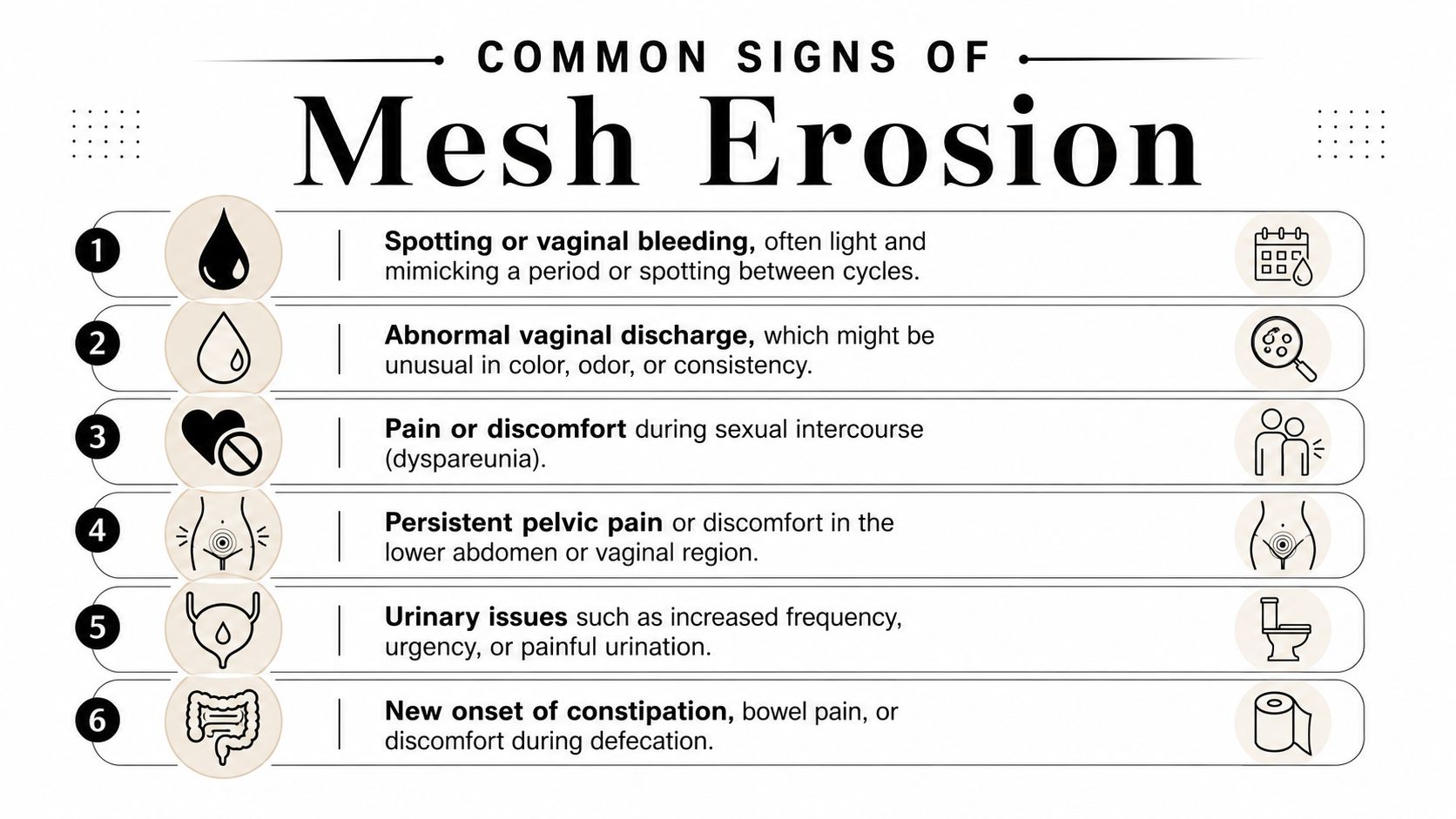
The most common symptoms tend to sound ordinary at first. That's part of the problem. A light spotting pattern can seem like a late period, a discharge change can seem like irritation, and pelvic pain can feel like the kind of soreness people expect after surgery.
The signs people notice first
In a 5-year cohort of 510 women with vaginal mesh, 9.6% had erosion, and among those with symptoms, spotting was reported by 24.5%, discharge or infection by 24.4%, and dyspareunia by 8.2% (cohort study). Those numbers don't mean everyone gets the same pattern, but they do show the most common complaints clinicians hear.
Think of spotting or bleeding as an unexpected light drip, not a heavy flood. It may show up after intercourse, between cycles, or long after the original surgery. Abnormal discharge can look unusual in color, smell, or thickness, especially if tissue is irritated or infected.
Pain during sex, or dyspareunia, often makes people seek help because it's hard to ignore and often affects both comfort and confidence. Some people also notice persistent pelvic pain, vaginal burning, or discomfort at rest.
How the body signals the problem
- Bleeding or spotting: Can appear as light staining on underwear or toilet paper, and may seem intermittent rather than constant.
- Discharge changes: May reflect irritation, tissue breakdown, or infection around the exposed material.
- Dyspareunia: Often feels like sharp, rough, or deep pain during intercourse rather than general soreness.
- Pelvic or vaginal pain: Can be constant, positional, or triggered by pressure.
- Urinary symptoms: Some people first notice frequency, urgency, or discomfort when urinating.
- Bowel discomfort: Less common, but a change in comfort with bowel movements can matter.
A small symptom can still be worth reporting. If the area around the vaginal opening feels raw or unusually tender, pain at the vaginal opening isn't something to just watch forever, especially when it follows mesh placement.
When a symptom keeps repeating, the pattern matters more than the intensity. A mild problem that doesn't go away deserves attention.
Less Common and Hidden Symptoms
Mesh problems do not always announce themselves with one obvious sign. The symptom pattern depends on where the mesh is irritating tissue, so a bladder-related erosion can look very different from a vaginal exposure, and bowel involvement can be harder to recognize still. The body does not label the problem for you, it reacts in the area under stress.
A person may feel that something is wrong long before a clear diagnosis is made. Sometimes the clue is a urinary complaint that keeps coming back, sometimes it is a discharge pattern that does not fit a typical infection, and sometimes the discomfort seems too vague to connect to surgery at first.
When the bladder or urethra is involved
When erosion reaches the bladder or urethra, symptoms can include painful voiding, urinary frequency, urgency, hematuria, recurrent urinary tract infection, urinary calculi, and urinary fistula. ACOG notes that persistent vaginal bleeding, discharge, or recurrent UTIs after mesh placement should prompt evaluation for exposure or erosion (ACOG guidance).
This pattern is easy to miss because many people expect mesh trouble to stay in the vagina. Urinary symptoms can be the only sign that the mesh is affecting a nearby structure. A complaint that sounds like a routine bladder problem can still point back to the prior surgery, which is why symptoms after mesh surgery deserve a careful history instead of a quick assumption.
When the bowel is involved
Bowel erosion is less common, but it can be harder to spot because the first signs may look digestive rather than gynecologic. A 2025 clinical series reported 7 out of 8 patients with bowel erosion developed enterocutaneous fistulas, and the same series described abdominal pain, bowel obstruction, chronic discharge, and sepsis (Frontiers Partnerships series).
A related review of intestinal erosions after inguinal hernia repair found acute obstruction was the most frequent presentation, and early erosions were more likely to cause obstruction than late ones. That means new bowel symptoms after mesh surgery should not be dismissed as unrelated stomach trouble. If the discomfort feels intestinal, pelvic, or unexplained, it still belongs in the same conversation with your surgeon.
When Symptoms Appear and Risk Factors
The timeline can be confusing, and that is part of what makes mesh erosion easy to overlook. Some people notice symptoms early, some do not feel anything for a long time, and some only connect the problem to surgery years later. A quiet stretch after an operation does not rule it out.
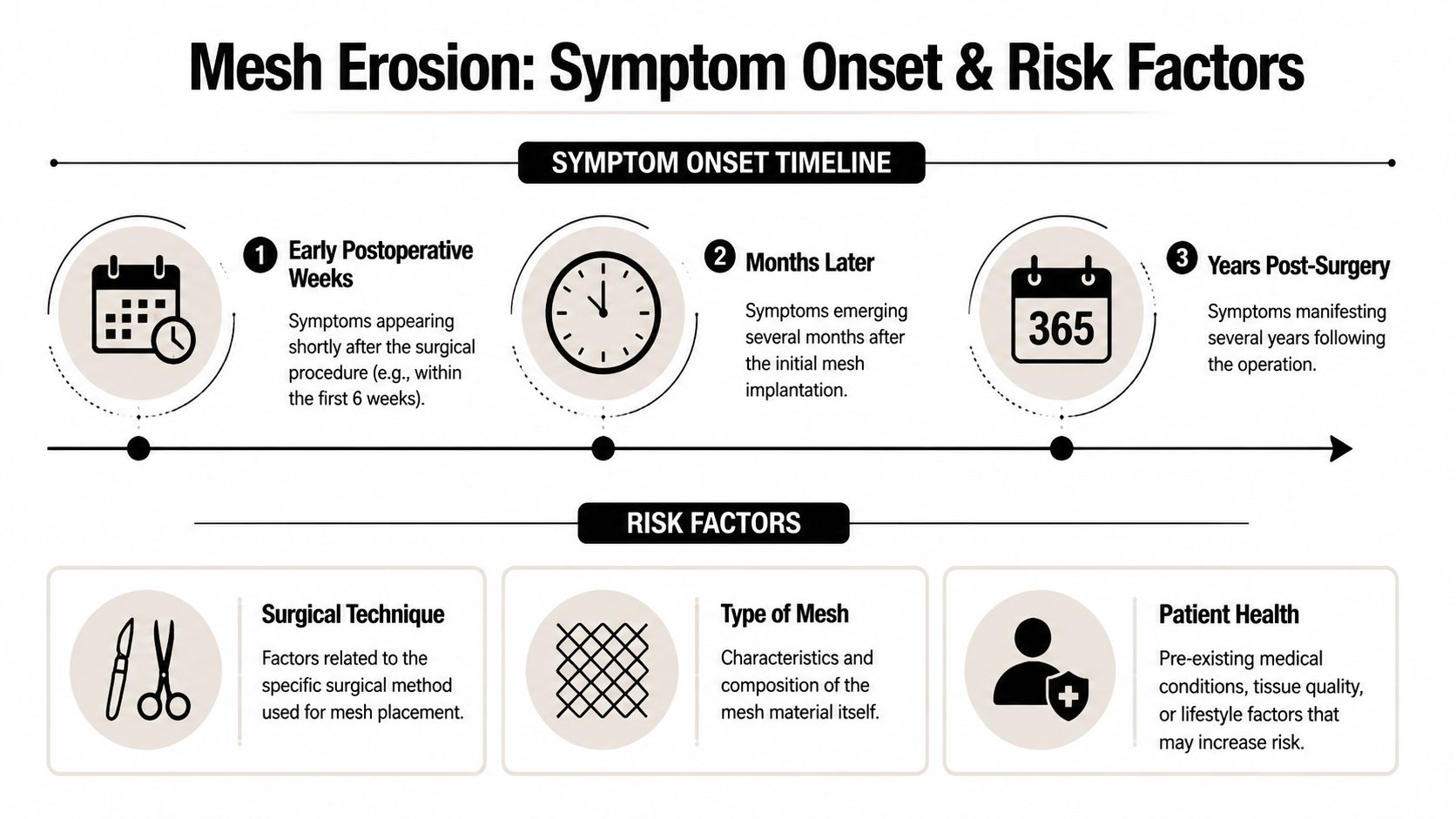
Why the timing is unpredictable
Some mesh problems announce themselves quickly, while others stay hidden like a frayed seam inside fabric, visible only after more stress or tissue change. That is why delayed symptoms can feel so puzzling to patients, especially when the first months after surgery seemed uneventful.
Clinical literature has described erosion rates that vary widely by procedure type, with reported rates ranging from 0% to 33% across studies and a mean incidence of 10.3% in a meta-analysis of nearly 12,000 patients (review). Those differences reflect how surgeons place the mesh, what material is used, and how erosion is defined or found.
The delay can be long enough to blur the connection. Signs may show up only after erosion has been present for some time, so a person may think the symptoms came from nowhere. They did not, they were easy to miss.
Risk factors that shape the picture
- Surgical technique: The method used to place the mesh can affect how tissues heal around it.
- Type of mesh: Material and structure matter, because different meshes interact with tissue differently.
- Patient health: Tissue quality, pre-existing conditions, and healing capacity can all influence how a person responds.
Important distinction: Risk factors do not diagnose erosion. They only help explain why one person might develop symptoms sooner, later, or not at all.
If you are comparing your own experience with other patients, symptom pattern and persistence matter more than a single dramatic episode. Risks of labiaplasty points to a separate procedure, but the broader lesson still applies, one operation can heal normally in one person and still lead to unexpected tissue problems in another.
How Clinicians Diagnose Mesh Erosion
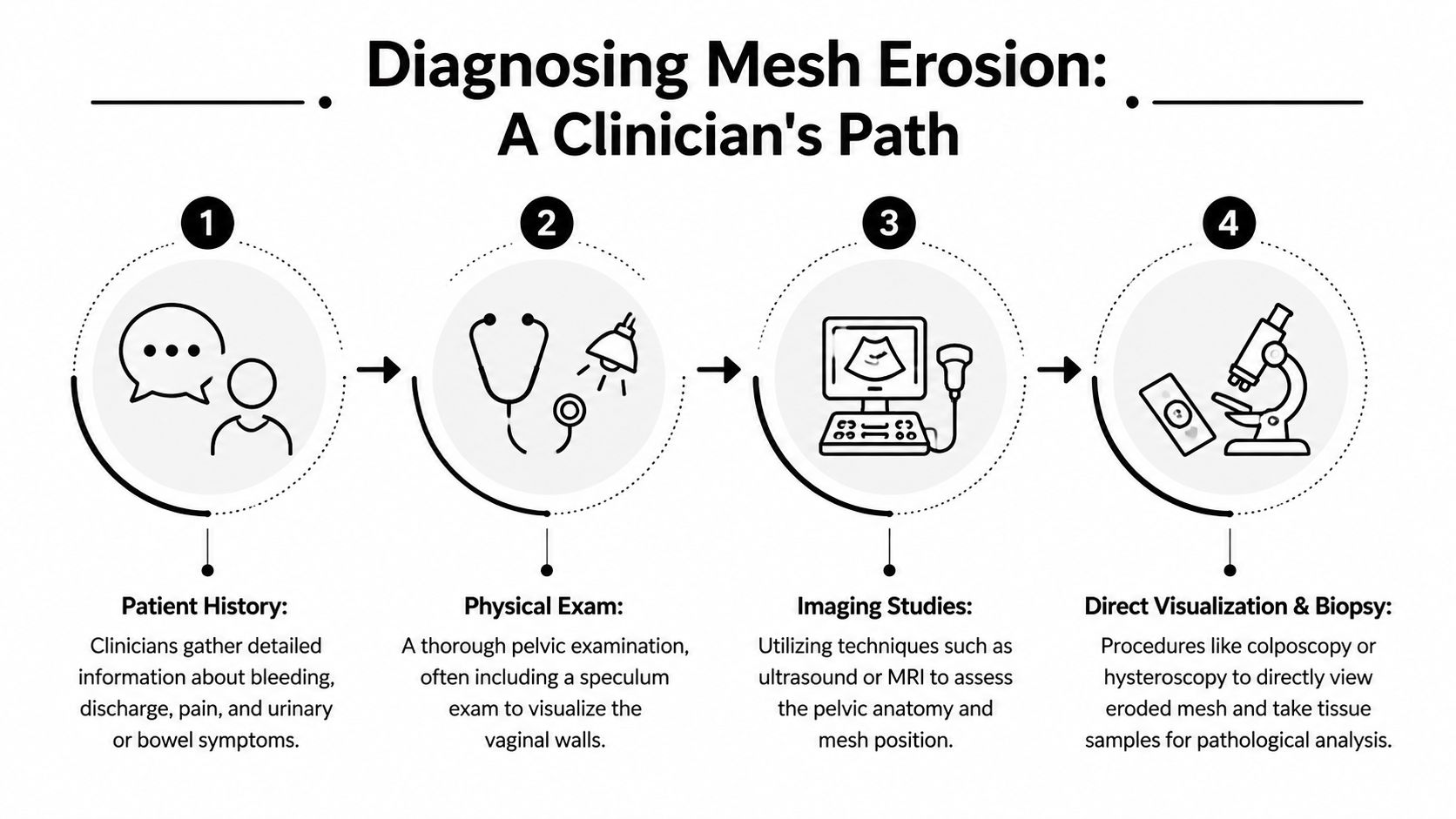
A diagnosis often begins with a patient describing a change that does not fit the expected recovery pattern. A clinician will ask about bleeding, discharge, pain, urinary changes, bowel changes, and whether the symptoms began after mesh surgery. Those details matter because a small shift in timing or location can point to a different tissue or organ.
Some cases are obvious. Others are easy to miss at first, especially when symptoms are mild, delayed, or mistaken for a routine infection. A person may have only a small patch of exposed mesh, or only a nagging change such as irritation that keeps returning.
What the clinician is looking for
A pelvic exam can show exposed mesh directly, especially during a speculum exam. That is why a careful physical exam often reveals more than imaging alone, much like checking a loose stitch by hand before ordering a larger repair.
If the bladder or urethra seems involved, cystoscopy may be used to look inside the urinary tract. Imaging such as ultrasound or MRI can help map anatomy and show where the mesh sits, but those tests do not always tell the whole story by themselves. Direct visualization methods, including colposcopy or hysteroscopy, can help confirm what the tissue is doing and whether a biopsy is needed.
A careful examiner also looks for subtler clues that can hide in plain sight. Recurrent irritation, tenderness in one spot, or discharge that keeps returning after treatment can matter even when the surface findings look mild. Some patients describe symptoms that come and go, which can make the problem seem less important than it is.
The sequence usually makes sense in steps
- Patient history. The clinician connects symptoms to timing and prior surgery.
- Physical exam. The pelvic exam looks for visible exposure, tenderness, or tissue changes.
- Imaging or endoscopy. These tests help define where the mesh sits and whether nearby organs are involved.
- Tissue evaluation. If needed, direct visualization and sampling clarify the diagnosis.
Persistent vaginal bleeding, discharge, or recurrent UTIs after mesh placement should prompt evaluation for exposure or erosion, as noted in ACOG guidance. In practice, that threshold is useful because the symptoms can look ordinary at first, then keep returning despite treatment. If a problem keeps resurfacing, the question is not only what it feels like, but why it is not settling down.
For some patients, the finding is not classic erosion but another surface injury or inflammatory change that needs a different label and approach. A related example is vulvar granuloma fissuratum, which can also produce persistent discomfort and exam findings that need careful sorting out. That is one reason clinicians do not rely on symptoms alone. They match the story, the exam, and the tissue findings before deciding what is happening.
Treatment Options and Expected Outcomes
Treatment depends on whether the exposed area is small and localized or whether the erosion reaches deeper tissue. The best choice isn't always the most aggressive one, and it isn't always the least invasive one either. The right answer depends on symptoms, location, and how much tissue is involved.
Conservative care versus surgery
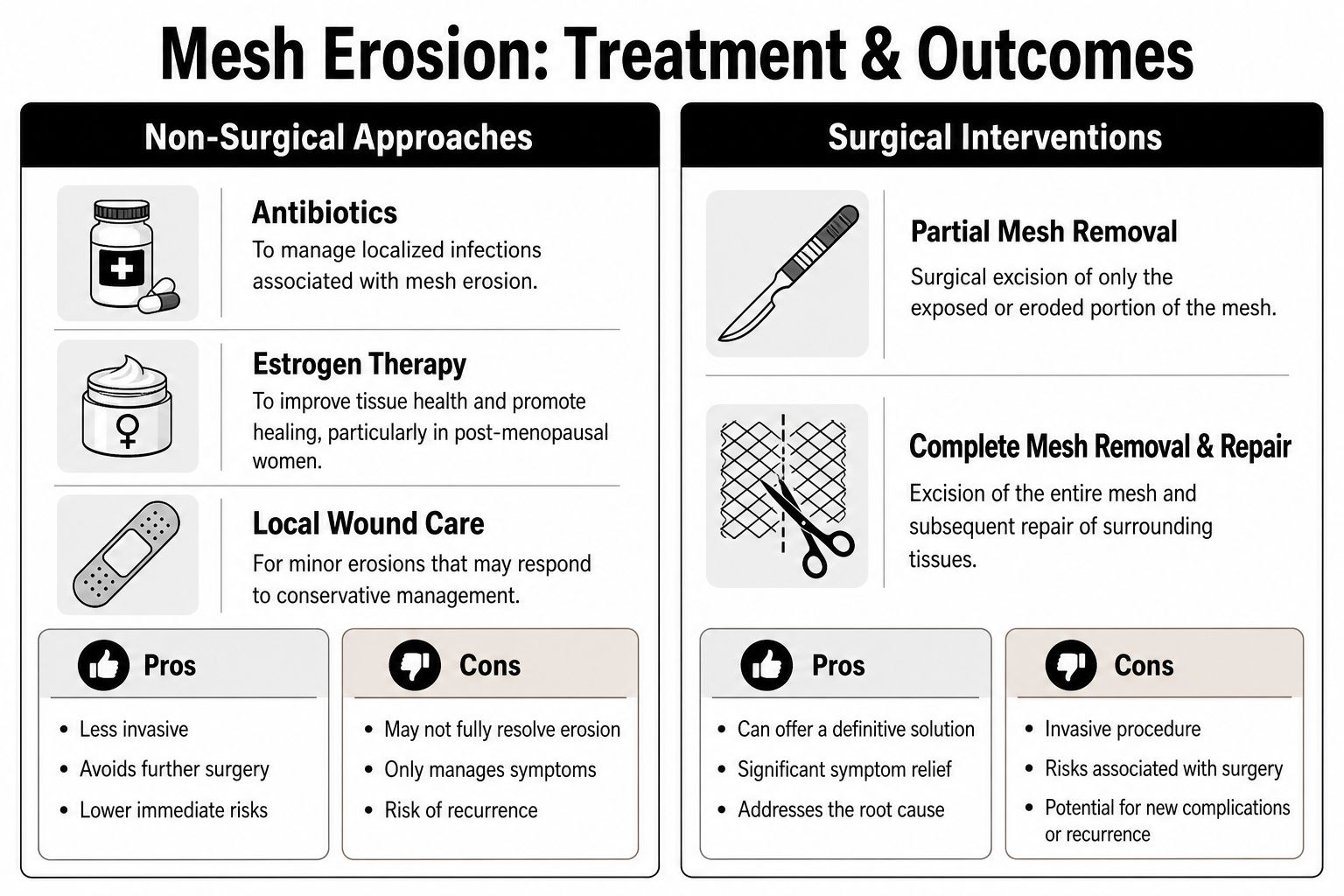
Non-surgical options may include antibiotics for localized infection, estrogen therapy to support tissue health in post-menopausal patients, and local wound care for minor erosions. The main advantage is that these approaches are less invasive. The limitation is just as important, they may reduce symptoms without fully resolving the erosion.
Surgical treatment is more direct. A clinician may remove only the exposed portion of mesh, or in some cases perform a more extensive excision with tissue repair. That can offer a more definitive solution when symptoms are persistent or the erosion is more extensive.
How to think about tradeoffs
- Less invasive care: Good when exposure is small or symptoms are mild, but it may not end the problem.
- Partial mesh removal: Targets the visible problem while preserving as much support as possible.
- Complete removal and repair: More definitive, but also more complex and more likely to require careful planning.
A useful way to frame the choice is this, conservative care manages the local reaction, surgery removes the source. Neither path is automatically “better” for everyone.
Bottom line: The decision should match the actual anatomy, not just the symptom list.
For people trying to understand tissue irritation around the vulvar area more broadly, vulvar granuloma fissuratum is a useful comparison point because it shows how chronic friction and tissue breakdown can produce persistent discomfort without a simple one-size-fits-all fix.
Recognizing When You Need Urgent Care
Some symptoms can wait for a scheduled visit. Others can't. Heavy bleeding, fever, severe pain, signs of sepsis, or acute urinary retention need prompt medical attention because they can signal a more serious complication.
If abdominal pain is escalating, discharge becomes foul or suddenly heavy, or you feel unable to pass urine, don't watch it for days. A bowel erosion, urinary obstruction, or infection can worsen quickly, and delayed care can make treatment harder.
Seek urgent evaluation if your symptoms feel sudden, severe, or clearly different from your usual post-operative recovery.
The most important rule is simple. Don't wait for a symptom to become dramatic before reporting it. A person with mesh erosion can look stable on the outside while the underlying problem is already affecting tissue or organ function.
Questions to Ask Your Surgeon
Use a short checklist so the appointment stays focused.
- What signs should I watch for? This helps you separate normal healing from warning symptoms.
- Do my symptoms fit exposure or erosion? The answer shows how seriously the pattern is being taken.
- What tests do I need next? This tells you whether the plan is a pelvic exam, imaging, or a procedure.
- What are my treatment options? You need to know whether care is conservative, surgical, or both.
- Who should follow me after diagnosis? Mesh problems sometimes need specialist care and long-term follow-up.
If the answers feel vague, ask for specifics about next steps and timing. Clear follow-up plans reduce the chance that a quiet but real problem gets ignored.
Labiaplasty.com offers clear, patient-friendly education on surgical topics, recovery, risks, and how to prepare for honest conversations with a qualified clinician. If you're sorting through symptoms and want more practical guidance on women's surgery and follow-up questions, visit Labiaplasty.com for straightforward resources that can help you talk with your care team more confidently.
