
Dermabond usually sloughs off the skin in about 5 to 10 days, and some closure systems with mesh support can stay in place 7 to 14 days. It sets within minutes, so the part you can see lasts much longer than the part that locks the wound edges together.
That gap between setting time and wear time is why people get uneasy. You may look at the incision on day 8 or day 12 and wonder if it's stuck, peeling, or somehow not healing right.
The Short Answer on Dermabond Duration
The short answer to how long does Dermabond last is that the visible adhesive film usually stays on the skin for about 5 to 10 days, then loosens and falls off on its own, while some adhesive plus mesh systems are commonly left until 7 to 14 days if healing is ready for removal or natural release. Patient instructions from Nationwide Children's say the adhesive “will loosen from the skin and fall off in 5 to 10 days,” and Johnson & Johnson's DERMABOND ADVANCED materials say the polymerized film “naturally sloughs off within 5-10 days” (Nationwide Children's Dermabond incision care).
What makes this confusing is that Dermabond sets fast. In product materials, the adhesive is described as reaching its initial bond in about 45 to 180 seconds and maximum bonding strength at roughly 2.5 minutes, which means the wound is closed quickly even though the film remains visible for days afterward (J&J MedTech Dermabond Advanced). That's the key distinction.
So when a patient asks what “lasts” means, I usually separate it into two timelines. The first is the working time, measured in minutes. The second is the visible wear time, measured in days, and sometimes up to two weeks in systems like PRINEO when mesh support is part of the closure (DERMABOND PRINEO patient care pad).
Practical rule: if the skin edges are staying together and there's no drainage, a film that's still present near the two-week mark can be normal in some closures.
If you're comparing different recovery instructions, the wording can feel inconsistent. A general guide and a surgeon's follow-up sheet may sound different because they're describing different closure types and different wound conditions, which is why patient instructions matter more than any one headline range. This overview of surgical glue care is useful for that same reason, it focuses on what patients see instead of only the product label.
A Day-by-Day Picture of Dermabond as It Heals
The first day usually looks very simple. The incision is sealed, the film sits on top of the skin, and the line may look shiny or slightly stiff because the adhesive has already set. The goal here is not for it to disappear, the goal is for it to hold the wound edges still while the tissue underneath starts its work.
By days 2 to 4, the look often changes more than the wound itself. The film can seem darker, wrinkled, or slightly raised, and that can alarm people who expected it to look fresh the whole time. In most cases, that change is just the surface film aging as the skin below continues to heal.
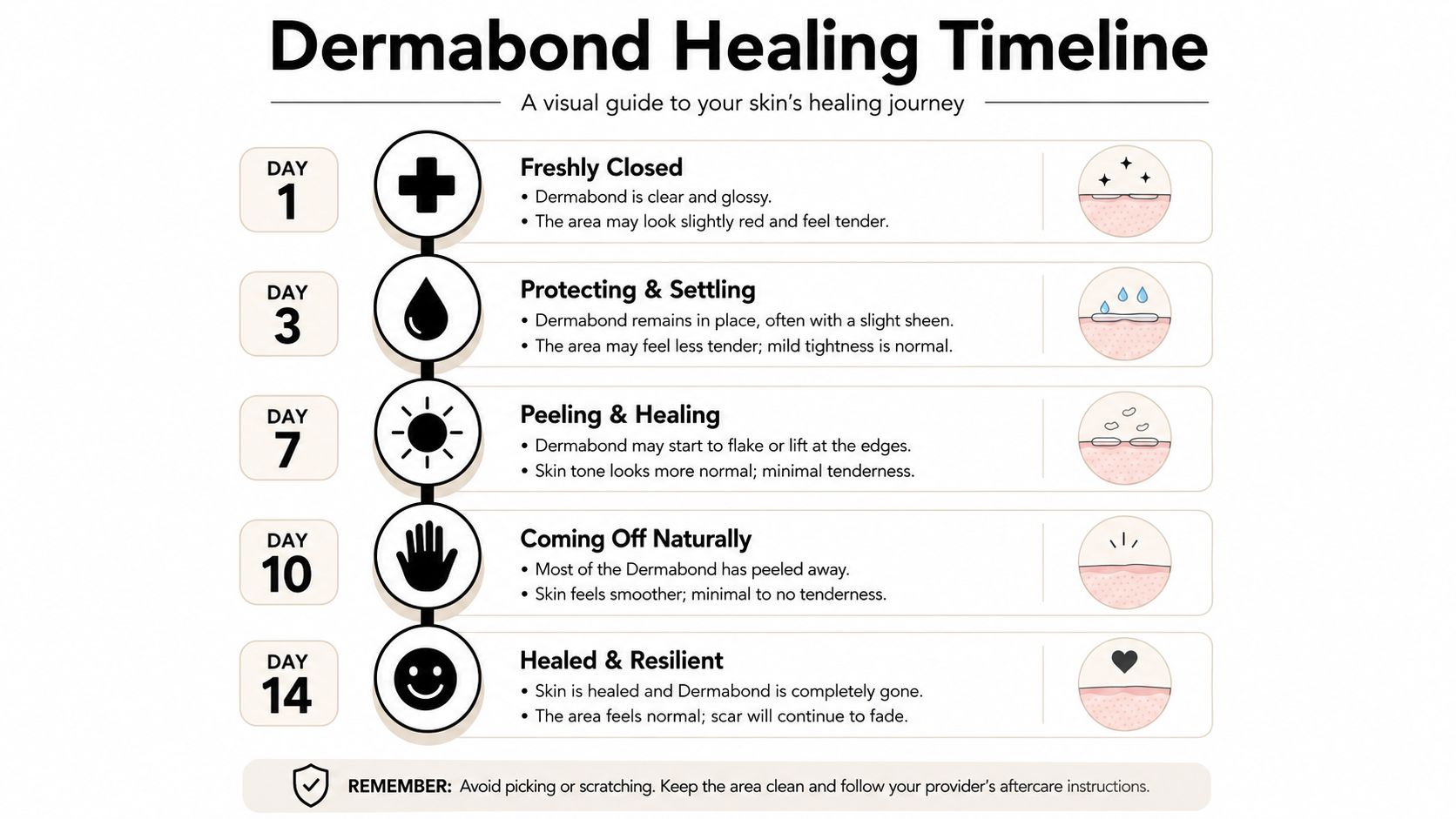
Around days 5 to 10, you often see the first real loosening at the edges. That's the normal beginning of slough-off, and it can happen unevenly, with one end lifting before the other. If you're told to trim a loose edge, that's very different from pulling the whole film off.
The film doesn't have to look perfect to be working. What matters is whether the wound edges stay closed and quiet.
If the adhesive is still attached at days 10 to 14, that can still fit a normal course, especially when the closure is in a lower-tension area or when the system includes mesh support. The later end of the timeline is one reason so many follow-up questions come from people who are healing well but still see adhesive at the visit.
A useful way to think about this is by touch, not just sight. Fresh Dermabond is a smooth sealed layer. Later, it can feel dry, a little flaky, or loosely attached at the margins. If the center is still holding while the edges are lifting, that usually means the film is doing what it's supposed to do rather than failing early. This surgical wound-healing guide helps frame that transition in plain language for patients who want a broader recovery picture.
Factors That Shorten or Extend Dermabond Wear Time
Dermabond doesn't fall off on a clock that's identical for every body part. The same adhesive behaves differently on skin that stays dry and still versus skin that stretches, sweats, or rubs against clothing. That's why the 5 to 10 day range is a normal expectation, not a promise.
What tends to shorten wear time
Moisture is the most obvious reason a film can loosen sooner. Sweat, soaking baths, swimming, and frequent wetting all work against the bond by softening the outer layer and lifting the edges. A closure over a joint can also peel sooner because every bend and twist adds stress.
Friction matters too. Waistbands, athletic gear, bra straps, and repetitive movement can wear down the film even when the incision itself is fine. Skin that's oily or naturally moist can also release adhesive faster than dry, calm skin.
What tends to extend wear time
Low-tension areas usually keep the film in place longer. A forehead closure often behaves differently from one on the palm, because the forehead doesn't flex and stretch the same way. Dry skin and careful aftercare can also help the film stay intact until the wound is ready.
Layered closure systems can last longer as well. The PRINEO patient guidance notes that the system is usually removed when healing is adequate, often 7 to 14 days, which is why some people still have material at follow-up even though the wound looks quiet (DERMABOND PRINEO patient care pad).
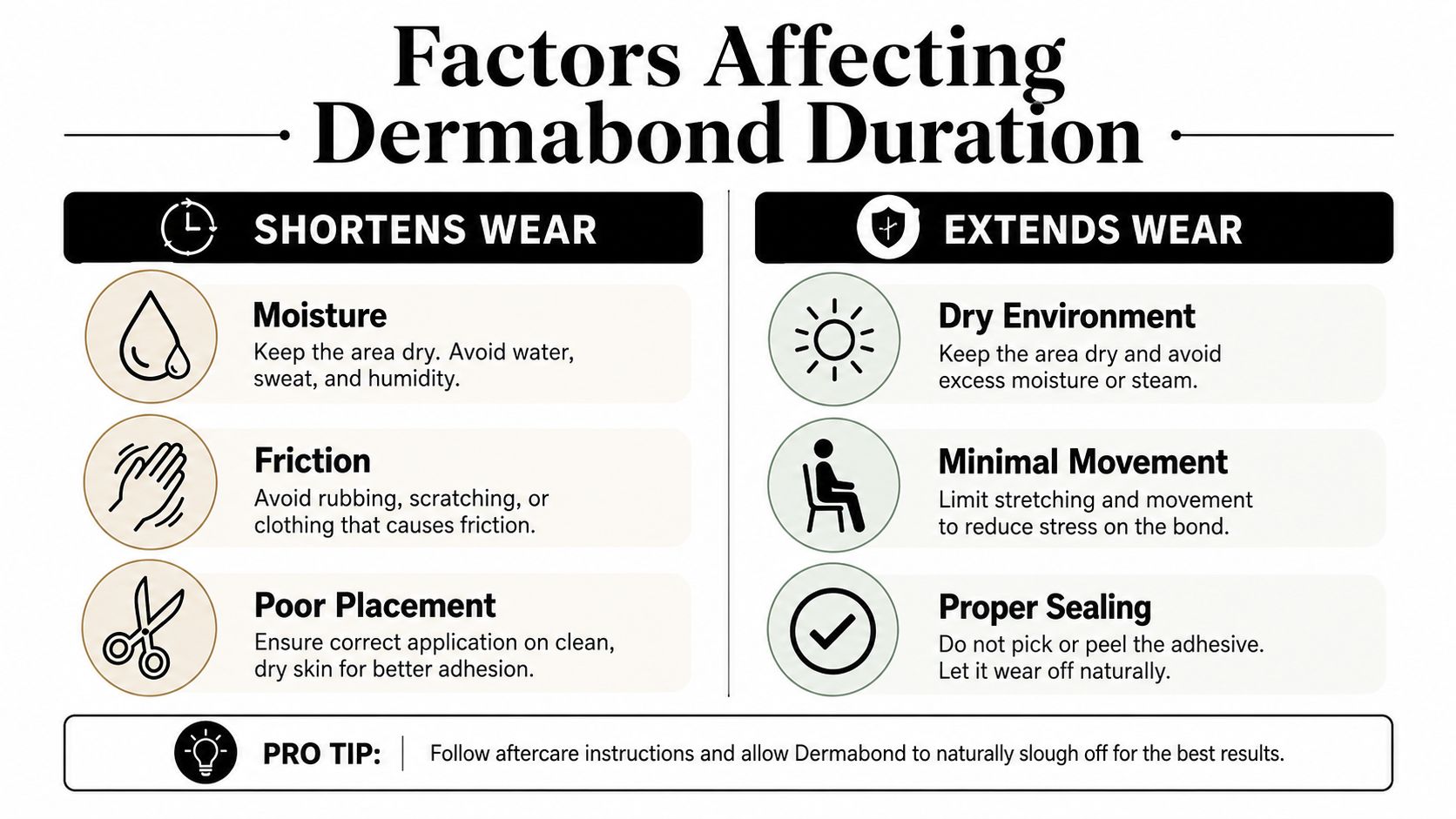
Simple way to judge your own case: if the wound sits in a dry, low-motion area, expect the film to stay on longer. If it's in a hot, sweaty, high-motion place, expect it to loosen earlier.
That's also why two people can both be told “Dermabond lasts about a week,” yet one sees peeling on day 6 and the other is still looking at a neat film on day 13. The adhesive hasn't changed. The environment around it has.
Safe Aftercare Habits That Protect the Film
A clean Dermabond film usually stays in place best when the incision gets quiet, simple care for a short time. The goal is not to babysit the adhesive. It is to avoid the small habits that lift it before the skin underneath has finished closing.
Do
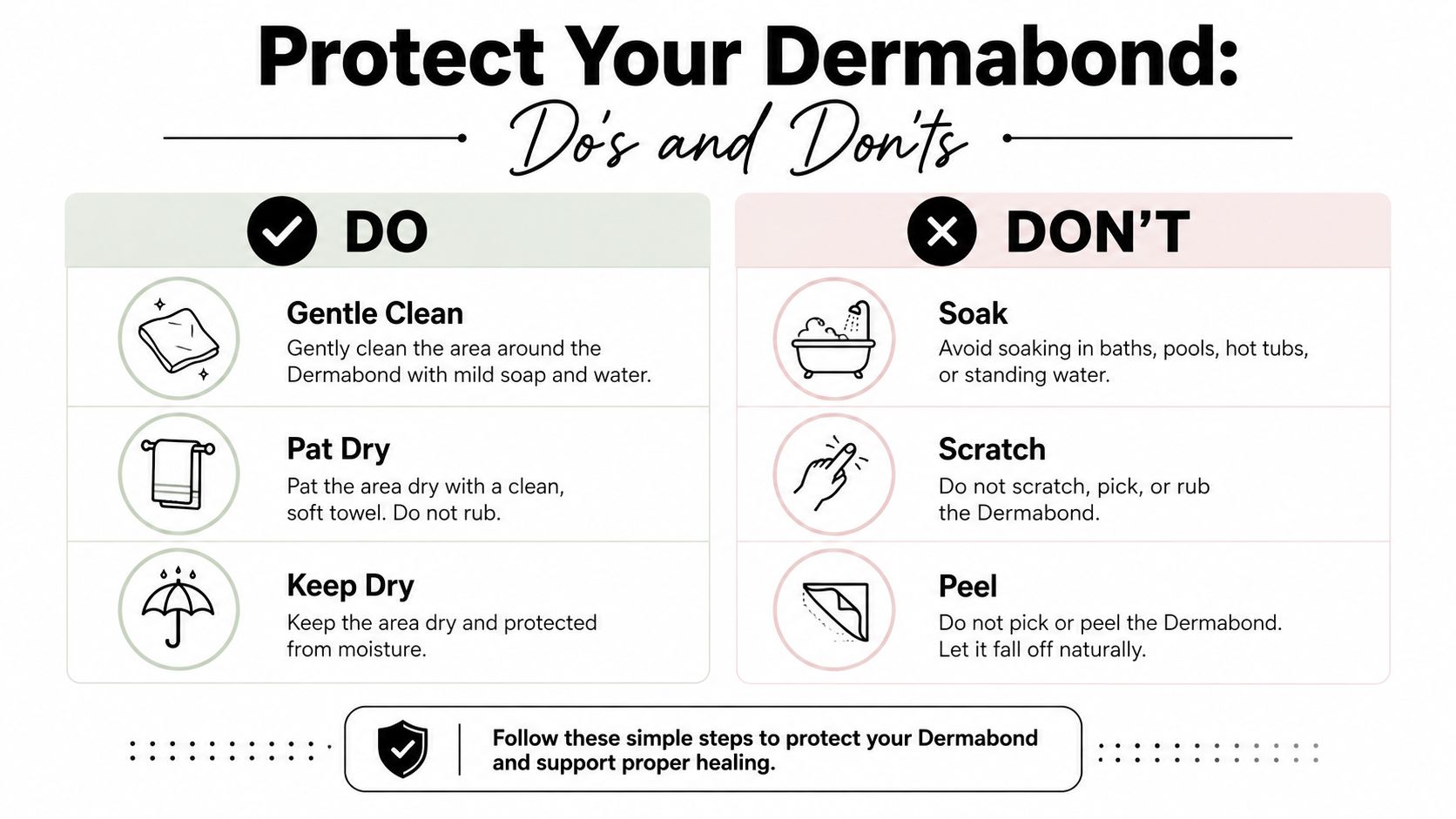
- Clean gently: Wash around the area with mild soap and water if your surgeon says it is okay, then pat dry instead of rubbing. A soft towel or gauze works better than friction.
- Keep it dry when you can: Brief showers are different from soaking. Dry skin gives the film a better chance to stay put, especially while the wound is still fragile.
- Leave loose edges alone: If a corner lifts, trim it only if your surgical team told you that was okay. Don't pull at it, because tugging can open the edge that is still attached.
Don't
- Don't soak the site: Baths, pools, and hot tubs can loosen the adhesive faster than you expect.
- Don't scrub or pick: Fingernails, washcloth friction, and “just checking” the edge can tear a film that was otherwise fine.
- Don't put ointments under it: Ointments and peroxide can soften the bond and trap irritation against the wound.
If you want a fuller home-care checklist for incisions, this surgical incision care guide walks through the same basic principles in more detail.
High-intensity exercise in the first 48 hours can also be a problem if it makes the area sweat or stretch. That matters most when the closure sits over a joint, the groin, or another spot that moves with each step, because the film is still carrying the full load during those first days.
If the adhesive starts lifting at the edges, the safest habit is usually to leave the center alone and let the film come off naturally.
Sun protection belongs in the same conversation because the skin underneath is still healing. Even after the film loosens, the area can darken more easily if it gets a lot of direct sun.
The fastest way to undo good healing is to treat the site like normal skin too soon. Clean it, dry it, and let the film do its job until it naturally loosens.
How Dermabond Compares to Sutures for Wound Closure
Dermabond and sutures solve the same problem in different ways. Dermabond seals the skin from the outside and is often chosen when the wound is small, clean, and low tension. Sutures physically hold tissue together, which gives the surgeon more control when the wound needs stronger mechanical support.
| Dimension | Dermabond | Sutures |
|---|---|---|
| Removal visit | Usually no removal visit for standard adhesive | Often requires a removal visit unless absorbable |
| Feel during recovery | Smooth film on the skin, then gradual loosening | Threads can feel tight or tender until removed or absorbed |
| Best fit | Small, clean, low-tension wounds | Deeper, longer, or higher-tension wounds |
| Cosmetic use | Often favored where a neat surface seal helps | Useful when precise edge control matters more |
| Activity trade-off | Less fuss around removal and dressing care | Stronger structural hold in selected wounds |
Dermabond's appeal is easy to understand once you've been through a closure. There's no stitch removal appointment for many small wounds, and the surface seal is in place quickly. Sutures, on the other hand, are better when the wound edges need more precise alignment or when movement would stress the closure too much.
The choice isn't about which one is “better” in general. It's about which one fits the wound in front of the surgeon. That's why glue is common on low-tension skin and why sutures still make sense for wounds that need stronger support.
For patients, the practical difference is usually the follow-up experience. With Dermabond, you watch for loosening and let it fall away. With sutures, you're usually thinking about when they come out, how the line feels, and whether the wound is ready for that next step.
If you're organizing recovery resources in one place, a site like Labiaplasty.com can also be a starting point for looking at recovery guidance, closure-related healing topics, and surgeon directories, especially when you're comparing aftercare expectations across procedures.
Red Flags That Mean Call Your Surgeon
Normal Dermabond changes are gradual. Red flags are not gradual, they usually get worse, and that difference matters.
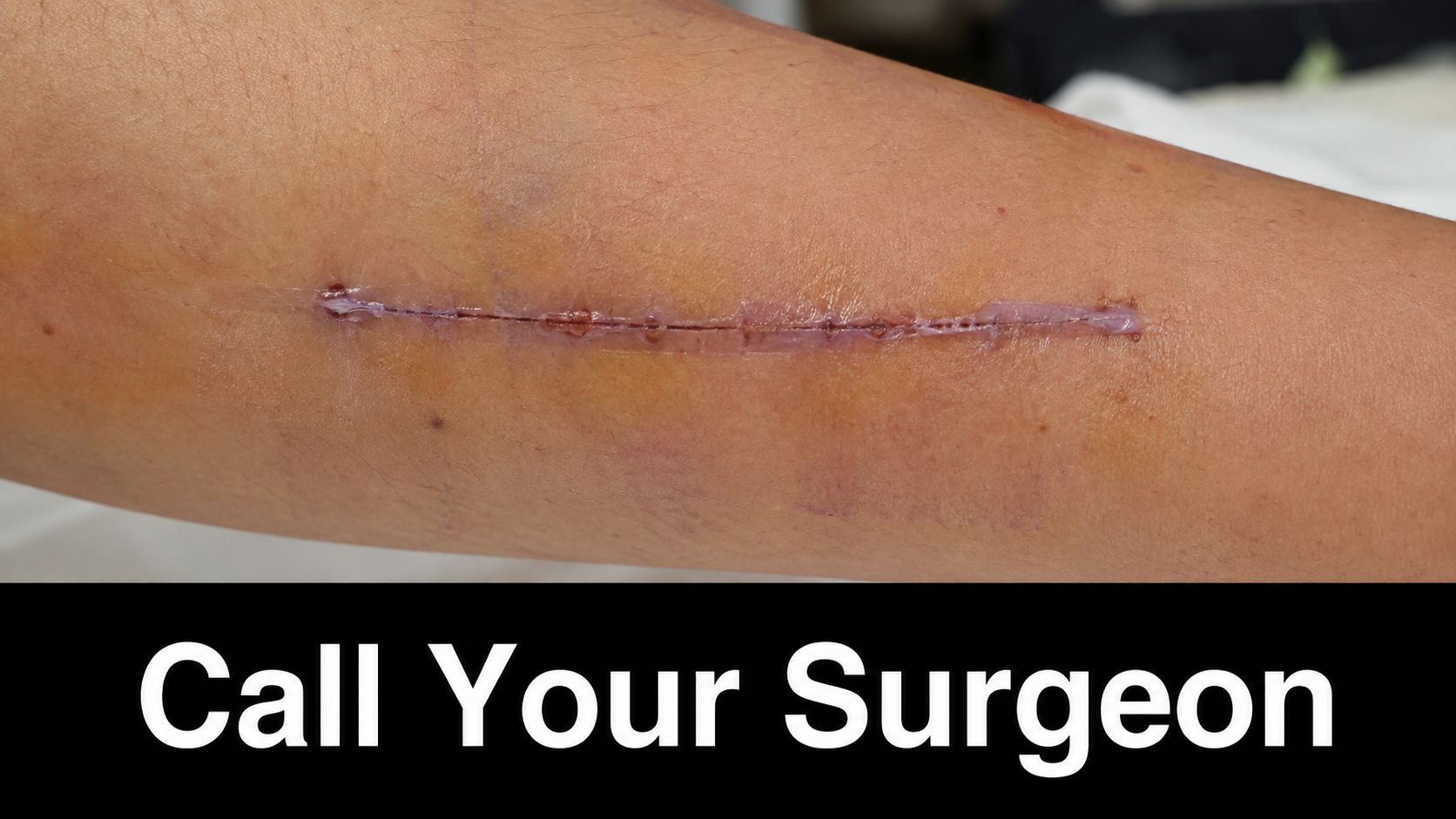
Call your surgeon's office if you notice any of these
- Spreading redness, warmth, or drainage: These can point to infection rather than routine healing.
- Wound edges pulling apart: If the skin separates before the film has naturally loosened, the closure may not be holding.
- Pain that increases after the first 48 hours: Healing discomfort should usually settle, not ramp up.
- Foul odor or red streaks: These are not normal film changes and deserve prompt attention.
- Fever: A fever alongside a healing incision needs to be reported.
- Dermabond falling off in the first 24 to 48 hours: That often means the wound didn't have enough time to bridge.
If the film comes off early but the edges still look sealed and your team gave you other instructions, you may still be fine. If the skin looks open, wet, or increasingly irritated, that's a different situation and needs a call.
A lot of patient anxiety comes from trying to judge a wound by one bad moment. A corner peeling is one thing. A wound that looks more open, more painful, or more inflamed over time is another.
Bringing It All Together for Your Follow-Up Visit
Dermabond means a minutes-long set time and a days-long wear time. Standard adhesive usually loosens in 5 to 10 days, while mesh-supported systems may stay in place 7 to 14 days, especially when the wound is healing and the site isn't under much stress (Nationwide Children's Dermabond incision care).
Before your follow-up, remember the basics. Keep it clean, keep it dry, don't pick at the edges, and don't soak it. If you see spreading redness, drainage, worsening pain, odor, fever, or early separation, call your surgeon instead of waiting it out.
The biggest source of confusion is thinking that visible glue should vanish as soon as the wound feels better. It doesn't work that way. The film often stays longer than the first few days of soreness, and that's normal.
If you're comparing recovery instructions or trying to make sense of incision care after a procedure, Labiaplasty.com offers clear educational resources on surgery, healing, and recovery planning. Visit Labiaplasty.com to explore practical guidance that can help you ask better questions at your follow-up and understand what normal healing looks like.
