
Quick answer — Public feedback on Spectrum Aesthetics varies quite a bit depending on where you look. Some platforms show high patient satisfaction, while others tell a different story. No single rating captures the full picture, which is exactly why checking multiple review sites is worth your time.
Spectrum Aesthetics Reviews Summary
Think of platform reviews like weather reports from different cities. Each one gives you part of the forecast, but you need all of them to plan your trip properly.
- BBB tends to reflect business complaints and carries a very small sample, which limits how much you can rely on it for surgical outcomes.
- Birdeye captures a large number of patient voices and shows higher volume with a stronger average, giving it more statistical weight.
- Yelp blends patient stories with local commentary and often skews toward polarized experiences.
- Indeed reflects employee sentiment and says more about clinic operations than clinical quality.
Cross-platform verification matters more than any single star score because volume, recency, and narrative detail combine to reveal real patterns.
Spectrum Aesthetics Rating Summary by Platform
| Platform | Average Stars | Review Count |
|---|---|---|
| BBB | 1.0 | 4 |
| Birdeye | 4.5 | 335 |
| Yelp | 2.5 | 167 |
| Indeed | 3.0 | 42 |
The differences here are striking, both in averages and sample sizes. Larger samples like Birdeye's give you a more stable read on patient experience. Tiny samples, like BBB's four reviews, can swing wildly based on a handful of strong complaints.
Why This Matters
Small sample sizes are like listening to one conversation in a crowded room. You might miss the broader consensus entirely. High-volume platforms with detailed narratives work more like hearing multiple people describe the same event — patterns start to emerge and become clear.
Practical Next Steps
- Read several recent reviews across platforms to spot recurring praise or complaints.
- Prioritize reviews that include medical details, timelines, and before/after photos.
- Cross-check surgeon credentials and clinic accreditation mentioned in reviews against official listings.
Read also: Learn more about patient review patterns and labiaplasty considerations in our detailed guide on Labiaplasty reviews.
This quick summary sets the stage for deeper analysis of surgeon credentials, outcome credibility, safety signals, and how to verify before-and-after evidence in the sections ahead.
Understanding How Aesthetic Clinic Reviews Work
No single review platform tells the whole story. Each one captures a different angle of the patient experience, and the real picture only emerges when you look at them together.
Patient-facing sites like Birdeye and RealSelf focus on surgical outcomes—what went right, what the recovery actually felt like, and whether the result matched expectations. Employer review sites like Indeed tell you something completely different: how the office runs behind the scenes, whether staff stick around, and whether the practice has the kind of stability that supports consistent follow-up care.
Here's the thing about sample size that matters more than most people realize. A 4.5-star average drawn from hundreds of reviews carries far more weight than a perfect 5.0 from twelve comments. Larger numbers smooth out the extremes—the one angry patient who had a complication, the friend of the surgeon who left a glowing but vague endorsement. Volume gives you signal instead of noise.
Reviews form a layered ecosystem where volume, recency, and narrative detail combine to reveal reliable patterns.
The comments that actually help you make a decision are the ones with substance. A patient who walks through their week-by-week BBL recovery, posts before-and-after photos, and describes what surprised them about healing—that's worth ten generic "amazing experience" posts. Specificity is credibility. When someone names their procedure, their timeline, and their honest take on discomfort or downtime, you're reading something closer to a real forecast than a slogan.
Platform Roles And Strengths
- Birdeye and RealSelf
- Capture procedural outcomes and patient satisfaction directly.
- High review volumes make trends easier to spot and reduce the impact of outliers.
- Yelp
- Blends local reputation with emotional reactions to the experience.
- Particularly useful for catching administrative friction—scheduling nightmares, billing issues, front desk problems.
- BBB
- Reflects formal complaints and how a business handles disputes.
- Small complaint counts can make a practice look worse than it actually is, so read the details, not just the rating.
- Indeed
- Offers a window into staffing, hours, and operational stability.
- High turnover or complaints about management can signal problems with continuity of postoperative support.
How To Read The Signals
- Start with recent, high-volume platforms to identify outcome trends.
- Treat low-count platforms as flags worth investigating, not final verdicts.
- Cross-check patient narratives against staff reviews for consistency.
Here's what this looks like in practice. Say Birdeye shows 335 reviews at 4.5 stars while the BBB lists 4 reviews at 1.0. The larger dataset is almost certainly a more reliable indicator of what your experience will look like. But if Yelp and Indeed both surface the same complaint—long wait times, difficulty reaching the office after surgery, staff turnover—that pattern matters even if the patient outcome scores are strong. Operational problems don't show up in surgical results, but they absolutely affect your experience.
Comparing Review Climates
| Platform | Primary Signal | What To Watch For |
|---|---|---|
| Birdeye | Patient outcomes | Volume, photo evidence |
| RealSelf | Verified patient feedback | Procedure-specific details |
| Yelp | Local sentiment | Administrative complaints |
| BBB | Business disputes | Nature and resolution of complaints |
| Indeed | Staff experience | Turnover and hours affecting care |
Reading reviews this way—layered, cross-referenced, and weighted by volume—turns a scattered pile of opinions into something you can actually use when researching a procedure like labiaplasty.
Review Volume and Trust Signals
Review volume changes everything when you're trying to make sense of star ratings for intimate procedures like labiaplasty.
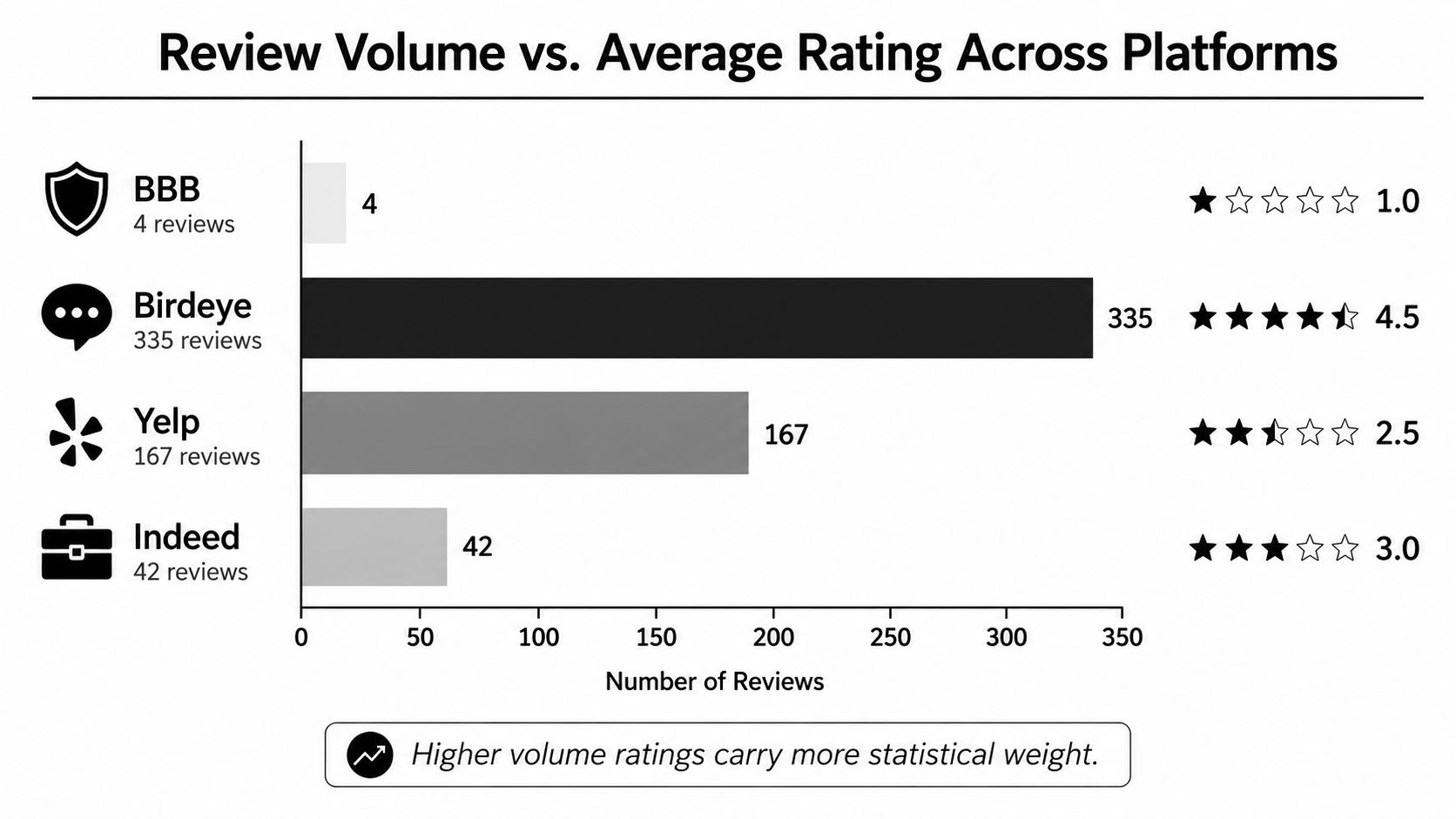
The chart above lays out review counts and average ratings across four platforms so you can compare sample size and score at a glance.
Platforms with large, recent samples reduce the chance that a single outlier will distort the picture. Birdeye's 335 reviews at 4.5 stars gives you far more statistical stability than BBB's 4 reviews at 1.0 star. Patterns on Birdeye are more likely to reflect consistent patient experiences, while a handful of reviews on BBB could represent anything from legitimate grievances to isolated incidents.
High volume plus narrative detail creates a reliable signal because stories with specifics behave like repeated eyewitness reports.
Short, detailed narratives matter more than tiny star-only samples. A review that names procedure steps, recovery timeline, and shows before-and-after photos is far more useful than a one-line five-star note. Recency matters too — clusters of recent praise or complaints suggest current practice patterns rather than outdated experiences.
How To Read Platform Differences
- Birdeye shows outcome-focused patient feedback with large numbers, so trends there carry weight.
- Yelp mixes local sentiment and administrative complaints; use it to spot scheduling or billing issues.
- Indeed reflects staff experience; persistent staffing complaints can affect continuity of postoperative care.
- BBB often highlights formal disputes; small counts should prompt investigation, not immediate dismissal.
Review Volume Across Sources
| Source | Reviews | Average | Interpretation |
|---|---|---|---|
| BBB | 4 | 1.0 | Very small sample; treat as a flag to investigate details |
| Birdeye | 335 | 4.5 | Large sample; trend signals are stronger and more reliable |
| Yelp | 167 | 2.5 | Mid-volume; useful for administrative pattern spotting |
| Indeed | 42 | 3.0 | Staff-focused; watch for turnover or support issues |
The table above shows why sample size matters. A single platform's average can be misleading without context about how many reviews back it up.
Practical Checklist For Interpreting Reviews
- Prioritize platforms with higher counts and recent posts for outcome trends.
- Look for specificity — timelines, complications, photos — as credibility markers.
- Cross-reference staff reviews and business listings to confirm operational stability.
- Treat single-platform extremes as prompts to dig deeper, not final judgments.
For example, if Birdeye and RealSelf show consistent before-and-after photos and many recovery narratives, but Yelp contains repeated complaints about scheduling, that pattern says outcomes may be good while administrative friction exists.
Statistical weight comes from volume and consistency, not just the headline average.
Learn more about how to evaluate surgeon reviews and compare clinic credentials in our broader guide on reviewing plastic surgeons at Labiaplasty.com: Read also our detailed resource on Reviews on Plastic Surgeons.
Employee Feedback and Business Listing Signals
Indeed and business hours give you a peek behind the curtain at how a clinic actually operates—beyond what patient reviews reveal.
Employee sentiment on Indeed can tell you about staffing stability, morale, and whether the office is set up to deliver reliable follow-up care. Business hours show whether someone's actually available when you need post-op questions answered.
Patient reviews are the finished painting. Employee signals are the studio conditions that made it possible.
Spectrum Aesthetics' Indeed listing sits in the middle range—roughly 3.0 stars across 42 reviews. That's not a crisis, but it's not a ringing endorsement either. It points to mixed staff experiences rather than universal praise or serious dysfunction.
This matters because consistent postoperative support depends on people showing up, communicating clearly, and following established protocols. If staff reviews mention frequent turnover, slow response times, or chronic understaffing, that can translate into delays getting dressing changes, prescription refills, or urgent questions addressed.
How to Layer Operational Signals With Patient Reviews
Look for overlap between patient complaints and employee issues. If multiple patients mention slow callbacks and staff mention being short-staffed, you've likely found a real scheduling problem.
Match business hours to typical recovery needs. A clinic with narrow weekday hours might make same-week post-op checks harder, especially for complications that arise over a weekend.
Treat Indeed as operational context rather than clinical verdict. Employee platforms reveal workflows and capacity—they don't measure surgical skill directly.
Practical rule of thumb: You need both a skilled surgeon and an office that can support recovery. Missing either piece weakens overall care.
Quick checks you can run in minutes:
- Verify posted business hours by calling during those listed times.
- Scan Indeed reviews for repeated keywords like "turnover," "missed calls," or "overtime"—these point to continuity risks.
- Cross-reference operational complaints with patient narratives. Do administrative delays align with negative outcome reports?
What the Signals Mean
| Signal | What to Watch For | Why It Matters |
|---|---|---|
| Indeed rating 3.0 / 42 | Recurrent staffing or communication issues | Affects postoperative continuity |
| Business hours | Limited after-hours or weekend access | Complicates urgent follow-up care |
| Cross-platform overlap | Same complaint appears across platforms | Strengthens credibility of the issue |
Here's a real-world example. If Birdeye shows many positive surgical outcomes but Indeed repeatedly flags understaffing and the clinic lists only 9-to-5 weekday hours, that's like a beautifully finished product shipped with minimal customer support—great results, but potential headaches during recovery.
Questions to Ask at Your Consultation
- How is post-op communication handled after hours?
- Who covers urgent calls on weekends?
- How long do follow-up appointments typically take to schedule?
Read also: Learn more about board credentials and why they matter in our article on Board Eligible Versus Board Certified Surgeons.
Common Positive and Negative Review Themes

Most Spectrum Aesthetics reviews fall into recognizable patterns that help you separate what matters from what doesn't. The positive ones tend to focus on surgical results, recovery support, and how well the team communicated throughout the process.
These reviews usually include concrete details—timelines, healing milestones, before-and-after photos. That specificity works like an eyewitness account. When multiple people describe similar experiences with the same level of detail, you're looking at something worth paying attention to.
Detailed personal narratives beat star-only summaries when you need to judge surgical performance and follow-up care.
Negative themes, on the other hand, often center on administrative friction. You'll see complaints about appointment scheduling, billing confusion, or slow callback times. These issues rarely reflect surgical skill, but they can make a real difference in how smooth your recovery feels.
Short, concrete examples tell you far more than vague statements. A patient who describes "week-by-week swelling and how staff handled a drainage question" gives you something you can actually use. A one-line complaint about "poor service" doesn't.
What To Look For In Narratives
- Specific outcome descriptions with timelines and measurable changes
- Before-and-after photos linked to review posts or profiles
- Mentions of postoperative availability and who handles urgent calls
- Repeated administrative concerns across multiple platforms
When reviews conflict, weigh volume and recency. Birdeye's large sample yields more statistical stability than tiny BBB counts, while Yelp often surfaces administrative pain points.
How To Judge Credibility
- Check for consistency across platforms.
- Prefer reviews that name the procedure, timeline, and recovery details.
- Look for photos and linked clinic galleries to verify visual claims.
"Look for repeatable details—timelines, photos, and consistent descriptions—rather than emotional extremes."
Practical Red Flags
- Identical wording across many reviews
- Star-heavy profiles without narrative or photos
- Recent clusters of negative operational complaints even if outcomes look good
Numbered Steps To Use Reviews in Your Consultation
- Compile 3–5 detailed patient accounts with photos.
- Bring specific quotes to your consult and ask the surgeon to contextualize them.
- Ask about post-op protocols referenced in reviews.
This approach turns scattered opinions into actionable insights you can test during your consultation with Spectrum Aesthetics.
Verifying Reviews and Spotting Red Flags
Start by checking multiple platforms to build a balanced view of Spectrum Aesthetics reviews. Look at Birdeye for volume and outcome-focused stories, Yelp for administrative patterns, BBB for formal complaints, and Indeed for staff perspectives. This layered approach treats reviews like different weather reports that, together, form a forecast.
Read recent publication dates first. Fresh reviews show current practice patterns; clusters of old praise or new complaints can indicate change. A surge of similar comments over a short period deserves closer attention.
Focus on repeated specifics rather than headline stars to spot consistent signals across reviews.
Key red flags to watch for:
- Tiny sample sizes such as four or fewer reviews on a platform, which can swing ratings wildly.
- Identical phrasing across multiple posts suggesting copy-paste or incentivized feedback.
- Reviews without postoperative detail or timelines, which often lack credibility.
- Star-heavy profiles with no photos or narrative; these offer little actionable information.
How to Verify Authenticity Quickly
- Compare text patterns across platforms to detect duplicate wording.
- Search for before-and-after photos tied to review dates; real recovery galleries often include timestamps.
- Cross-check surgeon names and credentials mentioned in reviews against official directories and the Spectrum Aesthetics doctors page.
- Call the clinic during posted business hours to confirm availability and ask how postoperative calls are handled.
Practical Examples and Checklist
- Example 1: If Birdeye shows 335 reviews at 4.5 stars but BBB lists 4 reviews at 1.0, treat Birdeye as a stronger signal but investigate any recurring operational complaints on Yelp or Indeed.
- Example 2: If multiple reviews mention slow callbacks and Indeed staff reviews reference turnover, operational problems are likely real and relevant.
Quick actions to take:
- Prioritize platforms with higher counts and recent posts for outcome trends.
- Favor reviews that include timelines, complications, and photos.
- Flag identical wording, missing details, or rapid rating shifts for skepticism.
- Bring 3–5 specific review excerpts to your consultation and ask the surgeon to respond.
Think of this like checking restaurant health scores and recent inspections rather than just looking at a single Yelp star—patterns matter more than one-off data points.
Use directory listings and clinic photo galleries to corroborate claims you see in reviews. Ultimately, interpret Spectrum Aesthetics reviews as pattern signals, not conclusive judgments, and use the practical checklist above to convert online findings into precise questions for your consultation.
Frequently Asked Questions About Clinic Reviews
Why Do Spectrum Aesthetics Ratings Differ So Much Across Platforms?
Each platform captures a different piece of the puzzle, and that's exactly why the numbers don't always line up. Birdeye tends to focus on procedural outcomes and benefits from high volume, which naturally smooths out the occasional extreme score. Yelp blends local sentiment with administrative gripes—think billing disputes or scheduling headaches—while BBB zeroes in on formal complaints, sometimes amplifying a small number of grievances. And then there's Indeed, which reflects staff experience rather than surgical skill.
So a 4.5 on Birdeye tells a different story than a 1.0 on BBB. Neither is wrong. They're just measuring different things. The smart move is to treat them as complementary signals rather than contradictions.
Cross-platform comparison gives you the fuller picture by combining outcome, operational, and dispute viewpoints.
How Many Reviews Make a Trustworthy Sample for Labiaplasty Clinics?
There's no magic threshold, but statistical reliability improves with both volume and recency. A dataset in the low hundreds with plenty of recent entries—say 300+ reviews—gives you much stronger trend visibility than a handful of scores. Small samples can swing wildly based on one or two experiences, so lean on platforms with larger counts for outcome patterns. Treat tiny samples as flags worth investigating, not as final verdicts.
- Look for: many reviews, recent dates, and narrative detail.
- Avoid relying only on star averages without timelines or photos.
Are Employee Reviews Useful When Choosing a Surgeon?
Absolutely—but think of them as an operational signal, not a clinical rating. Indeed ratings reveal staffing stability, communication patterns, and whether the clinic can reliably support you after surgery. Here's the thing: patients might report great outcomes while staff reviews mention constant turnover or missed calls. That disconnect matters. You could have a skilled surgeon but still face delays in follow-up care when you need it most.
Operational issues don't equal poor surgical technique, but they affect recovery experience and access to urgent support.
What Quick Checks Should I Run Before Booking a Consultation?
- Verify consistency across platforms—do outcome trends on Birdeye match what people are saying on RealSelf?
- Prioritize reviews with specifics. Timelines, complications, and before/after photos carry far more weight than one-line praise.
- Cross-check surgeon credentials and JCAHO or accreditation claims against official listings.
- Call the clinic during posted business hours to confirm availability and ask about after-hours post-op protocols.
- Bring 3–5 detailed review excerpts to your consultation and ask the surgeon to address them directly.
- Flag identical phrasing across reviews, clusters of new negative administrative comments, or star-heavy profiles with no narrative as potential red flags.
Treat reviews like weather reports from different cities—layer them, look for repeated patterns, and convert those patterns into specific questions for your consultation.
If you want structured resources and verified surgeon listings to follow up on what you learn in reviews, visit Labiaplasty.com at https://labiaplasty.com
