

You've stared at the same stubborn sun spot, uneven tone, or post-acne mark in the mirror more than once, and now Pico Genesis keeps showing up in consultation notes and clinic marketing. That can make the technology sound bigger and clearer than it feels from the outside, especially when every provider seems to describe it a little differently.
The fastest way to make sense of it is to strip away the buzzwords. Pico Genesis laser is a picosecond laser approach, and the practical question isn't just what it treats, it's how that ultrafast pulse changes what the skin experiences during treatment, recovery, and follow-up care. A good decision starts with a simple map of the physics, then moves into the clinical uses, candidate fit, and the trade-offs that matter most when you're the one sitting in the chair.
Why Pico Genesis Is on So Many Consultation Lists
A patient walks into a consult after years of sunscreen, brightening serums, and half-finished laser research. The concern is often the same, a few dark spots that won't budge, patchy tone, or skin that looks tired even when the person feels rested. Then “Pico Genesis” shows up on the treatment menu, and suddenly the conversation shifts from skincare to technology.
That's where confusion starts. Pico Genesis isn't a vague marketing phrase, it's a specific picosecond laser platform from Cutera, and the label can sit alongside other picosecond systems that work on similar principles but aren't identical in configuration or settings. Cutera describes the platform as using 532 nm and 1064 nm wavelengths, with a multi-pass technique and typically 2-3 treatment sessions for true revitalization, while the related Laser Genesis mode uses a non-ablative 1064 nm Nd:YAG laser that the manufacturer says is safe for all skin types and tones, and PICO Genesis FX extends the system into fractional treatment for acne scars and texture concerns. Cutera's skin revitalization overview
Practical rule: if a consultation sounds like it's about a brand name alone, ask what wavelength, pulse duration, and treatment goal are actually being proposed.
This article is a guided tour, not personal medical advice. The goal is to help you leave with five answers in hand, what the technology is, what it's used for, what a session feels like, who tends to fit it best, and how it compares with gentler or older alternatives. That way, when a provider says “Pico Genesis,” you can translate the phrase into a real plan instead of a glossy promise.
How the Pico Genesis Laser Works
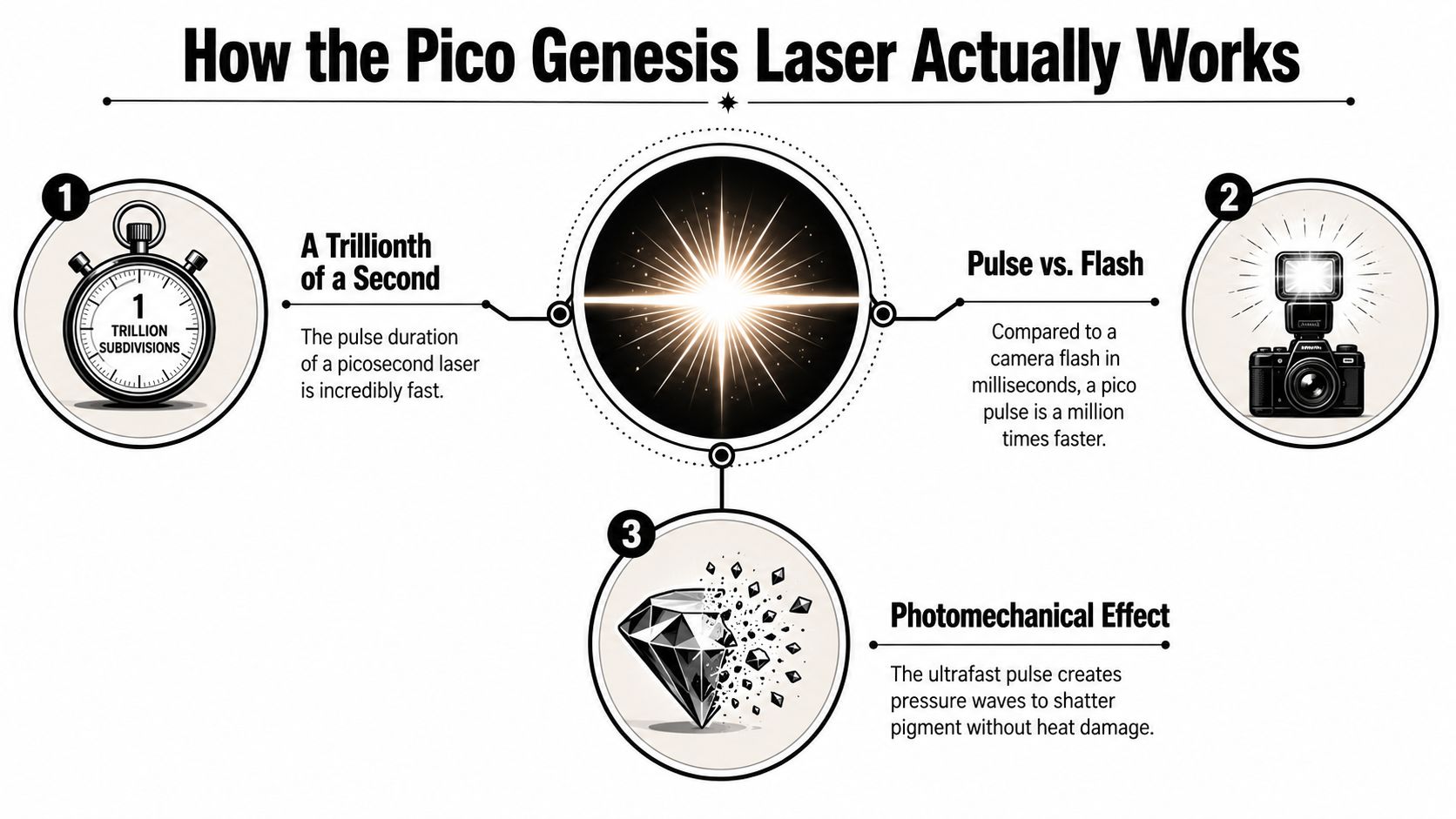
A consultation about Pico Genesis often sounds technical because the treatment depends on timing as much as on wavelength. A picosecond is a trillionth of a second, a pulse so brief that skin has very little time to turn that energy into heat before the burst is over. A useful comparison is a camera flash, although the laser pulse is far faster and more concentrated than anything you would notice in everyday photography. Cutera's technical bulletin describes the platform as using a 750 picosecond pulse duration on its Enlighten system, with 532 nm and 1064 nm wavelengths guiding how energy interacts with pigment at different depths. Cutera's technical bulletin for PICO Genesis
Photoacoustic action instead of heating
Older pigment lasers often rely more heavily on photothermal energy, which means they warm target tissue until pigment breaks apart. Pico Genesis is designed to rely more on a photoacoustic effect, where the ultrashort pulse creates pressure waves that fragment pigment with less surrounding heat exposure. That difference matters because less heat usually means less collateral irritation, which is one reason picosecond devices come up so often in discussions of tone work and pigment-prone skin.
The manufacturer also describes the related 1064 nm mode as non-ablative, which means it does not remove the surface layer of skin the way more aggressive resurfacing tools do. In plain language, the treatment is trying to disturb pigment or stimulate skin change without “burning off” the top layer. That is why a provider may use a multi-pass technique, moving over the same area more than once in a controlled way rather than relying on one heavy pulse.
Why wavelength selection matters
The two main wavelengths are not redundant. 532 nm is generally used when the target sits more superficially or when lesion color responds better to shorter light, while 1064 nm reaches deeper and is often chosen when the provider wants a safer, less melanin-interactive option, especially for darker skin tones. The practical effect is that the device is adjustable rather than stronger or weaker.
That adjustment is what turns physics into clinical judgment. A good provider is not asking whether the laser can treat pigment in general. The more useful question is which wavelength, fluence, and pass pattern will address the pigment with the least unnecessary heat. If you are asking about pigment concerns in a more sensitive area, such as intimate area lightening, this same logic matters even more because skin tone, depth, and heat tolerance all shape the plan.
Clinical Uses Pigmentation, Tone, Texture, and More
A Pico Genesis consultation often starts with a simple question, which problem is the laser being asked to solve? A small brown spot, a broader pattern of sun damage, a scar that changes light reflection, and a general dull tone all sit in different categories, even though they can look related to a patient. Pico Genesis gets attention because one platform can be adjusted for several of these goals, but the settings are not the same from one target to the next.
The white paper on the procedure describes a two-part protocol, with targeted treatment of individual lesions using 670 nm light and global facial treatment with 1064 nm light using 4-5 passes. In that study, the authors reported a significant therapeutic response for pigmented-lesion and photo-damage indications, with minimal side effects, no cases of hypo- or hyperpigmentation, and improved pigmentation and skin quality with minimal downtime. PICO Genesis 670 white paper
Pigmentation and photo-damage
For sun spots, freckles, and other visible pigment concerns, the logic is straightforward. The laser is directed at discoloration that sits in or near the skin's upper layers, and the short pulse helps break that target into smaller pieces without leaving heat in the tissue for long. That is why people with scattered spots often hear about Pico Genesis early in their research.
Photo-damage is broader than one lesion. It includes the mottled look that can happen after years of sunlight, where tone becomes patchy instead of even. In that setting, treatment is usually less about erasing a single mark and more about nudging the skin toward a cleaner, more uniform look.
Tone and overall radiance
The 1064 nm multi-pass approach is often used when the goal is overall revitalization rather than spot removal. Cutera says the skin revitalization approach typically uses 2-3 treatment sessions for true revitalization, which fits the idea that tone and radiance improve gradually rather than all at once. Cutera overview
For a patient, that usually means looking for a softer, more even appearance, not a dramatic change overnight. The best result may be that makeup sits better, discoloration looks less obvious, and the skin reads as healthier at a conversational distance.
Texture and acne scars
When providers talk about PICO Genesis FX, they are talking about a fractional extension of the platform for acne scars and texture concerns. Fractional treatment means the laser works in a patterned way rather than over every millimeter of skin at once, which can help when the goal is to influence scar texture instead of mainly fading pigment. That is a different conversation from treating a single dark spot, so expectations should shift with the indication.
Tattoos and stubborn ink
Picosecond lasers are also discussed in tattoo removal because ink behaves differently from natural pigment. Short pulses can help break tattoo particles into smaller fragments so the body can clear them over time. Multi-color tattoos often require more planning than a single brown spot, and the treatment plan depends on ink color, depth, and skin type.
| Indication | Typical Wavelength | Typical Approach | Typical Session Count |
|---|---|---|---|
| Superficial pigment and photo-damage | 532 nm | Targeted lesion work or multi-pass facial passes | Usually a short series |
| Deeper tone concerns and revitalization | 1064 nm | Multi-pass global treatment | Typically a short series |
| Lesion-specific pigment protocol | 670 nm and 1064 nm | Two-part protocol, targeted plus global passes | Protocol-based series |
| Acne scars and texture | Fractional mode on PICO Genesis FX | Fractional treatment pattern | Provider-dependent |
| Tattoo clearance | Wavelength chosen by ink and skin type | Repeated pigment fragmentation over time | Usually more than one session |
If you are comparing pigment work with other aesthetic issues in nearby areas, the same matching process applies in intimate-area lightening consultations. The common thread is matching the tool to the target instead of assuming one energy device fits every discoloration problem.
What a Treatment Course Looks Like
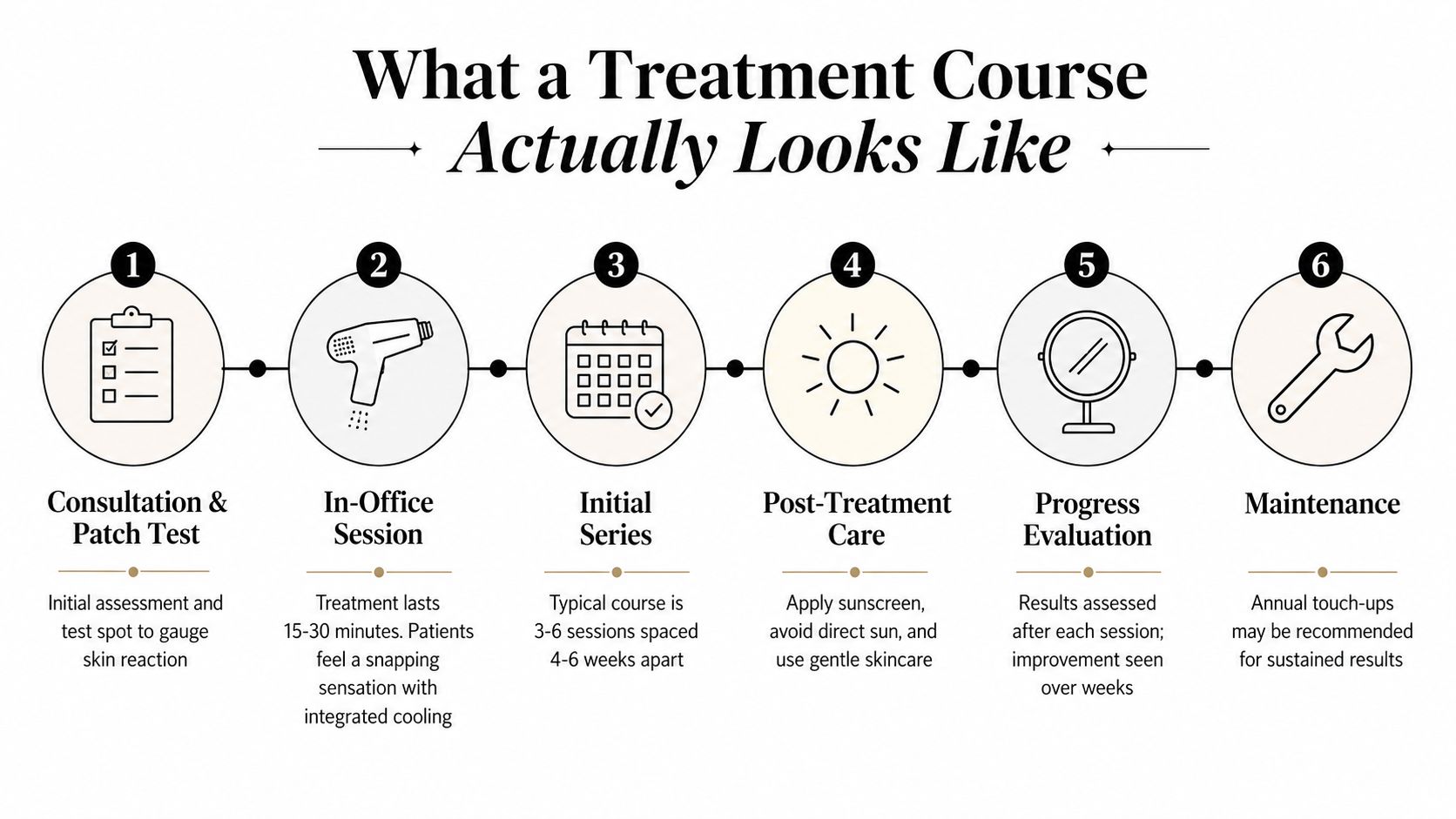
A realistic Pico Genesis visit is usually less dramatic than people expect. The provider starts by reviewing your skin, your pigment pattern, and your history, then decides whether the goal is a single lesion, broader revitalization, or a scar-focused fractional approach. A patch test may be used when the skin history raises any concern about how pigment will behave.
The in-office part
During treatment, the handpiece is moved across the skin in passes. The sensation is often described as a quick snap or light stinging, rather than deep heat, which fits the way picosecond energy delivers very short bursts instead of lingering thermal stress. The treatment is therefore often experienced as efficient rather than harsh.
Eye protection is standard, and a provider may use cooling depending on the protocol and the area being treated. The treatment itself is often brief, but the time in the room includes prep, parameter selection, and aftercare instructions, so the appointment is more than a quick machine pass.
What progress looks like
Results do not always show up as one dramatic before and after moment. Pigment may darken briefly before it lifts, flakes, or fades, and tone changes tend to reveal themselves over weeks rather than hours. That slower pattern of clearance and renewal is part of why patients are usually coached to watch for gradual change instead of instant clearing.
Practical rule: if a provider promises instant perfection for pigment, that is a red flag. Gradual clearing is usually a more believable story.
For maintenance, some people stay well after the initial series, while others only return if pigment recurs or if they want periodic skin-refreshing sessions. The visit rhythm depends on the target, the skin type, and how aggressively the provider treats the first session. If you are comparing a pigment-focused plan with adjacent aesthetic concerns, a similar what-is-realistic mindset applies to consultations for dark spots in the pubic area, where cause and treatment goals also shape the plan.
Who Is a Good Candidate and Who Should Wait
The strongest candidates are usually people with discrete pigmented lesions, visible photo-damage, mild texture concerns, or tattoos who want a lower-downtime option than more aggressive resurfacing. That does not mean everyone with discoloration should jump straight to a laser. The best fit depends on pigment depth, skin type, medical history, and what problem is bothering you most.
Skin type and pigment behavior
The manufacturer says the related 1064 nm Nd:YAG mode is safe for all skin types and tones, and that matters because darker skin can be more reactive to heat and pigment disruption. In practical terms, providers often prefer 1064 nm when they want a deeper-reaching wavelength with less interaction with epidermal melanin. The technical bulletin also shows that spot-treatment fluence is adjusted by skin type, with 0.4-1.0 J/cm² at 532 nm for skin types I-III and 4-10 J/cm² at 1064 nm for skin types IV-VI, which is another sign that treatment is customized rather than standardized. Cutera technical bulletin
When caution matters more
A good provider will slow down or defer treatment if there's an active infection, an open lesion, recent isotretinoin use, pregnancy, a history of keloids or post-inflammatory hyperpigmentation, or medication-related photosensitivity. Those aren't scare tactics, they're screening questions. They matter because the same laser energy that helps one skin pattern can irritate another.
Melasma deserves special nuance. It often behaves like a pigment problem, but it's also notoriously relapse-prone, so a good result may depend on maintenance and strict sun care rather than a one-time “fix.” That's why some patients are told they're candidates with caveats instead of being given a simple yes or no.
Best fit question: “Is my main issue a spot, a field of tone change, a scar pattern, or a condition that tends to recur?” The answer changes the whole plan.
If your expectation is complete and permanent erasure in one session, that's usually a sign to pause. Pico Genesis can be a strong option, but the right candidate is someone who accepts gradual change, understands maintenance, and can commit to post-treatment protection.
Recovery, Risks, and How It Compares to Alternatives
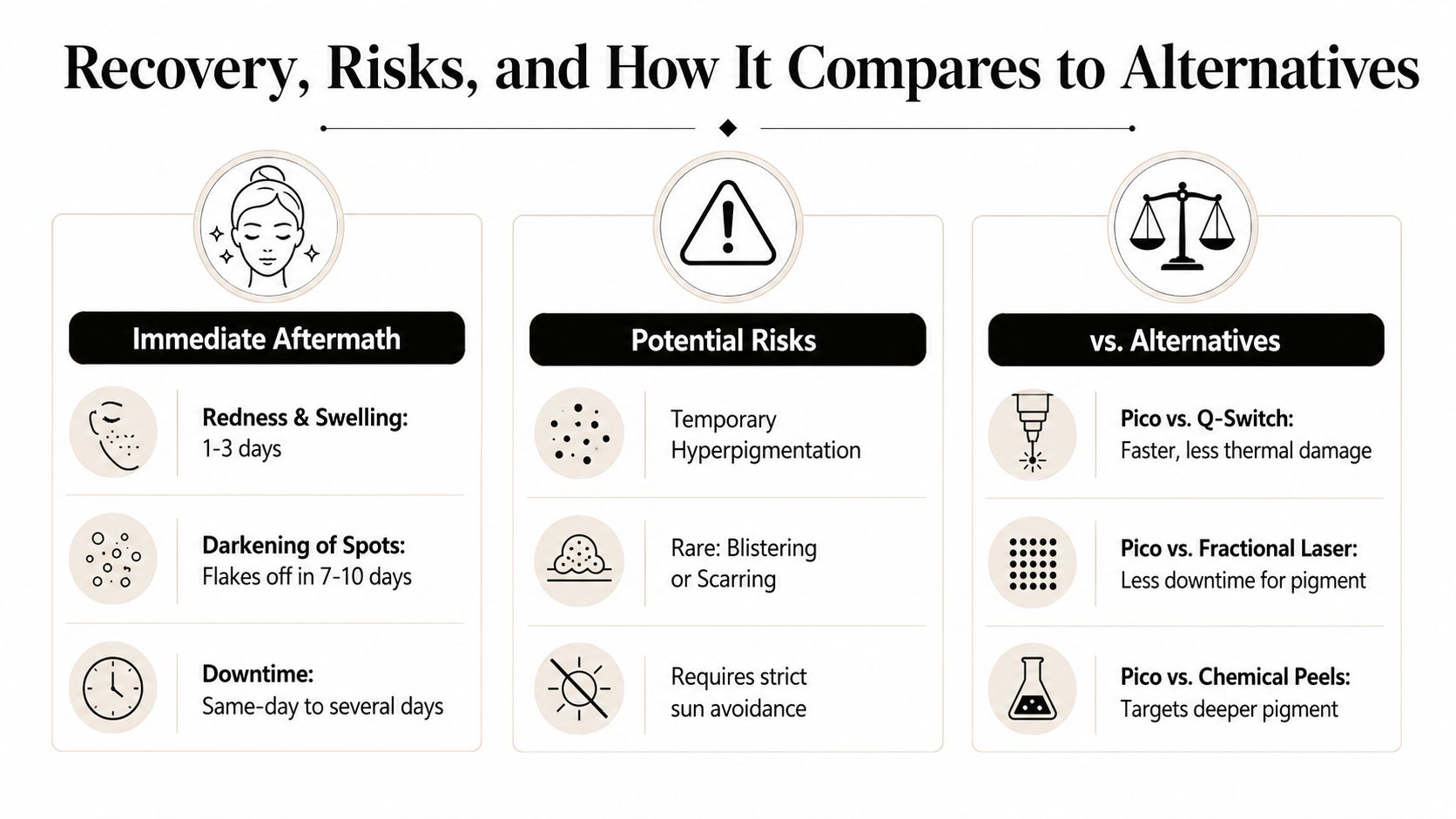
A Pico Genesis visit usually feels closer to a light reset than a disruptive procedure. Right after treatment, the most common reactions are redness, mild swelling, and pigment that can look a little darker before it starts to lift. Many clinic explanations describe downtime as ranging from same-day to several days, with treated spots sometimes flaking away in about 7-10 days, although real recovery depends on the area treated, the settings used, and how your skin responds. Sun protection matters during this healing window because freshly treated pigment is more vulnerable, and that is one reason many clinics pair the procedure with careful aftercare planning, especially in the context of laser rejuvenation planning.
Risks to know about
The white paper reported minimal side effects and no cases of hypo- or hyperpigmentation in that study, which is reassuring, but it does not mean the risk is zero for every patient in every setting. In day-to-day practice, clinicians still watch for temporary hyperpigmentation, blistering, scarring, and infection, especially if aftercare is poor or the skin is already irritated. PICO Genesis white paper
The safest result often comes from restraint. Conservative settings, careful wavelength choice, and strict post-treatment sun protection usually matter more than trying to do too much in one visit.
How it compares with common alternatives
Topicals like hydroquinone, retinoids, and vitamin C can be a reasonable first step for mild pigment, but they work from the surface and usually move more slowly. IPL and BBL can help with broad redness and uneven color, though they are not always the best fit for deeper pigment or every skin type. Traditional Q-switched nanosecond lasers have long been used for pigment and tattoos, while picosecond devices are often chosen for a shorter pulse that aims to reduce heat spread.
Microneedling, with or without radiofrequency, sits in a different category. It can help with texture and some forms of scarring, but it does not target pigment in the same direct way. Pico Genesis often ends up between these options, more focused on pigment than a texture-only treatment, less invasive than ablative resurfacing, and often used when patients want visible change without a harsher recovery.
A simple decision frame
- Choose topicals first if the discoloration is mild, diffuse, or still responding to skincare.
- Consider Pico Genesis if the concern is defined pigment, photo-damage, or a desire for lower-downtime revitalization.
- Look at other devices if redness, vascular change, or deeper textural remodeling is the main issue.
That comparison only helps if the plan matches the problem. If the treatment targets the wrong layer of skin, you can spend time and money and still feel disappointed.
Questions Worth Bringing to Your Provider
A strong consultation feels specific, not salesy. You want the provider to name the device, the parameters, the expected recovery, and the reason this approach fits your skin better than the alternatives. If they stay vague, keep asking until the plan makes sense.
Provider and platform
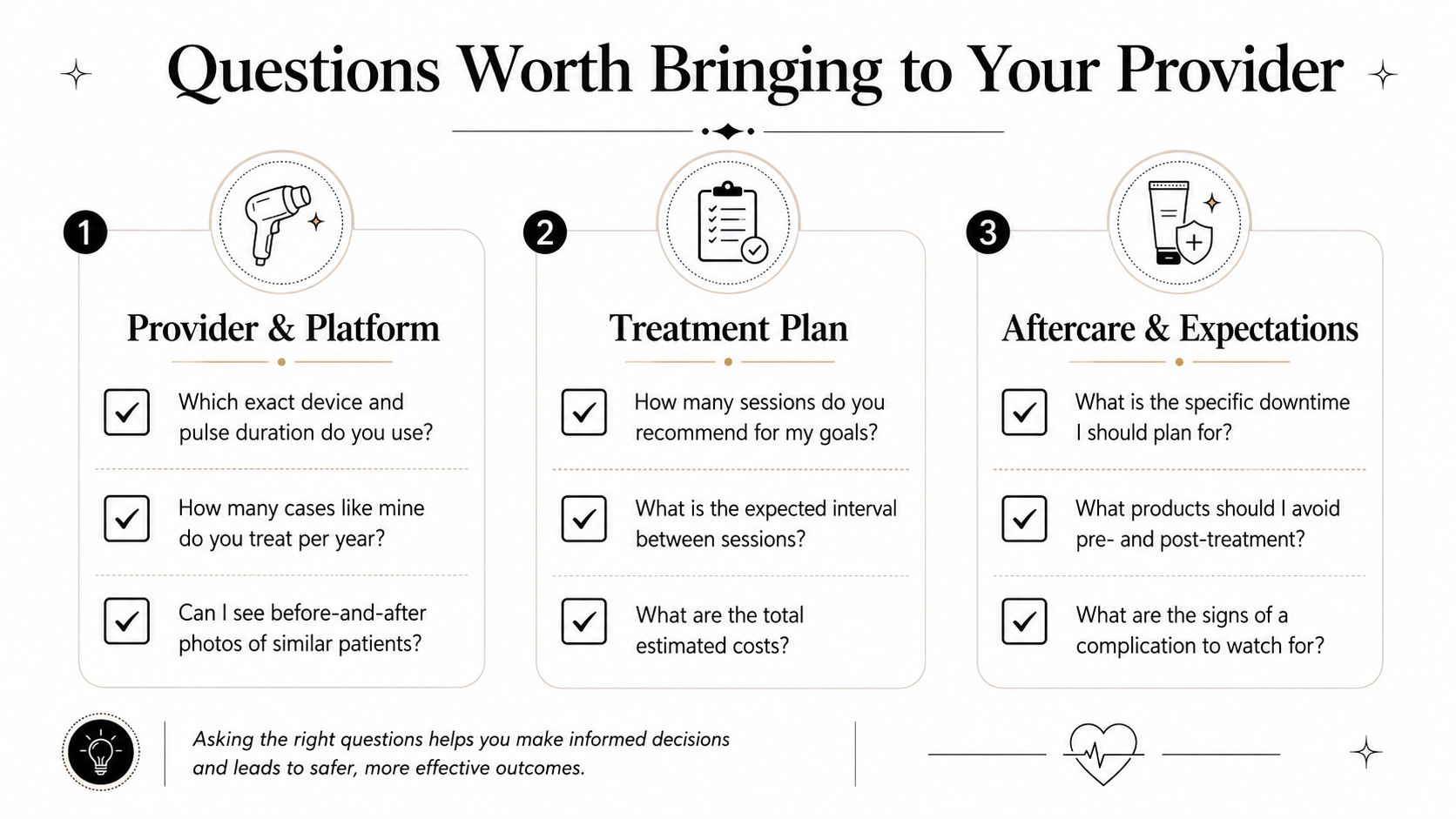
Ask which exact device they use and what pulse duration it delivers. Pico Genesis is a brand family, not a single universal setting, and the difference between platforms matters when you're deciding whether the clinic treats cases like yours. You should also ask how many similar patients they treat, and whether they can show before-and-after photos for your skin type and concern.
Treatment plan
Ask how many sessions they expect, how far apart those visits will be, and which wavelength they're planning to use. The technical bulletin makes clear that wavelength selection and fluence are adjusted to skin type and lesion color, so the provider should be able to explain why your plan is different from someone else's. Cutera technical bulletin
A few useful questions belong in every consult:
- Which wavelength are you recommending, and why?
- How many passes do you expect in a session?
- What kind of improvement is realistic for my skin tone and concern?
- What's the total visit count if I want the best response you'd expect?
Aftercare and safety
You should leave knowing what sunscreen or gentle skincare to use, what products to pause before and after treatment, and what signs mean you should call the office. If pigment darkens first, ask how long that usually lasts and what you should do while waiting for it to fade. Good aftercare is part of the treatment, not an optional add-on.
A board-certified dermatologist or plastic surgeon with documented picosecond experience is usually the safest place to start. Individual results vary, and medical decisions should always be made with a physician who can examine your skin in person and adjust the plan to your risk profile.
If you want more straightforward, patient-focused guidance before you book a consultation, visit Labiaplasty.com for clear educational resources on candidacy, recovery, and how to ask better questions at your next appointment. The same practical approach that helps people evaluate surgery can also help you judge a laser plan, compare providers, and walk into treatment with realistic expectations.
