

You've compared photographs, read recovery stories, and may still be stuck on one practical question: should you choose labiaplasty alone, clitoral hood reduction alone, or both at the same time? The answer depends on your anatomy, symptoms, and goals, not on a standard package. The clitoral hood and labia minora sit next to each other and often need to be evaluated as one connected contour.
This guide explains how that anatomy affects technique selection, candidacy, recovery, cost planning, and expectations. It also separates what current evidence supports, such as generally high short-term satisfaction, from what remains uncertain, especially long-term sensation and revision risk.
Why Labiaplasty and Clitoral Hood Reduction Are Often Combined
A patient may arrive at a consultation asking for labiaplasty because the inner labia rub during exercise or feel uncomfortable in fitted clothing. During the examination, she may also notice that the tissue above the clitoris looks fuller than expected. If the labia minora are reduced without considering that upper area, the clitoral hood can appear more prominent by comparison.
That doesn't mean every patient needs clitoral hood reduction. Some people have balanced anatomy and need treatment in only one area. The important point is that the surgeon should assess both structures before recommending a plan. A combined operation may be considered when the hood and labia overlap visually, share tissue borders, or create a contour that would look uneven if only one structure changed.
The distinction is easier to understand through a tailoring example. If a tailor shortens one panel of a garment but leaves the adjoining panel untouched, the finished edge may no longer flow naturally. The vulva isn't clothing, of course, and normal anatomy varies widely, but the planning principle is similar. The surgeon is shaping adjoining areas that contribute to overall proportion.
Practical rule: Clitoral hood reduction shouldn't be treated as an automatic cosmetic add-on. It should have a specific anatomical reason.
Patients who want a clearer explanation of the upper structure can review this overview of clitoral hood reduction, then use the consultation to ask whether their own hood is redundant, prominent, or asymmetrical. The next question is anatomical: what exactly is being connected?
The Anatomy Behind a Combined Procedure
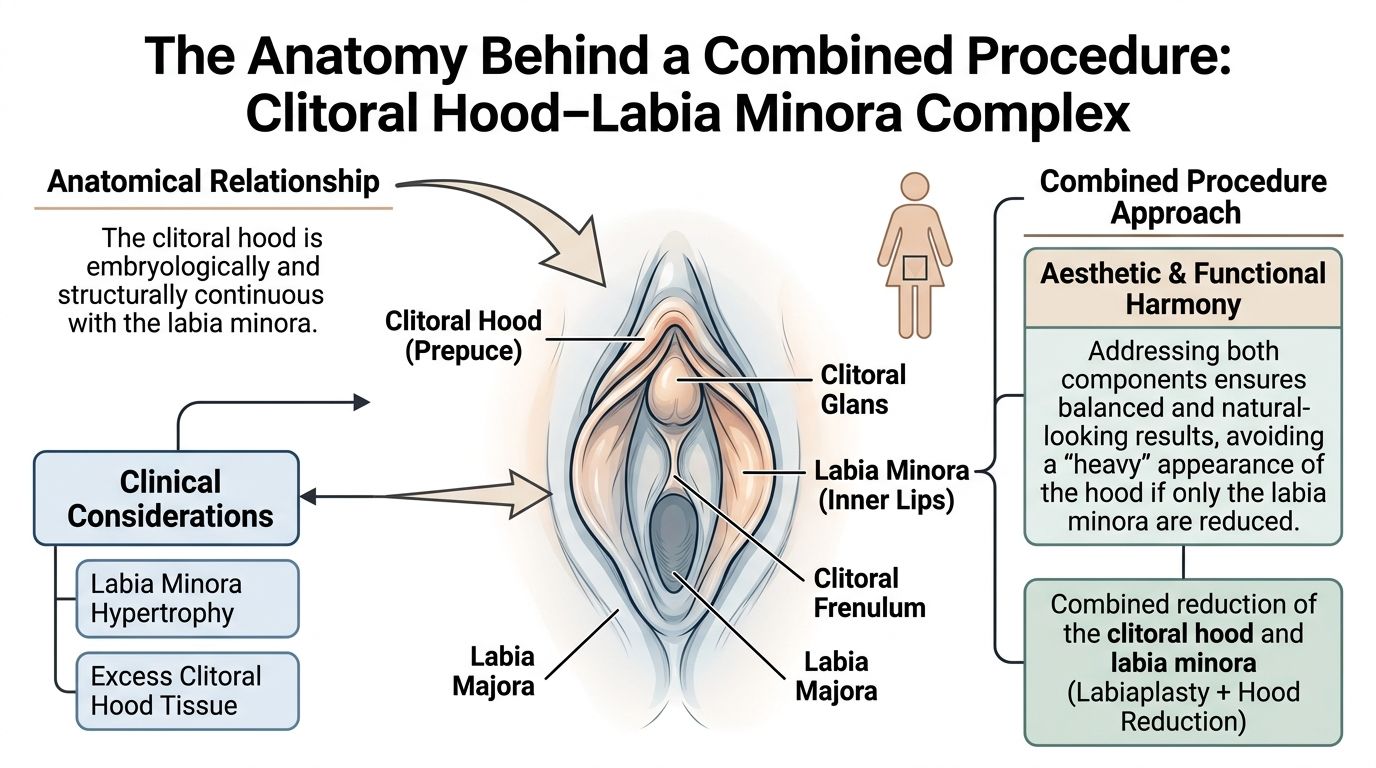
The clitoral hood, also called the prepuce, is the fold of skin that covers and protects the clitoral glans. On each side, it attaches near the front edge of the labia minora. Its lower border is shaped by the clitoral frenulum, a tissue connection beneath the clitoral glans.
That arrangement makes the hood and inner labia a clitoral hood–labia minora complex, rather than two completely separate cosmetic zones. Surgeons must identify where the labia begin, where the hood continues laterally, and where tissue folds change direction. The boundaries can be difficult to see clearly, particularly when the patient is standing, sitting, or changing position.
The landmarks that guide planning
The interlabial sulcus is the groove between the labia minora and labia majora. The anterior labial commissure is the front joining point of the labial tissue. These landmarks help the surgeon judge where tissue belongs to the labia, where it contributes to the hood, and how much can be removed without flattening or distorting the transition.
The purpose isn't just to remove visible skin. It's to preserve a natural relationship among the clitoral glans, hood, inner labia, and surrounding folds. Over-resection can create an appearance that feels too exposed or structurally altered. An imprecise plan can also leave one side fuller than the other or make the upper hood look disconnected from the reduced labia.
Why the examination matters
A photograph can't show every relevant feature. Tissue may look different when stretched, relaxed, or viewed from another angle. A surgeon should examine the complex directly and explain which landmarks are guiding the proposed incision.
The best consultation is therefore not just a discussion of how much tissue you'd like removed. It's a conversation about where tissue starts and ends, how the surgeon will preserve the clitoral covering, and why the proposed contour fits your anatomy.
Surgical Techniques and How They Differ
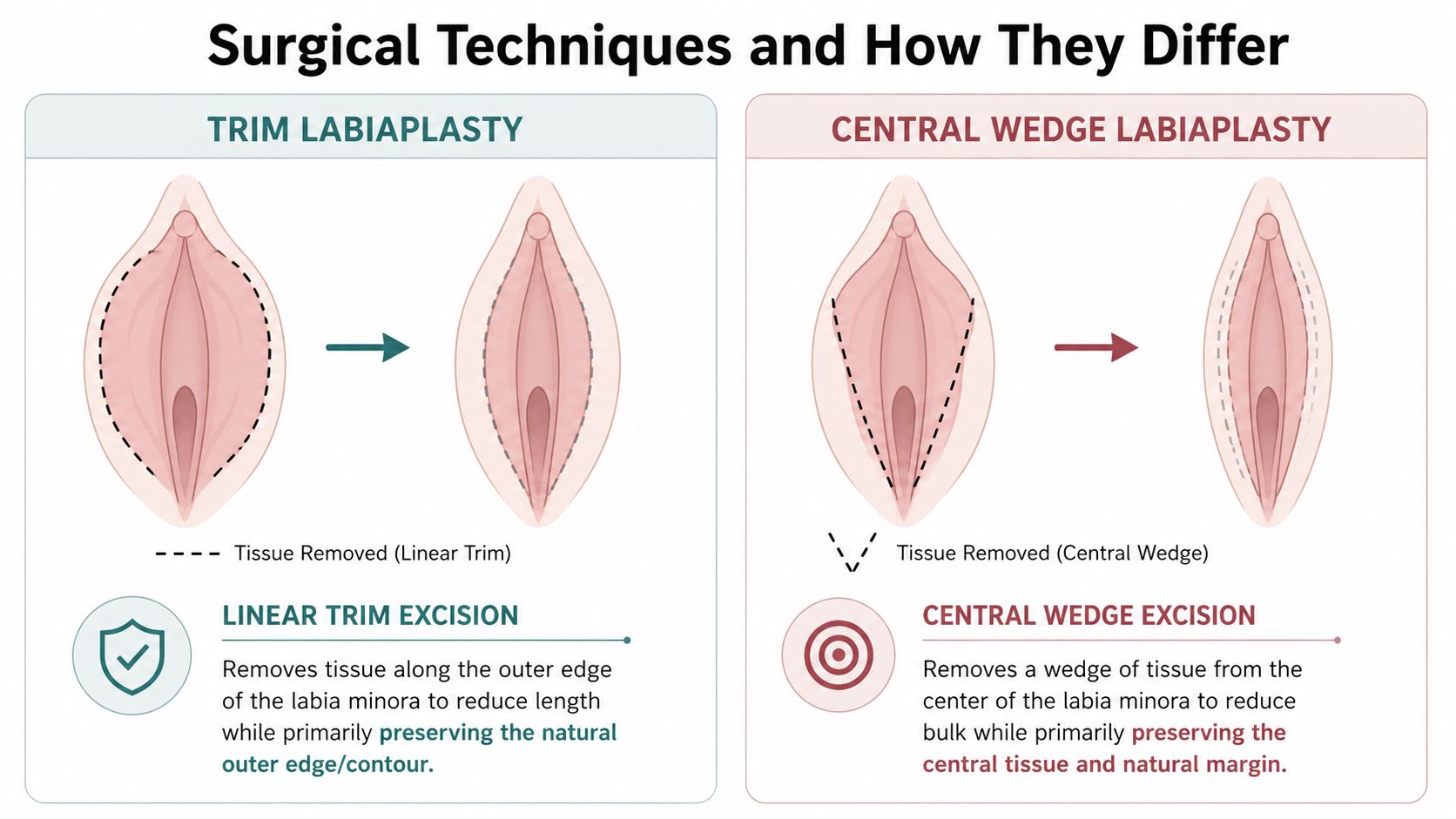
The main labiaplasty choices are usually described as trim and central wedge techniques. Neither is universally superior. Each removes tissue differently, and the surgeon may combine either approach with conservative lateral clitoral hood reduction when the anatomy calls for it.
A trim technique removes tissue along the labial free edge. This can address a darkened, irregular, or elongated edge and may allow the surgeon to shape the length directly. Because the natural edge is being altered, the incision line and healing quality matter. The surgeon must also avoid removing so much tissue that the labia become too short or lose a natural border.
A central wedge technique removes a wedge-shaped portion from the body of the labia while preserving more of the original free edge. The remaining edges are brought together, which can maintain the patient's natural rim. The trade-off is that the closure carries tension at the repair site, and the surgeon must plan the wedge carefully around asymmetry and tissue quality.
How the hood is added
With a wedge approach, some surgeons use lateral clitoral hood reduction to reduce redundant tissue extending beside the clitoral hood. With a trim approach, hood contouring may be planned as a separate step so the upper and lower borders follow a proportionate line. In either pairing, the hood portion requires independent markings and conservative judgment.
A surgeon may use a scalpel or a low-temperature radiofrequency device. The instrument itself doesn't determine the outcome. Tissue handling, anatomical knowledge, incision placement, closure, and restraint matter more than a device name.
The published technique data show why this choice deserves careful discussion. In an ASAPS meeting handout, central wedge reduction with lateral clitoral hood reduction was associated with a 2.9% revision rate and a 4.4% significant complication rate in the reported series, as summarized in the ASAPS technique handout. These figures describe that reported series, not a guaranteed risk for every patient.
A surgeon should explain not only which technique they prefer, but why it suits your tissue, symptoms, and desired amount of change. You can also compare terminology in this guide to different labiaplasty techniques before your appointment.
Who Is a Good Candidate and What to Ask in Consultation
A suitable candidate usually has a specific concern that can be connected to the anatomy. That concern may involve labial tissue that rubs during exercise, pulls during intercourse, becomes uncomfortable in clothing, or creates persistent self-consciousness. Another patient may have fullness or asymmetry in the clitoral hood that feels disproportionate to the labia minora.
A combined plan may make sense when both areas contribute to the complaint or when reducing one area alone would leave an obvious imbalance. It still isn't appropriate just because a bundled procedure is available. The surgeon should be able to identify the tissue involved and explain what problem each part of the operation is intended to address.

When to pause
Active vulvar skin disease should be assessed and treated before elective surgery. Uncontrolled medical conditions, active infection, or unrealistic expectations also warrant delay or a different form of care. A consultation should include medical history, medications, prior procedures, smoking status, healing concerns, and the symptoms you want to change.
A good surgeon won't promise a particular appearance or guarantee preserved sensation. They'll explain uncertainty and may recommend addressing the labia without the hood, the hood without the labia, or neither.
Questions that reveal the quality of the plan
Bring questions that require individualized answers:
- Hood assessment: What specific feature makes you recommend hood reduction, and what would happen if we left it untreated?
- Anatomical landmarks: How will you identify the interlabial sulcus, anterior labial commissure, frenulum, and clitoral covering during marking?
- Technique selection: Why does a trim or wedge approach fit my tissue better than the alternative?
- Photo comparison: Can I see results from patients with similar labial length, hood fullness, asymmetry, or skin tone?
- Sensation discussion: How do you counsel patients about numbness, altered sensitivity, arousal, and orgasm during and after healing?
- Revision policy: If the final contour is uneven or the hood remains prominent, how do you evaluate and manage a revision?
A surgeon who answers only with a package name hasn't necessarily explained the procedure. You're looking for a plan that connects anatomy, goals, limitations, and aftercare.
Recovery Timeline and Activity Milestones
Combined surgery affects more than one connected area, so swelling can make the early result look uneven or fuller than expected. Most patients need to plan for rest, hygiene, and gradual activity rather than judging the contour during the first days.
The first 72 hours are usually the most restrictive. Swelling, bruising, tenderness, and a tight or pulling sensation can make walking uncomfortable. Cold packs wrapped in cloth, loose clothing, prescribed or recommended pain medication, and a peri-bottle for gentle cleansing may help. Don't place ice directly on the skin, and follow your surgeon's exact instructions because products and wound-care protocols differ.
During the first two weeks, many patients limit walking, bending, lifting, and prolonged sitting. Desk work may be possible within several days for some people, but that depends on swelling, pain, commute time, and whether the job allows regular position changes. Dissolvable stitches may remain noticeable while the tissue closes, and itching, temporary numbness, and changing asymmetry can occur during healing.
A practical planning table
| Timeframe | What to Expect | Activity Clearance |
|---|---|---|
| First 72 hours | Peak swelling and tenderness, limited movement, careful hygiene | Rest, short necessary walking only |
| First two weeks | Gradual reduction in discomfort, continued swelling, possible itching or numbness | Light daily activity as tolerated, no strenuous exercise or sexual activity |
| Weeks three to six | Ongoing tissue settling, scar maturation, and changing symmetry | Gradual return only with surgeon approval |
| Six to eight weeks | Many patients reach a clearance discussion for intercourse and high-impact exercise | Resume restricted activities only after examination and explicit clearance |
Contact the surgeon promptly for worsening rather than improving pain, heavy bleeding, fever, foul-smelling drainage, spreading redness, wound separation, or sudden one-sided swelling. Those symptoms need professional assessment, not online reassurance.
Recovery principle: A temporary uneven appearance doesn't automatically mean the final result is uneven. Swelling resolves at different speeds on each side.
Sexual activity and cycling deserve particular caution because they place pressure and friction directly on healing tissue. Even if the outside looks better, deeper tissue may still be vulnerable. Follow the operating surgeon's timeline instead of using appearance alone to decide when to resume activity.
Costs, Insurance, and Financing Options
A single universal price for labiaplasty with clitoral hood reduction would be misleading. The total depends on the surgeon's experience, geographic market, procedure complexity, facility, anesthesia plan, and whether the operation is performed in an office, ambulatory center, or hospital setting.
Ask for an itemized estimate, not only a bundled figure. The written quote may include some combination of:
- Surgeon fee: Planning, operating time, and postoperative care may be grouped or separated.
- Facility fee: The operating location can add a distinct charge.
- Anesthesia: Sedation or general anesthesia may be billed independently.
- Follow-up visits: Confirm how routine postoperative examinations are handled.
- Supplies: Garments, dressings, and prescribed medications may or may not be included.
Prescriptions, laboratory testing, travel, time away from work, childcare, and treatment for complications are often separate planning items. A revision may also carry additional costs unless the surgeon's written policy addresses it. Ask what happens if delayed healing, asymmetry, wound separation, or a contour concern requires treatment.
Insurance commonly excludes procedures performed solely for cosmetic reasons. A functional complaint may require medical documentation, but coverage decisions depend on the plan and the insurer. Don't assume that describing discomfort guarantees reimbursement. Contact the insurer directly and ask what documentation, authorization, and exclusions apply.
Financing can take several forms, including a medical credit line, a clinic payment plan, or personal savings. Some patients also ask whether an HSA or FSA can be used when a physician documents a qualifying functional component, but account rules and tax treatment should be confirmed with the plan administrator.
Before comparing quotes, review this clitoral hood reduction cost guide and create a full budget that includes follow-up, recovery time, travel, and possible unexpected care. The lowest initial quote may not represent the lowest overall cost if the plan is poorly matched to your anatomy.
Realistic Outcomes, Satisfaction, and What the Evidence Does Not Yet Prove
The available evidence supports cautious optimism about short-term satisfaction, not certainty about every long-term outcome. A large multicenter outcome study published in 2010 included 258 women and 341 separate female genital plastic procedures across 12 gynecologists, gynecologic urologists, and plastic surgeons at 10 centers in 8 U.S. states. It recorded 24 clitoral hood reductions, 49 combined labiaplasty and clitoral hood reductions, and 34 procedures combining labiaplasty and/or hood reduction with vaginoplasty or perineoplasty. Across the combined groups, 91.6% of patients reported satisfaction after 6 to 42 months of follow-up, according to the multicenter outcome study.
Another 2008 study of 407 patients undergoing central wedge reduction with lateral clitoral hood reduction reported a 4% complication rate and a 2.9% reoperation rate. Among questionnaire respondents, average satisfaction was 9.2 out of 10, 93% reported improved self-esteem, 71% reported improved sex life, 95% reported less discomfort, and 98% said they would have the surgery again, as reported in the central wedge and hood reduction study. Questionnaire response patterns and study design matter, so these findings shouldn't be treated as a promise for an individual patient.

The unanswered sensation question
A 2025 systematic review found moderate short-term improvement in sexual function scores, but rated the certainty of that evidence as low because the studies were nonrandomized and had important limitations. The review also said high-quality controlled studies with at least 12 months of follow-up are needed. One prospective cohort using standardized sensory testing found no reduction in clitoral or labial sensitivity after labiaplasty with clitoral hood reduction, which is reassuring but not definitive. These findings are detailed in the 2025 systematic review.
The practical conclusion is clear: short-term satisfaction is often high, while long-term sensory outcomes remain insufficiently studied. A responsible consultation should discuss possible numbness, altered sensation, persistent discomfort, asymmetry, delayed healing, and revision without claiming that any outcome is guaranteed.
Evaluating Before-and-After Photos and Choosing a Surgeon
Before-and-after galleries can help, but they're easy to misread. Look for photographs taken with comparable lighting, distance, position, and angle. Check whether the images show the clitoral hood as well as the labial edge, and whether scars, swelling, and the timing of the “after” photograph are explained.
A strong gallery includes more than one aesthetic template. Natural anatomy differs in tissue thickness, pigmentation, asymmetry, hood fullness, and labial length. The relevant question isn't whether every result resembles an image you like. It's whether the surgeon can produce balanced, proportionate outcomes across different anatomies without over-resection.
Questions for surgeon selection
- Relevant credentials: Verify training and board certification appropriate to the surgeon's field and the procedure they perform.
- Combined experience: Ask how frequently they perform labiaplasty with clitoral hood reduction, not only labiaplasty alone.
- Anatomical reasoning: Ask what landmarks guide their markings and how they protect the clitoral covering.
- Sensation counseling: Notice whether they discuss arousal, orgasm, numbness, and sensitivity directly.
- Revision philosophy: Request a clear explanation of follow-up, correction criteria, timing, and fees.
- Photo transparency: Ask to see comparable cases rather than only the surgeon's most dramatic results.
A classic case report described patients whose clitoral hood appeared more prominent after free-edge resection labiaplasty, leading them to seek corrective surgery. That example reinforces the central planning issue: hood prominence can become a postoperative imbalance when the connected anatomy isn't considered at the outset. Review the case report on postoperative clitoral hood prominence and ask your surgeon how their technique addresses that possibility.
The right surgeon should plan the labia and hood together while still justifying each treatment separately. That approach gives you a clearer decision, a more realistic risk discussion, and a better basis for evaluating the result over time.
Labiaplasty.com offers educational information on clitoral hood reduction, recovery, costs, financing, before-and-after galleries, and a doctor directory to help you prepare for informed consultations. Visit Labiaplasty.com to compare your questions and planning resources before speaking with a qualified surgeon.
