

You may be reading about g shot injections because your sex life feels good but inconsistent. You may enjoy penetration sometimes, feel very little other times, or wonder whether a targeted, non-surgical procedure could make intercourse more reliably pleasurable.
That is a reasonable question. It is also a point where online marketing often gets ahead of evidence.
As a cosmetic gynecology practitioner, I view the G-Shot as an elective enhancement procedure, not a cure for complex sexual concerns. For the right patient, it can make a sensitive area easier to stimulate during vaginal intercourse. For the wrong patient, it can become an expensive detour that does not address the underlying issue at all.
The useful conversation is not “Does it work for everyone?” It does not. The better question is whether your anatomy, goals, and expectations match what this procedure is designed to do.
The Modern Pursuit of Enhanced Sexual Experience
Sexual wellness has expanded far beyond the old framework of “problem” versus “no problem.” Many patients are not in crisis. They are functional, healthy, and want more sensation, more confidence, or a better match between physical arousal and emotional desire.
That is the context in which g shot injections are usually discussed. They sit in the same broader world as pelvic floor therapy, counseling, lubricants, energy-based treatments, and aesthetic procedures. Interest in genital procedures has also grown as patients become more comfortable researching intimate concerns, much like the broader visibility discussed in why labiaplasty has become so popular.
The key distinction is purpose. A G-Shot is aimed at enhancement of localized stimulation. It is not a treatment for low libido, unresolved pain disorders, relationship distress, hormonal deficiency, or lifelong inability to orgasm from any form of stimulation.
Enhancement is not the same as treatment
Patients often combine several goals into one sentence. They may say they want “better orgasms,” but mean different things:
- More friction during penetration: They feel vaginal intercourse is not reliably stimulating enough.
- Greater confidence: They want to feel more responsive and engaged with a partner.
- A fast, office-based option: Surgery feels excessive for what they are trying to improve.
- A temporary trial: They prefer something reversible or self-limited before considering anything more involved.
Those goals can make sense for a G-Shot consultation.
What does not work well is using the procedure as a stand-in for problems it was never designed to solve. If the main issue is absent desire, pain with sex, vaginal dryness from hormonal change, trauma history, or chronic pelvic floor tension, a filler injection into the anterior vaginal wall is unlikely to fix the underlying cause.
The best candidates usually already respond to G-spot stimulation and want to amplify an experience they can already access, not create one from nothing.
An honest consultation matters more than a glossy treatment page. A careful clinician should help you separate curiosity from realistic benefit.
What Exactly Are G Shot Injections
A G-Shot is a filler injection placed into the anterior vaginal wall to make the targeted area more prominent and, in some patients, easier to stimulate during penetrative sex.
The concept is straightforward. If a sensitive area is more projected and easier to contact, intercourse may create more friction there. Think of it as making a small target slightly fuller so it is easier to reach consistently.
The anatomical idea behind the procedure
The term “G-spot” comes from the Grafenberg spot, named after Dr. Ernst Gräfenberg. The G-spot was first described by German gynecologist Dr. Ernst Gräfenberg in 1950, and a US pilot study on 20 women reported that 87% experienced enhanced sexual gratification after treatment, according to this overview of G-shot G-spot amplification.
That historical background matters, but it should be interpreted carefully. The G-spot remains a debated topic in medicine. Some clinicians and researchers treat it as a distinct zone. Others see it as part of a broader network involving the anterior vaginal wall, clitoral structures, and pelvic nerve response. In practice, that debate helps explain why outcomes vary so much from patient to patient.
Why hyaluronic acid is usually used
Most modern g shot injections use hyaluronic acid, often shortened to HA. This is the same broad category of filler used in many facial procedures.
Clinicians favor HA for practical reasons:
- It adds volume immediately: The effect comes from plumping the treated area.
- It is biocompatible: Hyaluronic acid naturally exists in human tissues.
- It is temporary: The body gradually breaks it down over time.
- It is familiar to many injectors: Products such as Restylane, Juvederm, and Perlane are examples named in clinical descriptions of the procedure.
The G-Shot does not create a new erogenous zone. It attempts to enhance an existing one. If the anterior vaginal wall is already meaningful for your arousal, increasing its prominence may help. If your pleasure depends much more on clitoral stimulation, emotional context, pacing, pelvic floor relaxation, or other factors, the benefit may be limited.
What the procedure is and is not
A lot of confusion comes from oversimplified marketing.
| What a G-Shot is | What a G-Shot is not |
|---|---|
| A localized filler-based enhancement | A guaranteed orgasm treatment |
| An office procedure | A solution for low libido |
| A temporary change | A permanent structural correction |
| A cosmetic sexual wellness option | A proven therapy for every sexual dysfunction |
That distinction protects patients from the biggest disappointment I see in consultation. The procedure can make a responsive area more accessible. It cannot manufacture desire, remove every barrier to orgasm, or replace a full sexual health evaluation.
The G Shot Procedure Step by Step
Most patients feel less anxious once they understand what happens in the office. The procedure is brief and usually straightforward, but it should still feel methodical and medically controlled.

The consultation and exam
You arrive for a discussion first, not an injection first. That order matters.
A qualified provider should ask what you are hoping to improve, how you usually experience pleasure, whether penetration is already pleasurable for you, and whether you have symptoms that point to a different diagnosis. Someone with vaginal pain, recurrent infections, severe dryness, pelvic floor spasm, or absent orgasm in all settings needs a broader workup before considering filler.
The exam focuses on the anterior vaginal wall. Clinical descriptions place the target area roughly 5 to 8 cm from the vaginal opening, and the treatment itself typically uses 2 to 3 mL of hyaluronic acid filler, with the injection taking under 8 seconds as part of an office visit lasting under 30 minutes, according to this procedural description of the G-shot.
Numbing and positioning
After the exam, the provider prepares the area. Depending on technique, this may include topical anesthetic, local anesthetic with lidocaine, or both.
A speculum may be used for visualization and access. The point is precision, not drama. This should feel like a controlled office procedure, not a rushed cosmetic add-on.
The injection itself
Once the target is identified, the filler is placed into the anterior vaginal wall. The aim is to create additional projection in the area associated with G-spot stimulation.
Patients usually notice that this part is much faster than expected. The setup and preparation take longer than the injection.
A short educational video may help you visualize the appointment flow before you book:
After the appointment
Most patients stand up, get dressed, and leave without major interruption to the rest of the day. There is generally no formal downtime in the way people think about downtime after surgery.
Still, “back to normal” does not mean “ignore aftercare.” Your provider may advise a brief pause before intercourse, depending on technique, tissue response, and product used. Different clinics give different instructions, which is one reason I recommend asking for specific written aftercare guidance rather than relying on a generic statement like “you can do everything right away.”
If a clinic cannot explain exactly where the filler goes, what product they use, how they map the target area, and what they want you to avoid afterward, keep looking.
A well-run visit feels calm, private, and precise. It should not feel improvised.
Expected Outcomes and Recovery Timeline
The first thing to understand is that results are variable. Some patients describe intercourse as more direct, more noticeable, or easier to enjoy after treatment. Others notice only a subtle difference. A smaller group does not feel a meaningful improvement at all.
That range is not a sign that you did anything wrong. It reflects the fact that sexual response is anatomical, neurological, hormonal, psychological, and relational at the same time.
What you may feel right away
Because the treatment uses filler, there is an immediate volumizing effect. The tissue has more fullness from the start, even before you decide whether that translates into more pleasure.
In the short term, mild local symptoms are possible. Patients may notice temporary tenderness, slight spotting, minor discomfort, or a brief sense of pressure. These effects are generally described as mild and short-lived in clinical and provider materials.
The usual recovery pattern
Many individuals can return to ordinary daily activities the same day. The more nuanced question is not work or errands. It is intimacy.
A pioneering study reported that 87% of participants experienced heightened sexual gratification for up to 4 to 6 months, and that the filler immediately plumps the area, with effects typically lasting 3 to 6 months before re-administration is needed, according to this comparison of O-Shot and G-Shot outcomes.
That gives patients two practical takeaways:
- The effect is temporary: This is maintenance-based treatment, not a one-time fix.
- The response is short-term evidence: Most available claims focus on months, not years.
Why duration varies
Hyaluronic acid does not stay in place forever. Your body gradually metabolizes and absorbs it. That is why one patient may feel the benefit fading relatively quickly while another feels a longer window of improvement.
Other factors matter too:
| Factor | Why it changes results |
|---|---|
| Your baseline sensitivity | Patients who already respond to the area often notice more |
| Filler metabolism | Some bodies break down HA faster than others |
| Technique | Placement accuracy affects whether stimulation improves |
| Sexual pattern | Intercourse style and anatomy influence friction |
| Expectations | A subtle enhancement can feel large or disappointing depending on the goal |
What usually works and what usually disappoints
The best reports tend to come from patients who already know the anterior vaginal wall matters for their pleasure. They are not hoping for a miracle. They are hoping for more consistency.
The weakest outcomes tend to happen when someone expects the injection to fix broad dissatisfaction with sex. If arousal is absent, orgasm has never occurred in any context, or the relationship dynamic is strained, the filler may leave the central problem untouched.
A realistic timeline
A practical way to think about the experience is this:
- Day of treatment: You may feel fullness, mild tenderness, or very little at all.
- Early period after treatment: Local tissue settles. Some patients become more aware of the treated area.
- Active benefit window: If the procedure suits you, intercourse may feel more stimulating during the months while the filler remains effective.
- Fade phase: The effect gradually softens as the HA is absorbed.
This is why I encourage patients to judge the procedure by a narrow question. Did it improve the kind of intercourse-related stimulation you were targeting? If yes, repeat treatment may make sense. If no, repeating it usually does not magically produce a different sexual blueprint.
Candidates Controversies and Scientific Evidence
The most useful way to evaluate g shot injections is to separate candidate quality from evidence quality. Those are different questions.
A patient may be a good candidate in theory and still be considering a procedure that lacks strong long-term data. Both things can be true at once.
Who tends to be the best candidate
The strongest candidate profile is usually someone who:
- already experiences pleasure from G-spot or anterior vaginal wall stimulation
- wants enhancement rather than treatment of a major dysfunction
- prefers a non-surgical, office-based option
- accepts that results may be modest and temporary
- understands maintenance may be required
The weaker candidate profile includes people seeking a solution for low desire, severe pain with sex, major relationship distress, or lifelong absent orgasm across all forms of stimulation. In those cases, filler often addresses the wrong layer of the problem.
The central controversy
The most important scientific issue is not whether some patients report benefit. Some clearly do. The harder question is how confidently we can separate treatment effect from expectation, placebo response, selection bias, and marketing language.
The American Society of Plastic Surgeons notes a key critique. There is a lack of long-term efficacy data and large-scale randomized controlled trials, and the G-Shot is a trademarked, off-label use of filler that is not FDA-approved for this purpose, as described by the ASPS overview of nonsurgical aesthetic genital procedures.
That criticism matters more than many clinic websites admit.
What the current evidence can and cannot tell you
The existing literature and provider reports suggest that some women experience better arousal or gratification after treatment. The problem is not that every positive report is false. The problem is that the evidence base is limited.
Here is the balanced view:
| What the evidence supports | What the evidence does not firmly establish |
|---|---|
| Some patients report short-term enhancement | Long-term durability over repeated treatments |
| The procedure is feasible in office settings | Which patients benefit most with high certainty |
| Benefits may be tied to localized volumization | Whether results outperform placebo in strong trials |
| Temporary improvement is plausible | Standardized protocols across providers |
This is a reason I caution patients against reading testimonials as proof. Sexual response is highly suggestible. Hope, novelty, attention to intimacy, and expectation can all influence how a treatment feels.
Marketing often overstates the claim
In promotional language, the G-Shot is sometimes framed as if it “unlocks” hidden sexual function. That oversells the mechanism.
A filler injection does one basic thing. It changes volume and projection in a localized area. That can matter. But if a clinician implies that this automatically translates into stronger orgasms for everyone, the counseling is no longer evidence-based.
A credible provider should be comfortable saying, “You may notice improvement, you may notice only a subtle change, and you may decide this is not worth repeating.”
The anatomical debate matters too
The G-spot itself is still discussed in different ways across medicine. Some clinicians describe a distinct sensitive spot. Others consider the experience part of a broader arousal complex involving the clitoris, urethral sponge, pelvic nerves, and vaginal wall.
For patients, that debate has one practical implication. There is no universal map that works the same for every body. A treatment that feels intuitive in one patient may feel irrelevant in another.
That does not make the procedure meaningless. It means it should be offered with humility. The best consultations acknowledge both truths at once: some patients are pleased with the result, and the science is not settled enough to promise a predictable outcome.
Risks Costs and Finding a Qualified Provider
The usual marketing language around g shot injections is “simple,” “quick,” and “no downtime.” None of that is necessarily false. It is incomplete.
Any injection procedure in intimate tissue deserves a proper risk discussion. That discussion should happen before money changes hands.

The common and uncommon risks
Most side effects are mild. Temporary tenderness, slight bleeding, soreness, or a brief pressure sensation are the issues patients hear about most often.
Less commonly discussed are the risks that deserve explicit consent. Clinics often fail to detail rare complications such as infection, allergic reactions to filler, or vascular occlusion, and there are no universal qualification standards, which makes provider vetting especially important, as noted in this discussion of G-shot safety and provider concerns.
Potential concerns patients should ask about include:
- Infection: Any vaginal procedure involves tissue entry and bacterial exposure.
- Product reaction: Even generally well-tolerated fillers can cause unwanted responses.
- Filler placement issues: Overcorrection, asymmetry, or migration can affect comfort.
- Urinary or pelvic symptoms: Rare but important to discuss before treatment.
- Management of complications: Not every injector who offers the treatment is equipped to treat a problem.
What it costs
Cost varies by market, provider, and filler used. Available clinic-based pricing in verified material suggests that procedures can be expensive, with some clinics advertising financing options. If you are comparing treatment budgets with other intimate procedures, resources on understanding vaginal rejuvenation cost can help you frame the bigger financial picture.
Do not shop this procedure on price alone. A lower quote may reflect less experienced injection technique, lower-touch follow-up, or poor complication planning.
Questions to ask in consultation
This is a point where patients can protect themselves. Ask direct questions and expect direct answers.
What filler are you using?
Product names matter. Hyaluronic acid fillers are not all identical in texture and handling.How often do you perform transvaginal filler injections?
General cosmetic injection experience is not the same as vaginal injection experience.How do you identify the target area?
The answer should be specific and anatomically coherent.What side effects do you see most often, and how do you manage uncommon complications?
A strong provider does not minimize this question.What aftercare do you recommend?
Ask for written guidance.If I dislike the result, what are my options?
This is especially relevant with hyaluronic acid products.
Signs of a better provider
Some reassuring signs are simple and practical:
- Clear counseling: They discuss who should not get the procedure.
- Named products: They tell you exactly which filler they plan to use.
- Complication readiness: They have a protocol, not just reassurance.
- No pressure tactics: They do not rush you into same-day treatment if you are uncertain.
A polished website is not proof of skill. For this procedure, technical judgment and anatomical experience matter far more than branding.
Comparing Alternatives to G Shot Injections
A G-Shot is only one path within sexual wellness care. Some patients are better served by another procedure. Others are better served by no procedure at all.
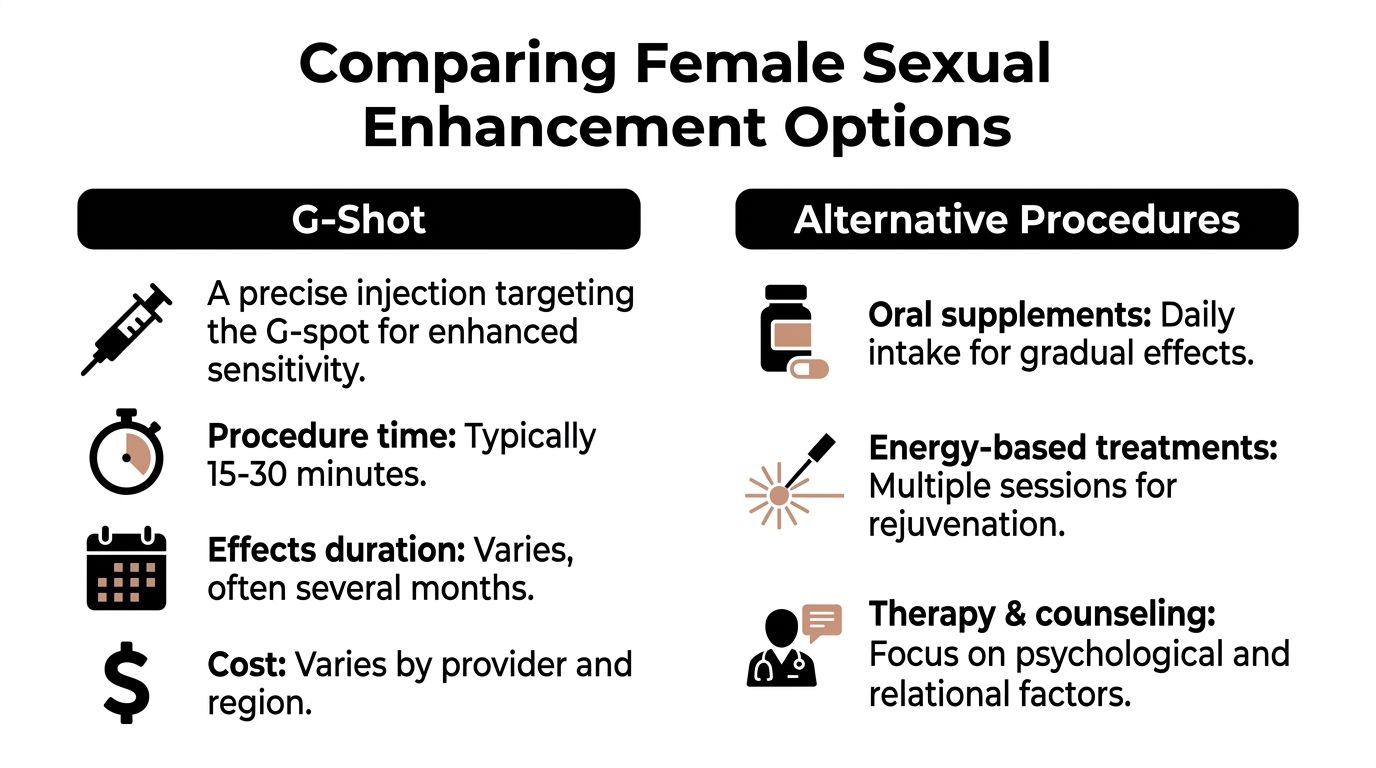
The most common comparison is the O-Shot, but that is not the only alternative. Pelvic floor therapy, counseling, lubricants, vaginal moisturizers, hormone evaluation, and relationship-focused care often matter more than an injectable for patients whose concerns are broader than penetrative friction.
G-Shot versus O-Shot
The cleanest difference is mechanism.
A G-Shot is a volume-based filler procedure. Its aim is to make a targeted area more prominent. An O-Shot is usually discussed as a regenerative or biologic approach, often centered on platelet-rich plasma rather than filler.
Here is a practical comparison.
| Feature | G-Shot (G-Spot Amplification) | O-Shot (Orgasm Shot) |
|---|---|---|
| Primary mechanism | Hyaluronic acid volumization | PRP-based injection approach |
| Main treatment idea | Increase prominence of the target area | Promote tissue response and sensitivity through biologic signaling |
| Procedure feel | Quick office filler procedure | Office procedure with blood processing and injection |
| Best fit | Patients focused on penetrative stimulation | Patients exploring broader sexual wellness goals |
| Limitation | Temporary and localized | Variable response and less immediate structural change |
That difference in mechanism also affects candidacy. Someone who says, “I know penetrative sex feels better when that specific area is stimulated” often fits the G-Shot discussion more naturally. Someone focused on overall responsiveness, lubrication, or broader tissue concerns may ask about alternatives instead.
Other non-surgical paths
Not every useful alternative is injectable.
- Pelvic floor therapy: Helpful when muscle tension, guarding, or poor coordination reduces pleasure.
- Counseling or sex therapy: Often overlooked when anxiety, communication, or anticipation shape arousal.
- Energy-based treatments: Marketed for rejuvenation, though evidence quality varies and careful counseling is still needed.
- Supportive self-care: Lubrication, comfort, pacing, and even exercises aimed at vaginal muscle awareness can matter more than patients expect. Some people researching non-surgical intimacy options also look into approaches for how to tighten vagina muscles.
Which option makes the most sense
The right choice depends on your goal.
If the goal is localized enhancement during intercourse, the G-Shot is the most directly targeted option in this group. If the goal is broader sexual function, a more extensive plan usually makes more sense than a single filler injection.
That is the larger point patients often miss. Procedures are tools. A tool works well when it matches the job. It disappoints when it is asked to solve a different problem.
Frequently Asked Questions
Will a G-Shot guarantee a vaginal orgasm
No. It may enhance stimulation for some patients, but it does not guarantee orgasm and should not be presented that way.
What if I have never been able to orgasm from penetration
That usually makes me more cautious. The procedure tends to make more sense for someone who already finds the area pleasurable and wants enhancement, not for someone seeking a first-ever orgasmic response from penetration.
Can I get a G-Shot if I have an IUD
Many patients with an IUD may still be candidates, but that decision depends on your anatomy, symptoms, and exam. Your provider should assess you individually.
What happens if I do not like the result
That depends on the filler used and the nature of the concern. This is one reason to ask exactly which product is being injected and what the provider would do if the outcome feels uncomfortable or unhelpful.
How many treatments will I need
There is no universal number. Because the effect is temporary, repeat treatment is usually about whether you felt the result was worth maintaining.
Is this better than therapy or pelvic floor treatment
Not if your main issue is psychological distress, pain, muscle tension, or relationship strain. In those cases, an injection may be secondary or unnecessary.
If you are researching intimate procedures and want practical, non-promotional guidance, Labiaplasty.com offers educational information on procedure options, recovery, costs, and how to prepare for a consultation with a qualified specialist.
