
You've just come home from surgery, you're tired, and the first real question hits fast: What is normal right now, and what needs a call to the office? That's the reality of myomectomy laparoscopic recovery, it's usually quicker than people expect, but the first days still feel uncertain because the body is healing in more than one place at once.
The reassuring part is that recovery after laparoscopic surgery is built around small incisions, short stays, and earlier return to function. Many patients return to work in 4 to 6 days, with home recovery often around 2 to 4 weeks, while open myomectomy can take up to 6 weeks for full recovery, according to early outcome data on laparoscopic myomectomy [^1]. That same review also reported a 55% pregnancy rate over 10 months to 4 years in infertility cases, which is one reason the operation is discussed not just as a recovery story, but as a fertility-preserving one [^1].
If you're trying to make sense of pain, bloating, incision care, sex, exercise, fertility, or whether you need a scan, keep reading. The most useful recovery advice is the kind that explains why your body feels the way it does, not just what to do next. For background on wound healing in general, this surgical healing guide can also help frame what your skin is doing while deeper tissues catch up.
Your Guide to Healing After Laparoscopic Myomectomy
The first morning home often feels strangely ordinary and unsettling at the same time. You may be walking slowly to the kitchen, holding your abdomen when you cough, and wondering why a surgery with tiny cuts still leaves you so aware of every movement. That reaction makes sense, because laparoscopic myomectomy is less traumatic than open surgery, but it still involves uterine repair, abdominal entry, and a short stretch of body-wide recovery.
The value of the laparoscopic approach is that the healing burden is lighter. Hospital guidance describes 5 to 12 mm incisions, a stay of 0 to 1 nights, and a 2 to 3 week recovery window, with many patients advised to plan about 3 weeks off work [^3]. In practical terms, that means you're not recovering from a large abdominal wound, you're recovering from several smaller entry sites and the internal work of the uterus itself.
Practical rule: if your energy comes in waves, that's expected. Recovery after minimally invasive surgery often improves in uneven steps, not in a straight line.
The reason this matters is simple. People sometimes judge healing by what they can see on the skin alone, but the uterus and pelvic muscles are doing their own repair behind the scenes. That's why the first few days can feel more exhausting than the incision size suggests, and why patience matters even when the operation itself was technically small.
A useful way to think about myomectomy laparoscopic recovery is as a sequence of layers. First, anesthesia clears. Then pain settles. Then bowel function and walking improve. After that, stamina returns, and only later does the deeper internal healing feel complete.
The First 48 Hours Post-Surgery
The first two days are usually about staying comfortable enough to move, drink, eat, and sleep. In the recovery room, grogginess from anesthesia can make time feel distorted, and a sense of abdominal pressure can be more noticeable than sharp pain. Many patients are relieved to learn that laparoscopy has measurable early recovery advantages, including lower pain scores at 6 hours and less frequent need for analgesics during the first 48 hours compared with minilaparotomy in a randomized study [^2].
What usually helps right away
Start with small, predictable actions. Sit up slowly, take short walks when the team says you can, and sip fluids rather than trying to “catch up” all at once. Gentle movement matters because it helps circulation, supports bowel activity, and often makes the gas discomfort from laparoscopy easier to tolerate.
Pain may feel different from one hour to the next. Some people describe incision tenderness, others feel cramping low in the pelvis, and some notice shoulder discomfort from the gas used during surgery. That mix can sound alarming if nobody warned you, but it's a common part of recovery after minimally invasive abdominal procedures.
What not to overreact to
A groggy, bloated, slow first evening does not mean something went wrong. It usually means your body is adjusting to anesthesia, abdominal insufflation, and the first round of pain control. What matters most is whether symptoms are trending in the right direction, even if that trend is gradual.
Keep walking short and simple. A few steps every few hours is often more useful than one long burst of activity that leaves you wiped out.
If you're keeping food light, that's sensible too. Bland meals, hydration, and rest usually work better than heavy food or trying to “push through” nausea. The goal in this window is not productivity, it's stability.
Navigating Your First Two Weeks at Home
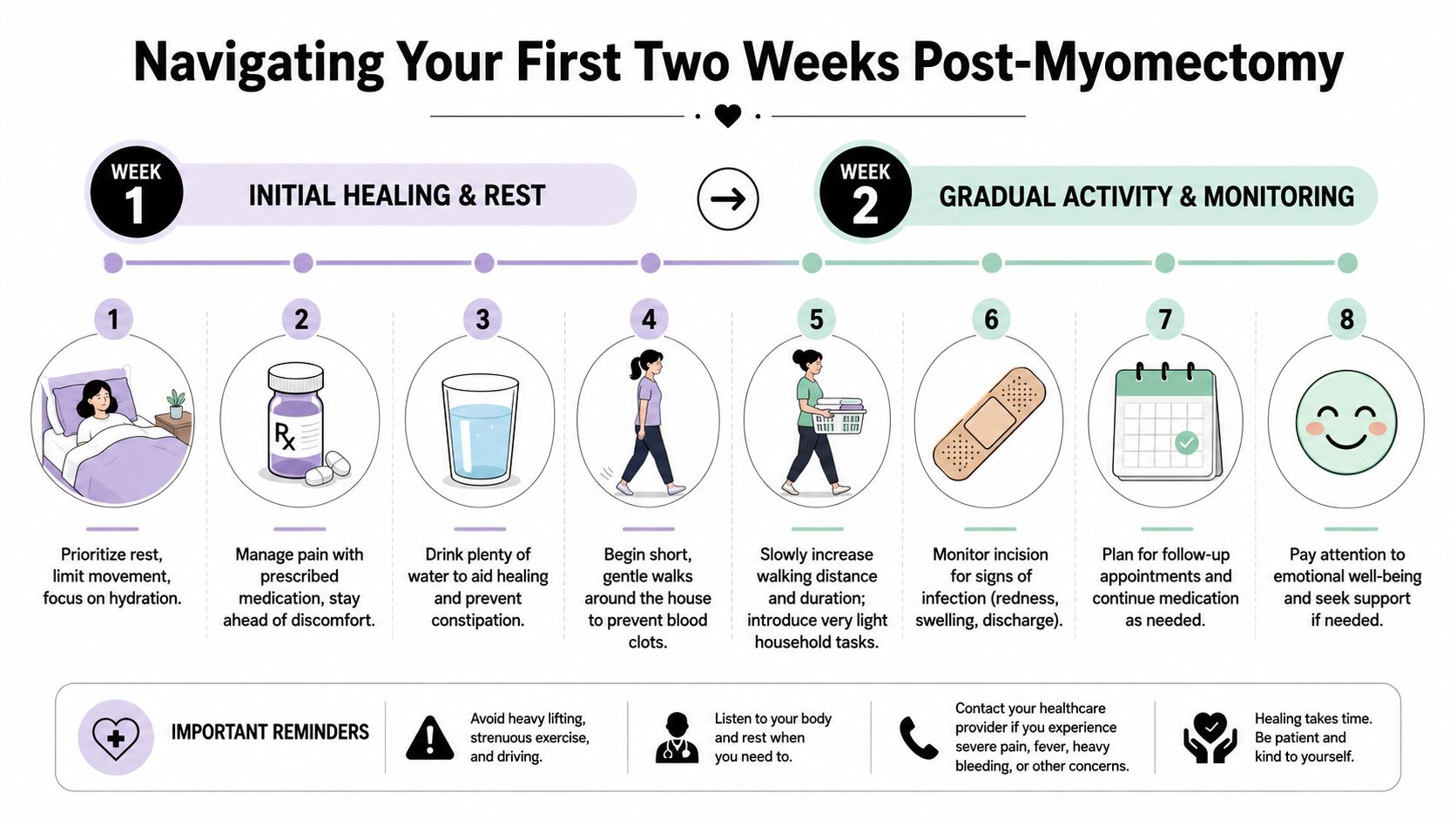
The first two weeks are when you start noticing which habits are most helpful. The incision sites are small, but they still need clean, protected healing, and your energy can run out faster than your mind expects. That's why patients often do best with a simple structure, rest first, then short walks, then a gradual return to ordinary chores.
Incisions, showering, and the skin level
Your abdominal cuts are typically small, and they should look cleaner and calmer over time, not more inflamed. Clean them exactly as instructed by your surgeon, keep an eye out for increasing redness or drainage, and avoid anything that rubs or traps moisture unnecessarily. Showering is usually easier than soaking, because standing water can irritate healing skin before the closure has fully settled.
Energy, appetite, and bowel function
Fatigue is common because surgery isn't only a local event, it's a whole-body stressor. Many people need more rest than they expected, and that's normal. Hydration and fiber-rich foods can help prevent constipation, which matters because straining is one of the fastest ways to make the pelvis feel worse.
Walking is the safest exercise in this phase. Start with short loops around the house, then extend them when you can do so without a pain spike. That small movement helps prevent stiffness and supports circulation, which is part of why it's encouraged so early after surgery.
A quick reference for weeks 1 and 2
| Milestone | Typical Timeline |
|---|---|
| Short walks around the house | First days |
| Showering with incision care | Early home recovery |
| Need for extra rest | Common in week 1 |
| Light household tasks | Often begin gradually in week 2 |
| Return toward normal stamina | Progresses through weeks 1 to 2 |
By the end of the second week, many patients can tell the difference between ordinary healing soreness and a problem that needs evaluation. That distinction becomes clearer once the routine, and not just the pain, starts to normalize.
Managing Pain and Discomfort Effectively

Pain control works best when it stays ahead of discomfort instead of chasing it after it ramps up. Enhanced recovery after surgery protocols often recommend scheduled NSAIDs such as ibuprofen 800 mg every 6 to 8 hours for 3 to 5 days, paired with early activity, to help limit narcotic use and support faster recovery [^4]. That approach fits laparoscopy well because the surgical trauma is lower, so the pain plan can usually stay simpler.
Matching the pain tool to the pain type
Incisional pain feels different from cramping, and bloating feels different again. A heating pad may help pelvic cramps, loose clothing can reduce pressure at the waist, and a pillow held against the abdomen can make coughing, laughing, or standing from a chair less abrupt. Those small adjustments matter because they reduce guarding, and guarding is what makes many patients move too stiffly.
Use stronger medication only as directed and only when you need it. The aim isn't to prove you can tolerate pain, it's to keep you mobile enough to breathe fully, walk, sleep, and eat.
What works better than “toughing it out”
A steady pain plan usually works better than waiting until the pain becomes intense. Once the pain is high, it can be harder to move, and the body then tightens up more. That's one reason scheduled non-opioid medication is so commonly used in recovery pathways.
If pain is making you stop walking, breathe shallowly, or avoid eating, the plan needs adjustment. Recovery should still feel manageable, even when it's uncomfortable.
For a practical overview of how ibuprofen is commonly used around surgery, see this ibuprofen guidance page. The exact medication choice should always follow your surgeon's instructions, especially if you've been told to avoid NSAIDs for another medical reason.
Returning to Daily Life Work Exercise and Sex
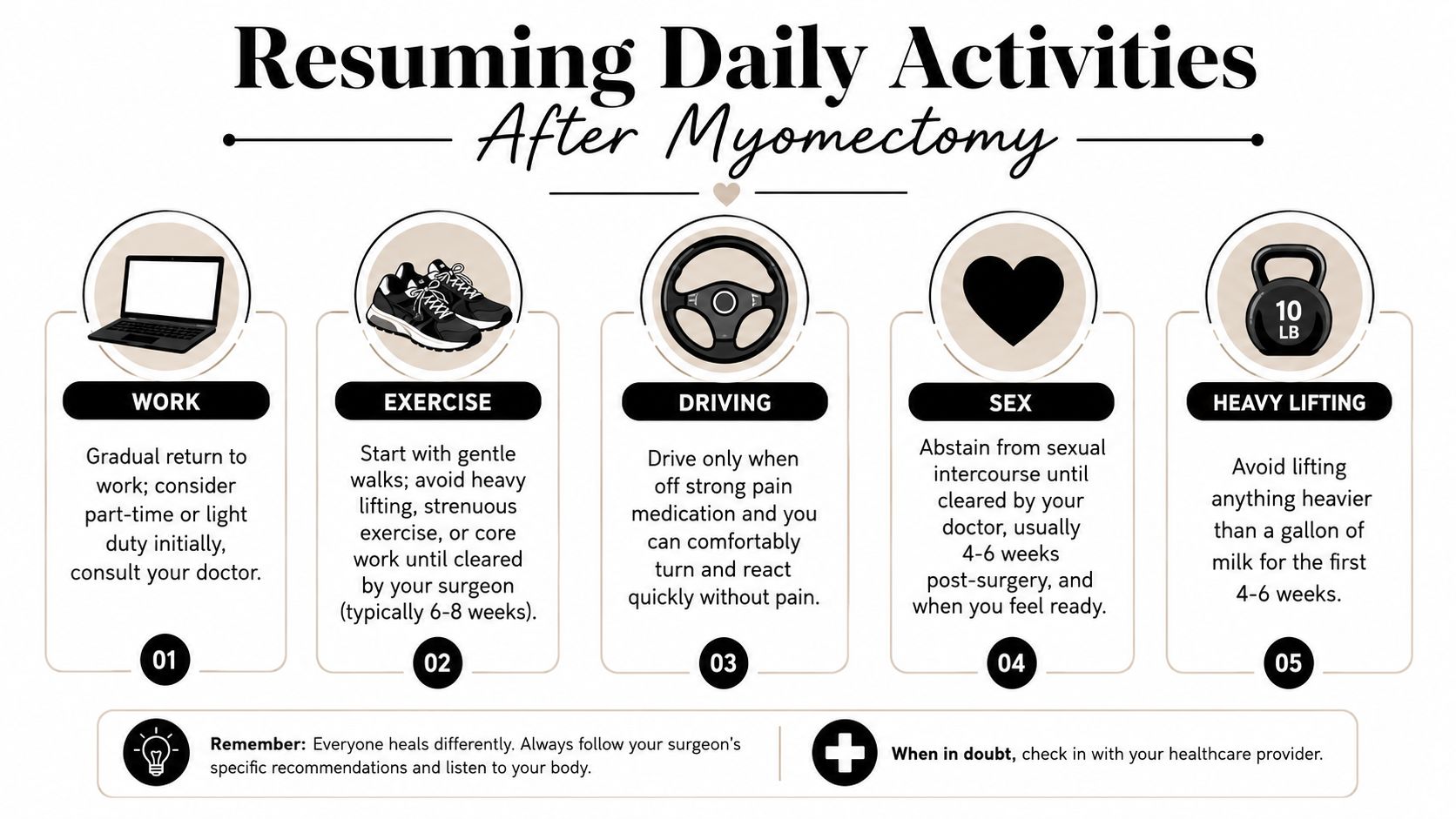
The hard part about going back to normal life is that “normal” doesn't return all at once. Your body may feel ready for a desk shift before it's ready for lifting, or ready for a walk before it's ready for core work. That's why the safest rule is to let the activity match the tissue healing, not the calendar alone.
Work and driving
Many patients are back to work within the first week, but the type of work matters. A desk job is different from a job that requires lifting, reaching, bending, or long standing. If pain medication is still affecting your alertness, driving can wait until you can react quickly and turn comfortably without pain.
Exercise and lifting
Walking usually comes first, and it's the one movement that tends to help rather than irritate. More strenuous exercise, heavy lifting, and core work should wait until your surgeon clears you, because the repaired uterus and abdominal wall need time to regain strength. One practical example many surgeons use is to avoid lifting anything heavier than a gallon of milk during the early recovery phase.
Sex and intimacy
Sexual activity should be based on comfort and your surgeon's clearance, not on pressure to “get back on schedule.” Some postoperative guidance varies, but a common recommendation is to wait about 4 to 6 weeks and to resume only when you feel ready and healed enough for it to be comfortable [^6]. The reason is straightforward, the vagina and uterus both need time before friction or penetration makes sense again.
The timing of these milestones can vary, which is why some patient guidance places return to work and exercise on a wider range than others [^6]. Your own healing, the number of fibroids removed, and the extent of uterine repair matter more than someone else's timeline.
For a related discussion of pelvic muscle recovery and rehabilitation concepts, this guide on pelvic tightening may be useful once you've been cleared for activity.
Long-Term Healing Fertility and Follow-Up Care
The skin may look healed long before the inside feels fully settled. That's normal after uterine surgery, because scar maturation and internal tissue repair take longer than the first external recovery window. The practical takeaway is that feeling “mostly fine” does not always mean every activity is automatically safe again.
Fertility questions deserve a real answer
Patients often want to know when it's safe to try to conceive again, and the honest answer is that it depends on how much repair the uterus needed and what your surgeon saw during the operation. Many doctors advise waiting until healing is complete before trying, because the uterus needs enough time to strengthen before it faces pregnancy-related stretching and pressure. If you were operated on for infertility, the earlier review's 55% pregnancy rate over 10 months to 4 years shows why the long view matters [^1].
Do you need a routine scan
This is one of the least clearly explained parts of recovery. Routine imaging is not indicated for asymptomatic patients at 4 weeks post-op and is usually reserved for persistent or worsening symptoms, or for concern about hematoma, abscess, or incomplete healing [^5]. That helps avoid unnecessary scans when healing is going normally.
What follow-up often focuses on
A follow-up visit is usually less about discovering something dramatic and more about confirming that the course looks right. The surgeon checks how you're tolerating activity, reviews pain control, and decides whether symptoms fit expected recovery. If bleeding, bloating, or fatigue are lingering, the question is not just whether they're present, but whether they're changing in the right direction.
Normal healing should trend toward easier movement, less tenderness, and more stable energy. If the trend reverses, that's when reassessment matters.
Individualized counseling is especially important. Some people need reassurance that symptoms are part of normal recovery, while others need a more specific plan for return to fertility care, exercise, or future pregnancy planning.
Warning Signs and Key Questions for Your Surgeon
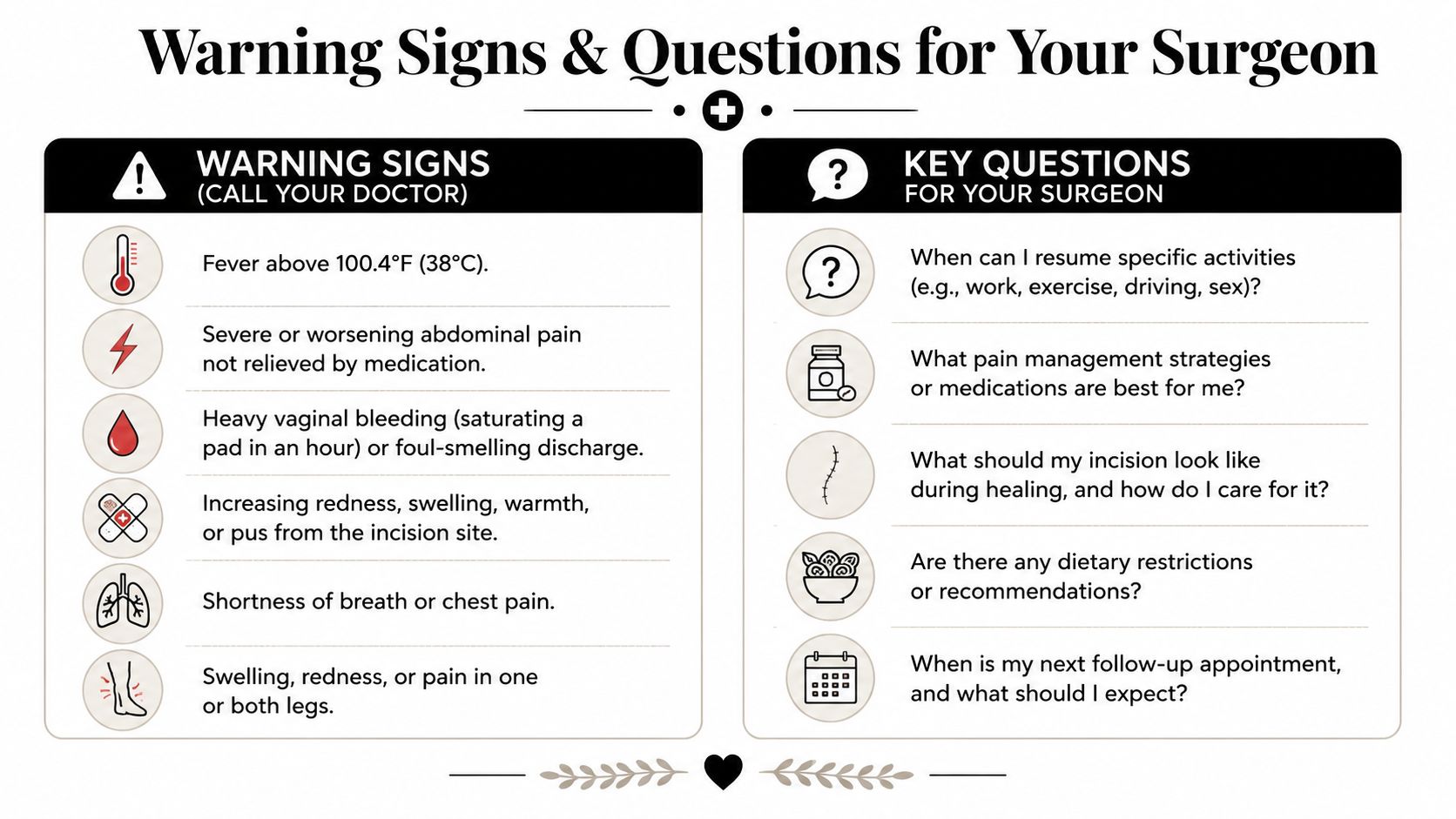
Some symptoms are expected. Others should trigger a call the same day. The cleanest way to think about it is to watch for worsening, not just presence, because normal recovery can include discomfort while complications usually announce themselves by intensifying.
Call your doctor promptly if you notice
- Fever: A temperature above 100.4°F (38°C).
- Pain that escalates: Severe or worsening abdominal pain not relieved by medication.
- Bleeding that feels excessive: Heavy vaginal bleeding or foul-smelling discharge.
- Incision changes: Increasing redness, swelling, warmth, or pus.
- Breathing or chest symptoms: Shortness of breath or chest pain.
- Leg symptoms: Swelling, redness, or pain in one or both legs.
If you're unsure, it's better to ask. A brief call is far cheaper, and far calmer, than waiting until a small issue becomes a bigger one.
Good questions to bring to follow-up
- Activity timing: When can I resume work, exercise, driving, and sex?
- Medication plan: Which pain medicines should I keep using, and for how long?
- Incision care: What should healing look like, and what would concern you?
- Diet and bowel care: Do I need any restrictions or constipation prevention steps?
- Next visit: When should I come back, and what will you check?
If you're still sorting out what feels normal, write down the exact day symptoms started, what makes them better, and what makes them worse. Specific details help your surgeon judge healing much more accurately than a vague “I still don't feel right.”
If you're preparing for surgery or trying to make sense of recovery after one, schedule a consultation with a qualified gynecologic surgeon and bring your questions about activity, pain, fertility, and follow-up imaging with you. The best myomectomy laparoscopic recovery plans are the ones specific to your procedure, your symptoms, and your goals.
