
You had rhinoplasty. At first, you were focused on swelling, bruising, and waiting for the bridge to settle. Then, somewhere in the mirror, you started noticing a new shadow. Maybe it looks like two lines running down from the bridge. Maybe the middle part of the nose seems pinched, or the contour no longer looks smooth. That change can be unsettling, especially when you're not sure whether it's normal healing or a real problem.
That visible change often has a name: inverted V deformity. It's a recognized post-rhinoplasty issue, not a mysterious or rare personal failure. Its common origin lies in a structural change in the middle part of the nose, which means it can be understood clearly and, in many cases, corrected thoughtfully.
Patients do best when they stop guessing and start looking at the nose the way a surgeon does. The question isn't only “What am I seeing?” It's also “What structure underneath the skin changed?” That shift in perspective matters, because surface irregularities and structural collapse are not the same thing.
If you're still choosing a surgeon for a first or revision procedure, credentials and training matter. Start with a board-certified cosmetic surgeon resource and then narrow your search to surgeons with meaningful rhinoplasty experience.
Introduction A Patient's Guide to Post-Rhinoplasty Concerns
Most patients who notice an inverted V deformity first describe it in very ordinary language. They say the bridge looks uneven. They see a dip where the smooth line should be. Some say the nose suddenly looks narrower in the middle, while the upper part seems more defined than expected.
That reaction makes sense. Rhinoplasty patients are looking at their noses more closely than ever, and subtle contour changes can feel huge. But not every postoperative concern is merely swelling, and not every visible line should be dismissed with “give it more time.” A careful exam matters.
Practical rule: If a bridge irregularity looks sharper as swelling improves, or if it comes with new breathing difficulty, it deserves a formal evaluation.
An inverted V deformity is one of those problems that can be both aesthetic and functional. Patients often come in worried about the appearance first, then mention that airflow feels different too. That combination is an important clue.
What Is an Inverted V Deformity
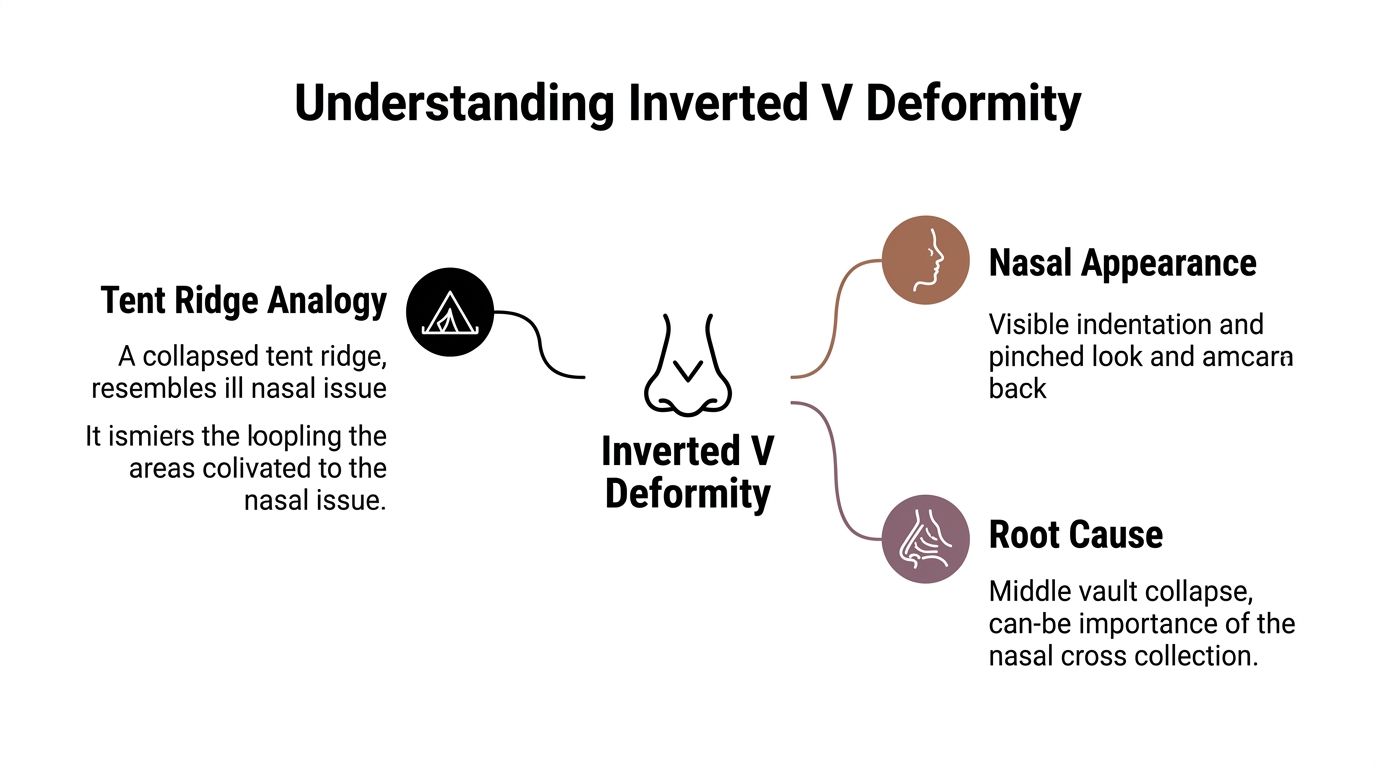
The easiest way to understand an inverted V deformity is to picture the ridge of a tent. If the center support is lowered too much, the fabric on either side loses tension and falls inward. You don't just get a smaller tent. You get visible lines where the shape has collapsed.
The nose behaves in a similar way after certain rhinoplasty maneuvers. Instead of a smooth transition from the nasal bones to the cartilage below, the middle part of the bridge develops a visible indentation or step-off. From the front, that shadow can resemble an upside-down V.
What patients usually see
Patients don't use surgical language at first. They usually notice one or more of these changes:
- A visible shadow on the bridge that wasn't there before
- A pinched middle third of the nose
- A loss of smooth contour between the upper bony bridge and lower cartilaginous bridge
- Sharp edges under thin skin, especially in certain lighting
This is a well-recognized issue after rhinoplasty. The inverted V deformity occurs in approximately 8 to 15% of rhinoplasty cases, and it appears as a visible indentation on the nasal dorsum after dorsal hump removal when the upper lateral cartilages lose support and collapse inward, as described in this clinical overview of post-rhinoplasty inverted V deformity.
A short visual explanation can help make that anatomy easier to grasp.
What it means underneath the skin
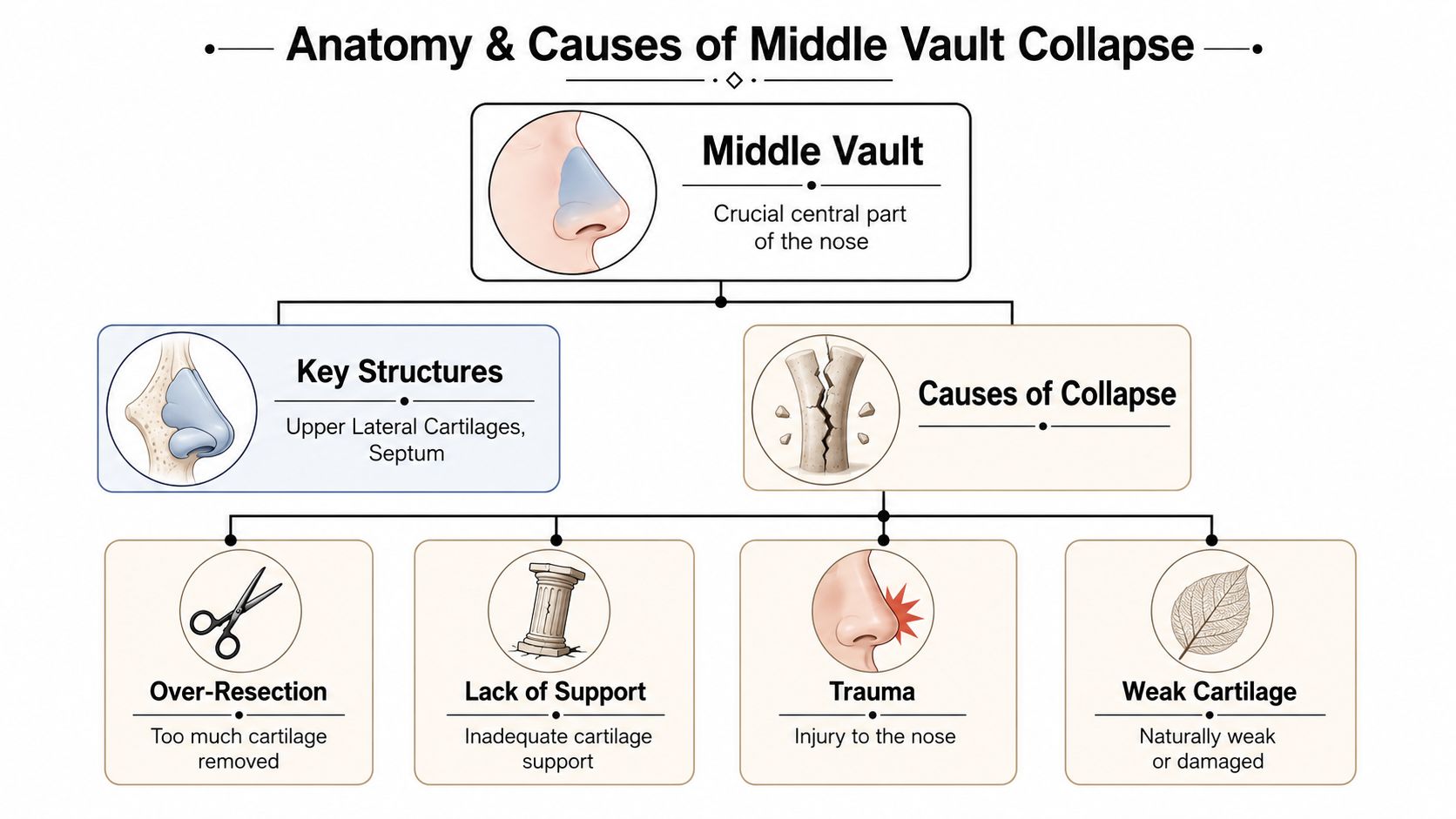
This isn't just a skin-level imperfection. An inverted V deformity is a sign that the middle vault of the nose has lost support. That middle vault is the structural zone that helps maintain both shape and airflow.
That's why patients shouldn't think of this as merely a cosmetic nuisance. When the bridge develops this pattern, the nose is often signaling that deeper support structures have shifted.
A visible contour problem after rhinoplasty is often a structural diagnosis first and an aesthetic diagnosis second.
Anatomy and The Root Causes of Middle Vault Collapse
To understand why this happens, it helps to know the three structures that meet in the middle third of the nose: the nasal bones above, the dorsal septum in the center, and the upper lateral cartilages on each side. These components work together like a joined framework. They don't just sit next to each other. They support one another.
Surgeons often think about this area as a T-frame. When that framework stays intact, the bridge remains smooth and the middle vault keeps its width and stability. When that framework is weakened, the sidewall cartilages can shift inward and lose contact with the bones above.
How hump reduction can create the problem
One of the most common pathways to inverted V deformity is overly aggressive dorsal hump resection. If too much support is removed from the bridge, the upper lateral cartilages are left without the tension and attachment they need. They can then collapse inward, creating the visible depression patients notice on the bridge.
A PubMed-indexed review on middle vault collapse and inverted V deformity describes this as collapse of the upper lateral cartilages after excessive dorsal hump resection, disrupting the dynamic T-frame structure that connects those cartilages to the nasal bones. That structural failure can create a step-off along the bridge and can also narrow the internal nasal valve, which may lead to nasal airway obstruction.
Where osteotomies fit in
Bone work matters too. Osteotomies are controlled fractures used to reposition the nasal bones. They are a routine and important part of many rhinoplasty operations. But they have to be done with precision and in the right context.
If the nasal bones are not repositioned appropriately after hump removal, the bony and cartilaginous parts of the bridge can stop meeting cleanly. That mismatch can leave the sidewall cartilages unsupported and create the classic inverted V appearance.
In plain terms, the roof of the nose has been changed, but not rebuilt in a stable way.
Why this can affect breathing
The upper lateral cartilages don't only shape the bridge. They also help form the internal nasal valve, one of the most important airflow areas in the nose. If those cartilages collapse inward, the passage can narrow.
Patients sometimes say, “My nose looks pinched, and I also can't breathe as well on one or both sides.” That pairing is not accidental. It often points to the same underlying middle vault problem.
When the middle vault collapses, the nose may look narrower, but the real issue is that support has been lost.
Key Risk Factors and Early Warning Signs
Some noses are less forgiving than others. A surgeon can remove the same amount of hump from two different patients and get very different outcomes because anatomy sets the margin for safety.
Patients at higher risk often have features that make middle vault support easier to lose or easier to see through the skin.
Who is more likely to develop it
High-risk anatomy includes:
- Short nasal bones, which provide less overlap and support in the upper bridge
- Thin skin, which makes even small contour irregularities more visible
- Long upper lateral cartilages, which may be more vulnerable if support is disrupted
- A large cartilaginous dorsal hump, especially when reduction is planned aggressively
A separate clinical explanation also notes that patients with short nasal bones and a large cartilaginous dorsal hump deserve careful preoperative assessment because they are more likely to develop this problem if the middle vault isn't supported properly.
What to watch for early
Healing after rhinoplasty is uneven, so patients often struggle to know what deserves concern. These are common warning signs that should prompt a closer look:
- The middle third looks narrower than expected
- A new shadow or groove appears along the bridge
- The bony edges seem more visible under the skin
- Breathing feels tighter after swelling should have improved
- The bridge looks smooth from one angle but sharply broken from another
Not every early asymmetry means permanent deformity. Swelling can distort the bridge for a while. But a true structural problem usually becomes more obvious, not less, as puffiness fades.
Why patients often miss the breathing connection
Many people assume breathing symptoms must come from the septum or turbinates alone. In reality, middle vault collapse can contribute to airflow problems because the sidewall support has weakened. That means the complaint may start as “I don't like how it looks,” but the full diagnosis includes function too.
That matters when planning treatment. Camouflage may soften the appearance, but it won't rebuild support for a narrowed valve.
How Surgeons Prevent Inverted V Deformity
Good rhinoplasty isn't just reduction. It's reconstruction. That's the principle patients should remember when they evaluate a surgeon's plan.
When a hump is lowered, support often needs to be restored at the same operation. If the surgeon removes structure without rebuilding the middle vault, the bridge may look acceptable in the operating room but become unstable later as tissues settle.
The central role of spreader grafts
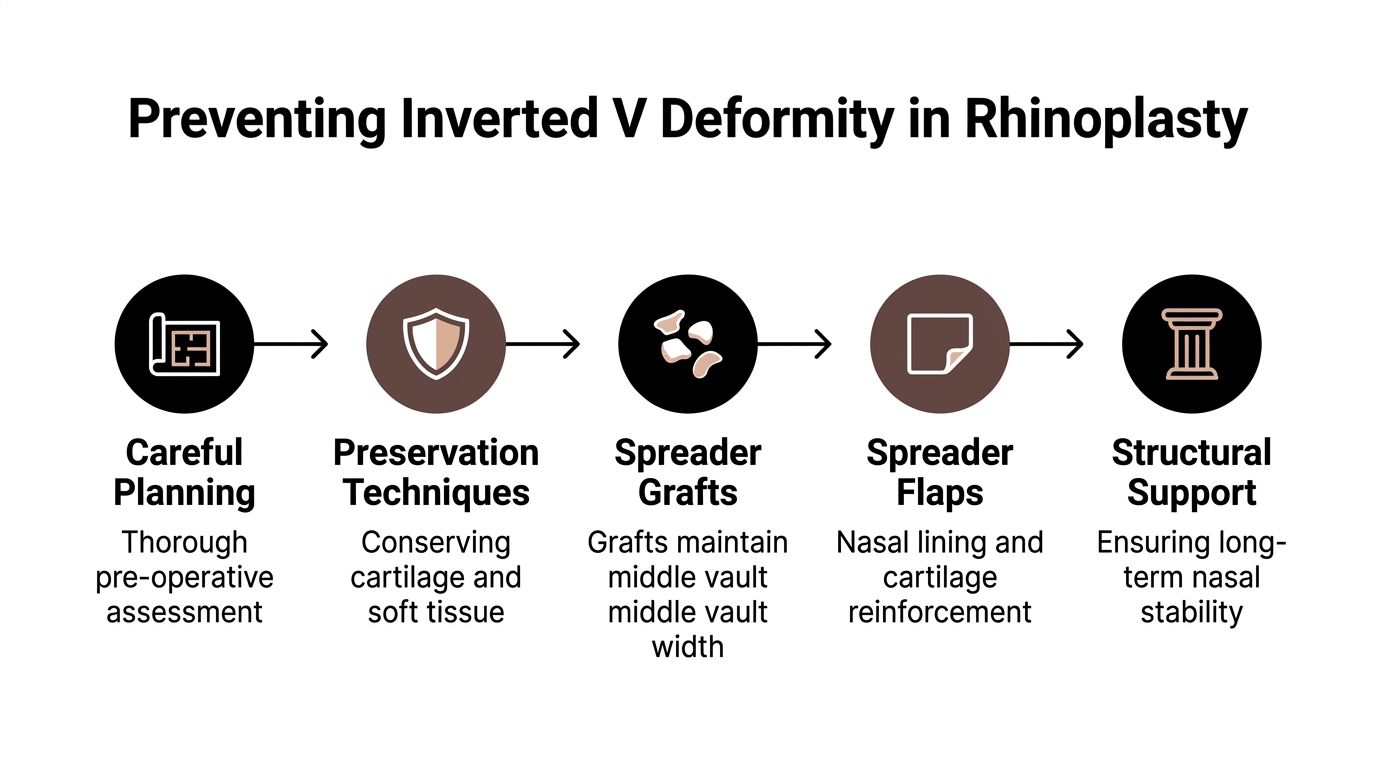
The most reliable preventive tool is the spreader graft. These are small strips of cartilage, often taken from the patient's own septal cartilage, placed between the dorsal septum and the upper lateral cartilages to preserve width and support in the middle vault.
A rhinoplasty prevention overview discussing spreader grafts and risk assessment explains that inverted V deformity can often be avoided during initial rhinoplasty with spreader grafts obtained from the patient's septal cartilage to support the middle third of the nose, particularly in patients with short nasal bones and a large cartilaginous dorsal hump.
Think of spreader grafts as internal support beams. They help keep the sidewall cartilages from falling inward after the hump has been reduced.
Other techniques that matter
Spreader grafts are important, but prevention is not one single maneuver. Experienced surgeons also pay attention to:
- Conservative hump reduction so support isn't removed recklessly
- Balanced osteotomies so the bones and cartilage meet properly after narrowing
- Spreader flaps in selected cases, when native cartilage can be used strategically
- Caudal traction to re-tension the upper lateral cartilages during reconstruction
- Preservation of stable anatomy whenever possible, rather than removing more than necessary
No single technique works in every nose. Prevention depends on matching the plan to the patient's anatomy.
The best rhinoplasty result doesn't come from making the nose smaller. It comes from making it stable.
What patients should ask before surgery
A strong consultation includes a real discussion of middle vault support. Good questions include:
- How do you support the middle vault after hump reduction?
- Do you use spreader grafts or spreader flaps in at-risk noses?
- What in my anatomy makes me higher or lower risk?
- How do you avoid a pinched middle third after surgery?
A surgeon doesn't need to use the same method in every patient. But the surgeon should have a clear structural plan.
Effective Treatment and Revision Options
Once an inverted V deformity is established, treatment comes down to a simple question: do you want to camouflage the shape, or do you want to rebuild the structure?
Those are not the same goal. Patients often benefit from hearing that distinction plainly, because many have already spent months hoping the bridge will soften on its own.
Revision rhinoplasty for structural correction
The most effective correction is usually revision rhinoplasty with spreader grafts. In practical terms, this means reopening or revisiting the operative field, restoring support between the septum and upper lateral cartilages, and rebuilding the smooth line of the bridge.
A revision treatment discussion focused on spreader graft correction and filler camouflage states that the most effective corrective treatment for an established inverted V deformity involves surgical revision rhinoplasty with spreader grafts. In milder cases, temporary filler can be used to camouflage the concavities, but that does not correct the underlying structural problem.
Revision surgery may also include related maneuvers, depending on what else has changed in the nose. Some patients need bone repositioning. Others need dorsal contour grafting. If tip position was affected by middle vault collapse, the operative plan may also address support below the bridge.
This is why revision rhinoplasty requires judgment, not just technical ability. The surgeon has to identify the actual failure point and rebuild it.
Dermal fillers for camouflage
Fillers occupy a different lane. They can be useful in selected mild cases when the patient's priority is improving the visible contour without surgery. By filling the depressions next to the bridge irregularity, a skilled injector can soften the shadow pattern and make the nose look smoother.
But fillers have limits:
- They are temporary
- They do not restore cartilage support
- They do not widen a narrowed internal valve
- They may mask the problem visually while leaving function unchanged
For the right patient, that trade-off is acceptable. For the wrong patient, it creates delay and disappointment.
If the problem is structural collapse, camouflage can change the picture, but it can't rebuild the frame.
Treatment comparison
| Attribute | Revision Rhinoplasty (with Spreader Grafts) | Dermal Fillers |
|---|---|---|
| Primary goal | Rebuild middle vault support | Soften visible indentation |
| Effect on structure | Corrects the underlying collapse | Does not correct the collapse |
| Effect on breathing | May improve airflow when valve narrowing is involved | Does not address structural airway narrowing |
| Longevity | Intended as definitive structural treatment | Temporary camouflage |
| Best use case | Established deformity with visible contour change, functional issues, or both | Mild deformity in patients seeking non-surgical appearance improvement |
| Trade-off | Requires revision surgery and recovery | Avoids surgery but leaves the root problem in place |
Patients considering revision should also understand that secondary surgery is different from a first operation. Tissue planes may be scarred, cartilage may be limited, and the surgical plan often has to be more deliberate. If you're researching secondary procedures in general, this overview of revision surgery considerations gives a useful framework for thinking about how corrective operations differ from primary ones.
What tends not to work
The least effective strategy is passive hope once a true structural deformity has settled in. Time can improve swelling. It does not rebuild collapsed cartilage. Massage won't restore middle vault architecture. Skin care won't smooth a step-off caused by support loss.
That's why diagnosis matters first. Before choosing any treatment, the surgeon should examine the bridge, assess valve function, and determine whether the issue is cosmetic camouflage, structural correction, or both.
Recovery Expectations and Choosing Your Surgeon
Revision rhinoplasty recovery is often similar to primary rhinoplasty, but patients should expect the experience to feel a bit more demanding. Tissues may be tighter, scarred, or less predictable. Swelling can be stubborn, and the nose may take time to declare its final contour.
That doesn't mean revision is a bad idea. It means the timeline has to be respected. Patients do best when they expect steady improvement rather than instant perfection.

Questions worth asking in consultation
A good consultation for inverted V deformity should be highly specific. Ask questions that force the discussion toward structure, not just appearance:
- How do you confirm that this is middle vault collapse and not only swelling or a contour irregularity?
- What graft material would you expect to use in my case?
- Would you recommend open or closed revision for this problem, and why?
- Do you expect my breathing to improve, stay the same, or is this mainly an aesthetic correction?
- Can you show me examples of patients you've treated with similar bridge collapse?
- What features of my anatomy make correction easier or harder?
- If filler is an option, what would it improve, and what would it leave untreated?
How to judge the answers
Look for clarity, not salesmanship. A surgeon with real revision experience should explain the structural problem in plain language, outline trade-offs clearly, and avoid promising perfection.
If you're comparing surgeons, this guide on how to choose a plastic surgeon can help you organize the decision-making process and ask better questions.
A reassuring consultation isn't the one that sounds easiest. It's the one that explains the problem accurately and offers a plan that matches it.
If you're researching surgery, recovery, revisions, or how to compare qualified doctors, Labiaplasty.com offers educational resources designed to help patients ask sharper questions and make more informed decisions before booking a consultation.
