

Some people find this topic after months, sometimes years, of being told that everything “looks normal.” Yet sex hurts. Sitting hurts. A pelvic exam feels unbearable. You may notice burning, pressure, spasms, or a gripping sensation that never seems to switch off. At that point, hearing the word Botox can feel strange, even a little absurd. It's usually associated with the face, not the pelvic floor.
But pelvic floor Botox is not a cosmetic treatment in this setting. It's a medical option used when tight, overactive pelvic floor muscles keep driving pain and dysfunction. For the right patient, it can interrupt a stubborn pain-spasm cycle long enough for more meaningful rehabilitation to begin.
Living with Chronic Pelvic Pain
You might wake up already bracing.
Before your feet even hit the floor, your body is guarding. A tampon feels impossible. Intercourse feels threatening, not intimate. A car ride, a work meeting, or a dinner out can turn into a countdown until you can stand up, shift positions, or go home. Many people with pelvic floor muscle overactivity start organizing their whole day around avoiding pain.
That pattern is exhausting, and it can also be confusing. Chronic pelvic pain doesn't always announce itself clearly. Some people feel deep aching. Others describe burning at the entrance of the vagina, sharp pain with penetration, or a pulling sensation that lingers long after an exam or sexual activity. If that sounds familiar, learning more about pain at the vaginal opening can help you put language to what you're experiencing.
When the muscles become part of the problem
Pelvic floor muscles are supposed to tighten and relax in coordination. When they stay clenched for too long, they stop acting like flexible support muscles and start acting like a fist that never opens. That can contribute to painful sex, difficulty with pelvic exams, trouble emptying the bowels, urinary symptoms, and a constant feeling of tension or pressure.
People often assume pain means weakness. In pelvic floor dysfunction, the opposite can be true. The muscles may be too active, too guarded, and too reactive.
Chronic pelvic pain can make ordinary activities feel risky, even when no one else can see what your body is doing.
Why Botox enters the conversation
By the time Botox pelvic floor treatment comes up, most patients have usually tried simpler options first. They may have done pelvic floor physical therapy, used dilators, modified activities, or tried medications. Botox is typically considered when the muscles remain stuck in spasm and pain keeps blocking progress.
The idea is not to erase the whole condition in one appointment. The idea is to reduce the muscle overactivity enough that the body can start tolerating movement, touch, therapy, and retraining again.
How Pelvic Floor Botox Works
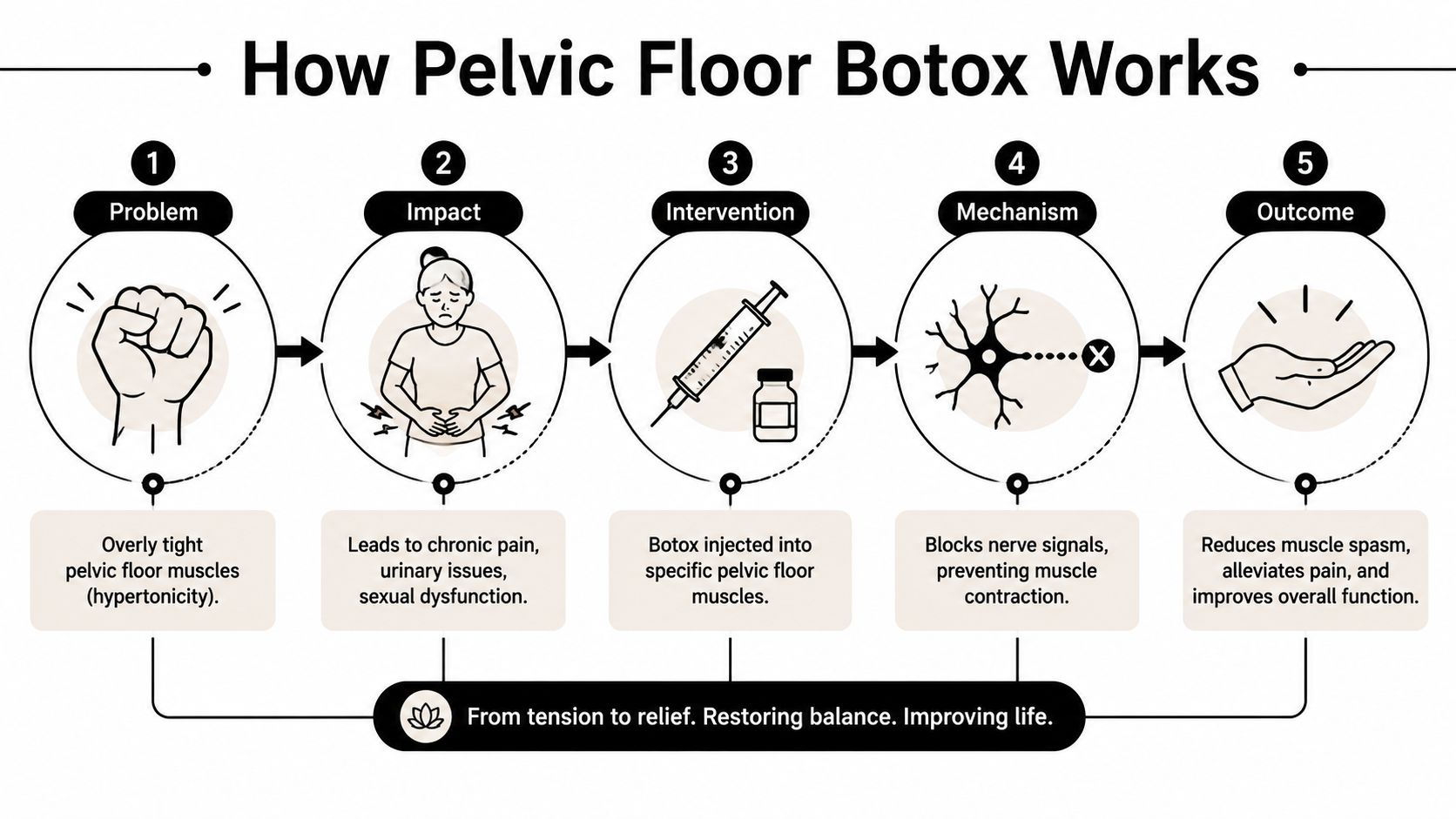
The simplest way to understand pelvic floor Botox is to think of it as a dimmer switch, not an off switch.
When pelvic floor muscles are overactive, the nerves keep sending “contract” signals. Botox reduces those signals in the targeted muscles. That temporary quieting can soften spasm, lower guarding, and create less resistance during therapy, penetration, and daily movement.
What it does and what it doesn't do
Botox doesn't “fix” the pelvis in a permanent way. It doesn't rebuild coordination, restore normal breathing patterns, or teach the muscles how to lengthen and contract well. What it can do is make the muscles less locked down for a period of time.
That matters because pain often creates more guarding, and guarding creates more pain. Once that loop gets established, even a skilled therapist may have trouble making progress if every touch triggers another spasm.
A good mental model is this:
- The tight muscle problem: Your pelvic floor is acting like a hand that keeps clenching.
- The Botox effect: The nerve signal to clench gets turned down.
- The short-term result: The hand can open more easily.
- The opportunity: You can then work on flexibility, control, and retraining while the muscle is less reactive.
Why the timing matters
The effect is temporary. Clinical summaries note that the therapeutic effect of Botox for pelvic floor conditions typically lasts 3 to 6 months, which is why repeat treatment may be needed for some patients according to this overview of pelvic floor Botox duration and retreatment.
That temporary window is easy to misunderstand. Some people hear “muscle relaxation” and expect a cure. A better expectation is this: Botox pelvic floor treatment can create a period where progress becomes possible, especially if pain and spasm were blocking everything else.
Practical rule: If Botox makes physical therapy possible when it previously felt unbearable, it's doing one of its most important jobs.
Why people get confused about “paralysis”
Patients sometimes worry that Botox means total loss of function. In practice, the intent is targeted relaxation, not complete shutdown. A trained clinician tries to identify the muscles contributing most to the tension pattern and inject those areas strategically.
That said, the treatment still has to be respected. If the muscle is relaxed too much, symptoms can shift in ways that surprise patients. That's one reason counseling matters so much before the procedure.
Who Is a Good Candidate for This Treatment
The best candidate usually isn't someone looking for a shortcut. It's someone whose symptoms point to high-tone pelvic floor dysfunction, meaning the muscles are too tense, too tender, or too reactive, and that tension is playing a central role in pain.
Common clinical patterns include vaginismus, pelvic floor myofascial pain, levator ani tension, vulvodynia with muscle guarding, and chronic pelvic pain that hasn't responded well enough to conservative care alone. Many of these patients describe pelvic exams as intolerable, intercourse as painful, or any attempt at internal therapy as too triggering to continue.

Signs you may fit the typical profile
A clinician may consider Botox pelvic floor treatment if your story sounds like this:
- Pelvic floor muscles feel guarded on exam: The provider notices marked tightness, tenderness, or spasm.
- Pain blocks therapy: You want to do treatment, but internal physical therapy, stretching, or dilator work is too painful to tolerate.
- Symptoms cluster around muscle overactivity: Pain with penetration, pelvic pressure, aching after sitting, and difficulty relaxing are more prominent than true weakness.
- Conservative care helped only partway: You've tried therapy or self-care, but the muscles keep snapping back into the same pattern.
If vestibule pain is part of the picture, some patients also explore related conditions such as treating vulvar vestibulitis because entrance pain and pelvic floor guarding often overlap.
Who may not be a good fit
Botox is usually a poorer match when the core problem is weakness rather than overactivity. Someone with an already underperforming pelvic floor may not benefit from a treatment that relaxes muscle further. It also requires caution in people with mixed symptoms, especially if they already struggle with leakage or bowel emptying problems.
A careful clinician also reviews broader medical issues, including neurological or neuromuscular concerns, medication history, prior reactions, and whether the symptoms really map to muscle spasm in the first place.
A good candidate has a clear tension pattern. A poor candidate often has a different pelvic floor problem that Botox won't solve, or could even aggravate.
The most useful mindset
The strongest candidates usually understand one thing from the start. This treatment is a tool, not a finish line. People tend to do best when they're ready to use the temporary relief to build lasting change through guided rehabilitation.
The Pelvic Floor Botox Procedure Step by Step
The procedure sounds intimidating until you know what usually happens. Most of the fear comes from not knowing the sequence.
Before the procedure
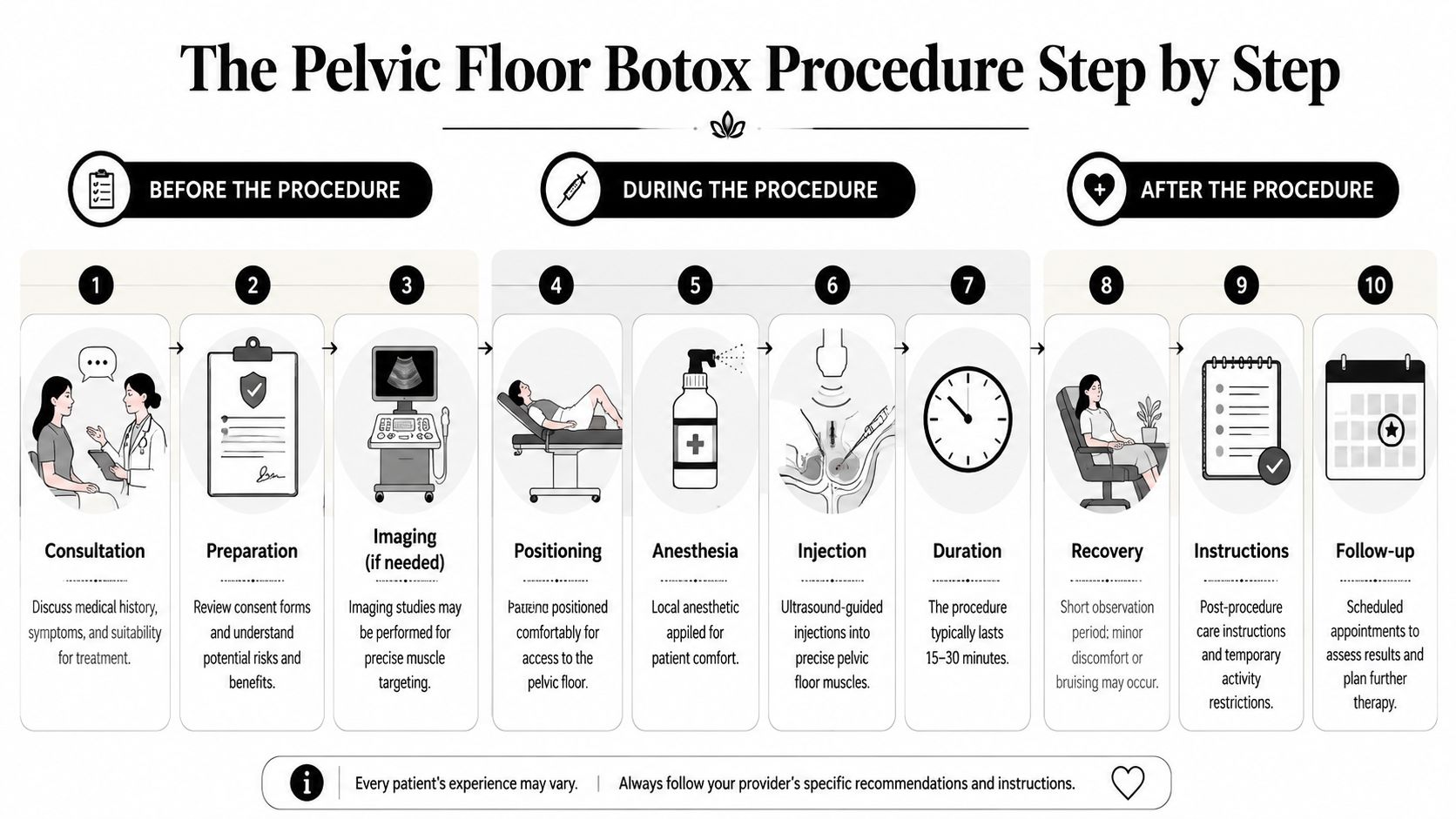
The process starts with a consultation, not an injection. Your clinician takes a symptom history, asks what you've already tried, and performs an exam if you can tolerate one. The goal is to confirm that tight pelvic floor muscles are a major driver of your pain.
Preparation often includes:
Reviewing your symptom pattern
Pain with intercourse, pelvic exams, bowel movements, prolonged sitting, or tampon use can all help guide the evaluation.Discussing prior treatments
Your clinician will want to know how pelvic floor physical therapy, medications, dilators, or trigger point work have gone.Going through consent and expectations
A good provider should explain both the upside and the possibility of side effects, including the paradox of too much relaxation.
Some clinicians use additional guidance techniques for targeting specific muscles. Others rely on exam findings and anatomical landmarks.
During the injections
The exact setup varies by practice, but the purpose stays the same. The clinician identifies the pelvic floor muscles contributing to the tension pattern and injects Botox into those specific areas.
Patients often ask what the appointment feels like. In plain terms, it's usually more awkward than dramatic. Positioning matters because the provider needs safe access to the pelvic floor. Depending on the setting, local anesthetic or another comfort strategy may be used.
A simple way to think about the procedure:
- Positioning: You're placed so the pelvic floor muscles can be reached safely.
- Targeting: The provider identifies the muscles that feel most overactive or tender.
- Injection: Botox is placed into the selected muscles in small amounts.
- Observation: You're monitored briefly afterward before going home.
After the appointment
The first day or two can involve mild soreness, pressure, or a strange sense that the pelvic floor feels different. That doesn't mean something has gone wrong. Your body is adjusting to a muscle pattern it may not have felt in a long time.
Many clinicians recommend a short period of reduced activity right after treatment, then a return to therapy or guided rehabilitation once the area settles. What matters most is not just recovering from the injections, but using the next phase wisely.
The procedure is only one event. The rehabilitation that follows is where many patients make the treatment count.
A practical question to ask before booking is: “What's the plan after the injections?” If the answer doesn't include follow-up and physical therapy, your expectations may need to be reset.
Efficacy and Expected Outcomes
Patients usually ask the same direct question. Does it work?
The honest answer is that it can help significantly in the right setting, but it isn't universal and it isn't a cure. The goal is meaningful improvement in pain, muscle tension, and function, not a promise that every symptom disappears.
What the published study showed
In a prospective pilot open-label study of women with high-tone pelvic floor dysfunction, 61.9% of participants reported improvement at 4 weeks, and 80.9% reported improvement at 8, 12, and 24 weeks after injection compared with baseline, according to the PubMed study on electromyography-guided Botox for high-tone pelvic floor dysfunction. The same study also found significant decreases in vaginal resting pressures on manometry at all follow-up visits.
That matters because it shows two things at once. Patients reported feeling better, and objective muscle measures moved in the same direction.
What “improvement” really means
Improvement in pelvic pain care is broader than a pain score alone. It can mean:
- Less guarding during touch or exams
- Reduced pain with intercourse
- More tolerance for internal physical therapy
- Less muscle tenderness
- Better day-to-day function
Clinical summaries also describe reductions in pain scores after pelvic floor Botox and note that many sexually active participants reported less dyspareunia over time in selected groups. That doesn't mean every patient regains pain-free intimacy right away. It means the treatment may lower the barrier enough for rehab and desensitization work to move forward.
Quality of life matters too
The pilot study didn't just track symptom change. It also reported significant improvement in quality-of-life measures. Physical and mental health survey scores improved by the later follow-up period in that study, suggesting that successful treatment can affect more than one symptom cluster when pelvic floor overactivity has been driving daily distress.
Success often looks like this: you can finally participate in treatment, tolerate more activity, and feel less trapped by your symptoms.
What not to expect
A common mistake is treating a good response as proof the whole condition has been solved. It hasn't. If your pelvic floor has spent a long time protecting, bracing, and reacting, that pattern usually needs retraining.
That's why a realistic outcome is not “one procedure and done.” A more grounded expectation is temporary symptom relief that opens the door to longer-term progress.
Risks Side Effects and Contraindications
Botox pelvic floor treatment gets oversimplified as “just relaxing tight muscles.” That framing leaves out an important truth. A muscle can be relaxed too much.
When that happens, the very treatment meant to reduce pain can create a different problem. This is the under-discussed part of counseling, and patients deserve to hear it plainly before they consent.
The paradox of over-weakening
Pelvic floor muscles help with continence and bowel function. If Botox reduces tension more than expected in the wrong setting, you may notice worsened leakage, trouble controlling urine, constipation, or a sense of incomplete emptying.
That surprises many patients because they assume relaxing a tight muscle can only help. In reality, pelvic floor function depends on balance, not just looseness.
One study reported adverse events including worsening constipation in 28.6% of patients and new onset stress urinary incontinence in 4.8% of patients after treatment. Those findings are already reflected in the earlier evidence section, and they support careful patient selection and careful counseling.
Side effects patients should ask about directly
Instead of asking only, “Is it safe?” ask more specific questions.
- Could this worsen leakage? This is especially important if you already have any degree of urinary incontinence.
- Could bowel symptoms get worse before they get better? Patients with constipation or evacuation difficulty should discuss that openly.
- What happens if the muscle relaxes too much? The answer should include how long the effect may last and how symptoms are managed while it wears off.
- How will we tell whether I'm a poor candidate? A strong consultation should include this, not just a list of benefits.
Some side effects happen because the treatment worked too broadly for that patient's functional needs.
Contraindications and caution areas
Certain people shouldn't move forward, or should do so only after a very careful medical review. Pregnancy, breastfeeding, prior serious reactions to botulinum toxin, and some neuromuscular disorders are common examples where clinicians may advise against treatment or proceed with extra caution.
Even outside those groups, mixed symptom patterns deserve a closer look. If you have both tightness and leakage, or pelvic pain plus bowel dysfunction, Botox may still be discussed, but the conversation should be more nuanced than “your muscles are tight, so let's relax them.”
A thoughtful plan weighs one question above all: Will reducing this tension improve function overall, or just trade one problem for another?
Alternatives and The Role of Physical Therapy
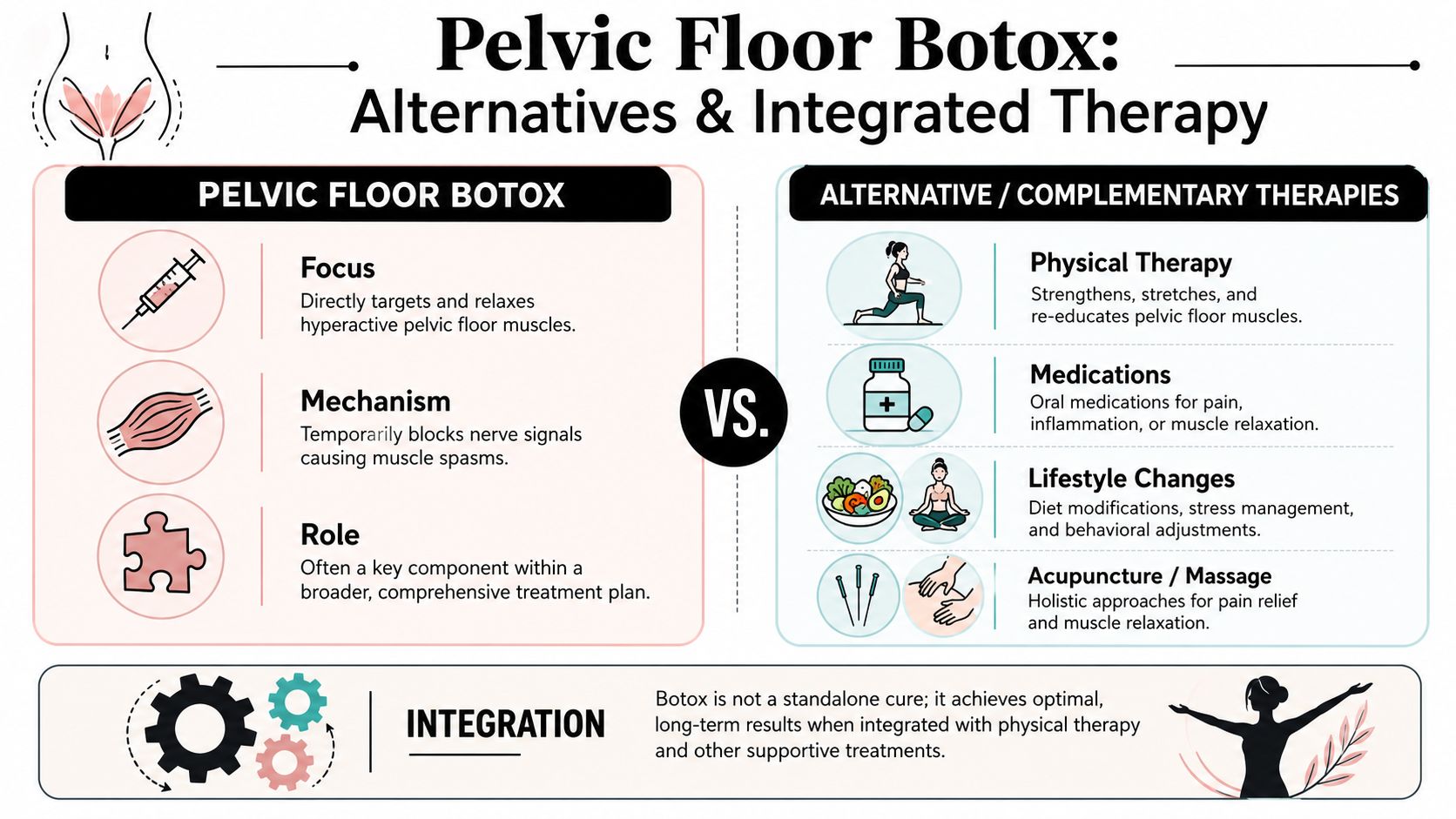
The most helpful way to frame Botox pelvic floor treatment is as part of a larger plan.
If the muscle spasm is so intense that you can't tolerate internal work, touch, or stretching, Botox may create a temporary opening. But if no one uses that opening for rehabilitation, the underlying pattern often returns. A clinical overview for patients notes that Botox is most effective as a temporary bridge to physical therapy, and that without concurrent pelvic floor PT, muscles often revert to their dysfunctional state within 3 to 6 months after the effect wears off, as explained in this discussion of Botox as a bridge to pelvic floor therapy.
What physical therapy does that Botox can't
Botox can reduce overactivity. It can't teach coordination.
Pelvic floor physical therapy addresses the skills underneath the symptom pattern, such as:
- Lengthening: Learning how to let go of chronic tension.
- Control: Contracting and relaxing on purpose, rather than staying in a guarded state.
- Breathing integration: Reconnecting the pelvic floor with abdominal pressure management and diaphragm movement.
- Desensitization: Gradually reducing the threat response around penetration, exams, or specific movements.
That's why some patients feel disappointed after an initially promising procedure. The pain may soften, but if rehab doesn't follow, the old muscle behavior often returns.
Other options that may be part of care
Not everyone needs Botox. Depending on the diagnosis, treatment may also include:
- Pelvic floor PT alone, especially if symptoms are milder or the patient can tolerate treatment
- Vaginal dilators, used gradually and strategically
- Medication support, when a clinician feels it fits the pain pattern
- Behavior and lifestyle work, including bowel habits, stress regulation, and avoidance of repeated guarding triggers
Some people also ask whether “tightness” means they should focus on strengthening. In many pelvic pain cases, that can backfire if the muscles are already overactive. Resources discussing how to tighten vagina muscles can be useful for understanding the difference between healthy muscle function and having more tension.
Botox can open the door. Physical therapy teaches your body how to walk through it.
The key mindset shift
If you're hoping for a single procedure to permanently reset chronic pelvic pain, Botox will probably disappoint you. If you see it as a strategic tool that lowers the alarm enough for real retraining to happen, it makes much more sense.
Frequently Asked Questions About Pelvic Floor Botox
| Question | Answer |
|---|---|
| Does pelvic floor Botox hurt? | The experience varies. Most patients describe the process as uncomfortable rather than unbearable, and clinicians often use comfort measures to make the injections more tolerable. |
| How quickly will I notice a change? | Some people notice change gradually rather than all at once. The improvement often unfolds over the following days to weeks rather than immediately after the appointment. |
| Will I be able to have sex right away? | Many clinicians recommend waiting until initial soreness settles and then resuming based on comfort and medical advice. If intercourse has been painful for a long time, returning usually works best as part of a guided rehab plan. |
| Will I need more than one treatment? | Some patients do. The effect is temporary, so repeat injections may be discussed if you benefited and symptoms later return. |
| Is this a cure for chronic pelvic pain? | No. It may reduce muscle-driven pain and spasm, but it doesn't correct the underlying coordination, strength, and nervous system patterns by itself. |
| Will insurance cover it? | Coverage varies widely by diagnosis, plan, and provider. It's worth checking both procedure coverage and whether pelvic floor physical therapy is also included, since the two often work best together. |
If you're researching intimate health procedures and want clear, patient-friendly education, Labiaplasty.com offers practical guides, recovery information, and a doctor directory to help you prepare for informed conversations with qualified providers.
