

So, what does at-home vaginal rejuvenation really mean? It’s a broad term for any non-surgical method you can use in the privacy of your own home to address common concerns like muscle tone, lubrication, or physical changes after childbirth or menopause.
These solutions, which range from simple pelvic floor exercises to various consumer devices, have become a popular and discreet alternative to in-clinic procedures for women wanting to take control of their intimate wellness.
The Truth About At-Home Vaginal Rejuvenation

The conversation around female intimate health is finally opening up. What was once confined to a doctor’s office is now a mainstream topic, and it’s fueling a booming market for at-home solutions. This isn’t just about aesthetics; it’s driven by a powerful desire for privacy, personal control, and non-invasive options to manage the very normal changes that happen throughout life.
This interest is creating explosive market growth. The global vaginal rejuvenation market is on track to hit an estimated $14.34 billion by 2030, expanding at a compound annual growth rate of 22.07% between 2024 and 2030. This growth is largely fueled by new technologies and a rising demand from women seeking help with everything from post-childbirth recovery to age-related changes. You can see how these market trends and their drivers paint a clear picture of this expanding field.
Why Is This Trend Happening Now?
A few key factors are driving the search for at-home options. Women are now more openly discussing issues that were once considered taboo, from pelvic floor weakness and urinary leakage to changes in sexual sensation. At the same time, the internet has made it possible for anyone to research their concerns and discover potential remedies from the comfort of home.
This shift has created a huge demand for solutions that fit modern life. Many women want to address their intimate health without the cost, recovery time, or potential risks that come with surgery. For them, at-home methods feel like an accessible and logical first step.
Think of it like this: just as you might use targeted skincare at home to maintain facial skin health, at-home rejuvenation methods are positioned as tools for maintaining intimate tissue health and muscle function.
Setting Realistic Expectations
But with this rise in popularity comes a critical need for honesty and caution. The term "vaginal rejuvenation" itself can be very misleading, as it lumps together everything from simple muscle exercises to sophisticated electronic devices. It is absolutely essential to understand that these methods are not one-size-fits-all, and their results can vary dramatically.
The goal of this guide is to help you navigate this complex landscape. We’ll break down the science behind the most popular at-home methods, see how they stack up against professional treatments, and give you a clear framework for making safe, informed choices. We're here to separate genuine wellness tools from overhyped marketing, giving you the knowledge to confidently pursue your personal health goals.
Understanding Your At Home Rejuvenation Options

The market for at-home vaginal rejuvenation is crowded, and it's easy to feel lost in the sheer number of products promising results. Each method is designed to address different concerns, and they all come with varying levels of scientific backing and required commitment.
To make an educated decision, it’s critical to understand what each approach can realistically achieve. Let’s break down the three main categories you'll encounter: foundational muscle exercises, topical solutions, and advanced home-use devices.
Mastering Your Muscles With Pelvic Floor Exercises
The single most fundamental and clinically supported method for improving internal vaginal tone is strengthening the pelvic floor. This group of muscles acts like a supportive hammock or sling at the base of your pelvis, holding your bladder, bowel, and uterus in place.
When this muscular "hammock" is strong, it provides better organ support and functional control. Weakness—often caused by childbirth, aging, or significant weight fluctuations—can lead to problems like urinary incontinence and a sensation of internal looseness.
Kegel exercises are the cornerstone workout for this muscle group, but correct form is everything.
- Finding the Right Muscles: To identify your pelvic floor, try to stop your stream of urine mid-flow. Those are the muscles you need to isolate. Do not do this regularly; it's just a one-time trick to learn the feeling.
- The Sensation: A proper Kegel should feel like an internal "lift and squeeze," pulling your pelvic organs upward and inward. You should not be clenching your glutes, thighs, or abdominal muscles.
- Breathing is Key: Never hold your breath. Breathe freely and deeply to ensure you're isolating the correct muscles without creating tension elsewhere in your body.
It’s a bit like learning to wink without scrunching up your entire face. At first, you might squeeze everything, but with practice, you learn to isolate just the eyelid—or in this case, just the pelvic floor—for a precise and effective contraction.
Once you’ve mastered the basic movement, you can introduce tools to make the workout more effective. Kegel weights, also called vaginal cones, add resistance to your exercises, much like using dumbbells for bicep curls. This progressive overload can help you build strength faster. For a more detailed guide, you can learn more about how to properly tighten your vaginal muscles with these targeted exercises.
For a more high-tech approach, biofeedback devices connect to a smartphone app to provide real-time data on your contractions. They measure the strength and accuracy of each squeeze, turning your exercises into a trackable, guided workout session.
Topical Gels And Creams For Temporary Effects
Another popular category includes topical products like gels, serums, and creams. These are primarily formulated to address two common concerns: vaginal dryness and a temporary feeling of tightness.
The star ingredient in many of these products is hyaluronic acid, a powerful humectant that can hold many times its weight in water. When applied to vaginal tissues, it draws in moisture, providing excellent lubrication and a temporary plumping effect. This can make tissues feel fuller and more elastic, which often eases discomfort during intercourse caused by dryness.
It is vital, however, to have realistic expectations about what these topicals can and cannot do.
- They are not a permanent fix. Any effects last only as long as you continue to use the product.
- They do not build muscle. No cream or gel can strengthen the pelvic floor or reverse significant tissue laxity.
- They do not stimulate long-term collagen. While they hydrate the surface, they do not fundamentally restructure the underlying tissues.
Think of these creams like a high-end facial moisturizer. They deliver immediate hydration and a temporary "glow," but they don't change your underlying facial muscles. They are an excellent tool for managing surface-level symptoms like dryness but are not a substitute for muscle-strengthening exercises or clinical procedures.
At Home Devices Using Light And Energy
The most advanced category in at-home rejuvenation involves devices that use technologies like low-level red light therapy (LLLT) or radiofrequency (RF) energy. These are engineered to go beyond simple hydration or muscle toning.
The core concept is to gently and safely warm the deeper layers of the vaginal tissue. This controlled thermal energy is intended to trigger the body's natural healing response, which includes stimulating the production of new collagen and elastin.
- Collagen is the protein that provides structure and firmness to tissue.
- Elastin gives tissue its flexibility and ability to "snap back."
By encouraging the body to create more of these foundational proteins, these devices aim to improve tissue elasticity, enhance natural lubrication, and heighten sensation over time. It's important to remember that at-home versions use significantly lower energy levels than their in-clinic counterparts. This means results are much more subtle and require consistent, long-term use to see any benefit.
When we talk about at-home vaginal rejuvenation, it’s easy to get swept up in slick marketing. To get a clear picture, we have to look past the promises on the box and dig into what the science actually says, especially for home devices using technologies like radiofrequency (RF). These tools claim to stimulate collagen by applying gentle heat, but what can they realistically accomplish?
Most of the solid clinical evidence for these technologies comes from studies on professional, in-clinic machines—which are far more powerful than anything you can buy for home use. Still, the underlying principles are similar, so these studies give us a valuable window into potential effects and realistic timelines.
What the Clinical Data Really Means
Scientific studies can be dense, but the numbers tell a story. Let's translate what the statistics mean for you. A key study on professional-grade RF treatments gives us a good benchmark for how results develop over time.
In one trial, 67% of patients saw an improvement in vaginal laxity after just one month. By the six-month mark, that number jumped to 87%. Another study showed that 43.5% of women in the RF group reported no laxity at all after six months, compared to only 19.6% in the group that received a placebo. These figures tell us that results aren't instant; they build progressively as the body generates new collagen. You can review the full research on these RF treatment findings to see the data for yourself.
It's critical, however, to understand the massive difference in power between professional and at-home devices. The impressive results from clinical trials are achieved with high-energy machines operated by trained medical professionals.
Think of it like this: a professional oven in a bakery and your kitchen microwave both use energy to heat things. But the power, precision, and final results are worlds apart. A baker can achieve a perfect crust that a microwave simply cannot replicate.
In the same way, in-clinic RF and laser devices deliver a potent, controlled dose of energy deep into the tissue to create significant, lasting structural changes. At-home devices are designed for safety first, which means they operate at a much lower energy level. Their effects are, by necessity, far more subtle and require dedicated, consistent use over a long period to see even modest improvements.
Before we compare the specifics, here is a table summarizing the fundamental differences between what you can do at home and what a specialist can do in the clinic.
At-Home Methods vs. Professional Procedures
| Factor | At-Home Methods (Exercises, Creams, Devices) | In-Office Procedures (Labiaplasty, Clinic RF/Laser) |
|---|---|---|
| Cost | Lower initial cost ($100 – $600) | Higher upfront cost ($3,000 – $12,000+) |
| Invasiveness | Non-invasive to minimally invasive | Minimally invasive (RF/laser) to surgically invasive (labiaplasty) |
| Results | Subtle, gradual, and require ongoing maintenance | Dramatic, targeted, and often long-lasting or permanent |
| Concerns Addressed | Mild laxity, dryness, minor sensation changes | Significant laxity, asymmetry, excess tissue, functional issues |
| Safety | Relies entirely on correct user application; risk of burns or masking issues | Performed by a trained medical professional in a controlled environment |
| Permanence | Temporary; benefits fade if use is discontinued | Long-lasting to permanent, especially with surgical procedures |
This table makes it clear that at-home and in-office treatments are in completely different categories. One is for mild, self-managed improvements, while the other is for achieving significant, medically supervised structural and functional change.
Realistic Timelines for At-Home Devices
If you choose an at-home device, patience and consistency are non-negotiable. While some users might report slight changes in moisture or sensation within weeks, any real structural improvement tied to collagen remodeling takes much longer.
Initial Phase (1-3 Months): You may notice better hydration or a subtle improvement in sensation. This is often due to the immediate effect of increased blood flow from the device's thermal energy.
Collagen Building Phase (3-6 Months): This is the window where you might start to see more noticeable changes in tissue resilience and elasticity, but only if the device has successfully triggered new collagen growth (neocollagenesis).
Maintenance Phase (6+ Months): Any benefits you’ve gained will require consistent, ongoing use to maintain. The natural aging process doesn't stop, and collagen will continue to degrade over time without continued stimulation.
A Clear-Eyed View of the Risks
While at-home devices are built to be safer than their clinical counterparts, they are not risk-free. The main danger comes from improper use, which can lead to real harm.
Potential risks include:
- Burns and Scarring: Using a device for too long, at too high a setting, or using a faulty product can cause thermal damage to delicate tissue.
- Aggravating Existing Conditions: Using a device without getting a proper diagnosis could easily worsen an underlying issue like an infection or skin condition.
- Masking a Serious Problem: Trying to self-treat symptoms like unusual pain, bleeding, or significant laxity could delay the diagnosis of a serious medical condition that needs a doctor's attention.
It’s essential to have a balanced perspective. The technology behind at-home devices is rooted in sound clinical science, but the power limitations and risk of user error demand that you manage your expectations. Safety must always come first.
At Home Options vs. Professional Procedures
Trying to decide between an at-home method and a professional procedure can feel like a major fork in the road. The truth is, they aren't just different paths to the same destination—they lead to entirely separate outcomes. They are designed for different goals, use different levels of technology, and produce vastly different results.
Think of it this way: at-home options are like following a general fitness app, while in-office procedures are like working with a specialist trainer who has access to an entire gym of professional equipment. Both have their place, but you wouldn't expect the same results from both.
At-home vaginal rejuvenation—things like Kegel exercises, topical creams, and the consumer devices you see online—are almost entirely focused on internal, functional improvements. Their goal is to gently improve muscle tone, provide some surface-level moisture, and support tissue health over a long time. These are for maintenance and very minor enhancements you manage yourself.
Professional procedures, on the other hand, are designed to create significant, targeted changes that at-home methods simply can't deliver. These are broken down into two main categories: non-surgical and surgical.
Comparing In-Clinic and At-Home Technologies
Professional non-surgical treatments, like in-clinic radiofrequency (RF) or laser therapy, often use the same type of technology as at-home devices but at a much, much higher energy level. A medical-grade machine, operated by a trained specialist, delivers a powerful, controlled dose of thermal energy deep into the vaginal tissue. This triggers a far more robust collagen and elastin response, leading to dramatic and measurable improvements in laxity and function.
Surgical procedures, however, are in a class of their own because they address anatomical structure directly.
A procedure like labiaplasty, for instance, has nothing to do with internal muscle tone or moisture. It's a surgical solution designed to physically alter the size or shape of the labia, addressing aesthetic concerns or functional problems like chafing and discomfort that no cream or device could ever fix.
If you are considering surgery to address these kinds of issues, you can learn more about how vaginal rejuvenation surgery differs from other options. The distinction is critical: at-home methods work on internal function, while surgery alters external form.
No matter what you're considering, safety has to be your number one priority. This simple decision tree is a good rule of thumb for any at-home device.
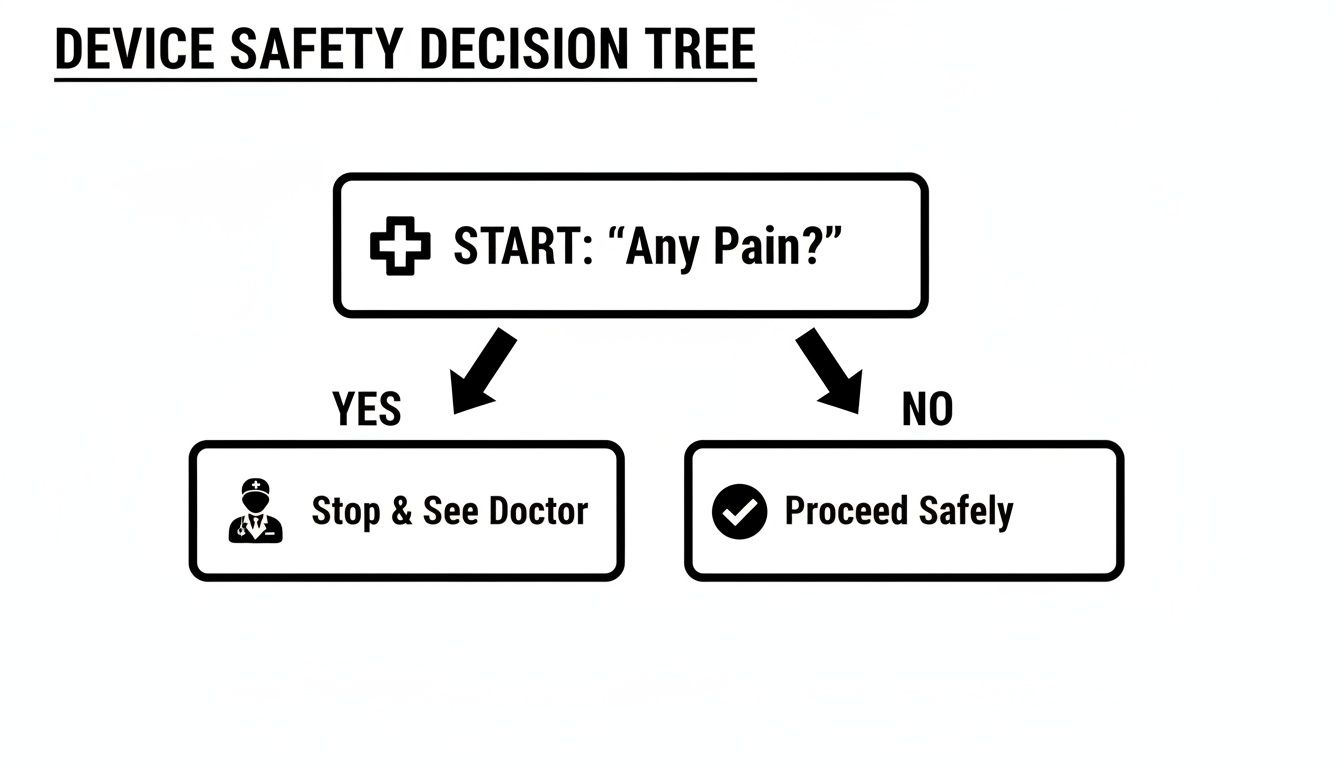
The takeaway here is simple: listen to your body. Pain is never normal. It's a clear signal to stop immediately and seek professional medical advice.
To make the choice even clearer, this table breaks down the key differences to help you align your goals with the right approach.
At-Home Methods vs. Professional Procedures
| Factor | At-Home Methods (Exercises, Creams, Devices) | In-Office Procedures (Labiaplasty, Clinic RF/Laser) |
|---|---|---|
| Cost | Lower initial cost ($100 – $600) | Higher upfront cost ($3,000 – $12,000+) |
| Invasiveness | Non-invasive to minimally invasive | Minimally invasive (RF/laser) to surgically invasive (labiaplasty) |
| Results | Subtle, gradual, and require ongoing maintenance | Dramatic, targeted, and often long-lasting or permanent |
| Concerns Addressed | Mild laxity, dryness, minor sensation changes | Significant laxity, asymmetry, excess tissue, functional issues |
| Safety | Relies entirely on correct user application; risk of burns or masking underlying issues | Performed by a trained medical professional in a controlled environment |
| Permanence | Temporary; benefits fade if use is discontinued | Long-lasting to permanent, especially with surgical procedures |
As the table shows, these two approaches really do exist in different worlds. At-home options offer a low-cost, low-commitment entry point for managing minor symptoms, like mild dryness or toning pelvic floor muscles. But they also place all the responsibility for safety and results squarely on you.
Professional procedures are a significant investment in achieving a specific, measurable outcome under medical supervision. Whether you're seeking the dramatic tightening from high-energy RF or the permanent anatomical change from a labiaplasty, these treatments are for those who want definitive results that go far beyond what any at-home product can deliver.
When it comes to exploring any form of at-home vaginal rejuvenation, patient safety must be the primary consideration. The market is filled with devices and creams making significant claims, but navigating these options requires a critical eye and a commitment to putting your health well ahead of promised results.
Your first step is to evaluate the product and the company behind it. Be immediately skeptical of any product promising "surgery-like results" or "permanent fixes." A true surgical procedure, like a labiaplasty, alters physical anatomy in a way no at-home device or topical cream can replicate.
Look for manufacturers who are transparent. Do they provide access to clinical data or safety certifications? A lack of verifiable evidence is a major warning sign. If a brand cannot substantiate its claims with research or is vague about the technology, it’s best to avoid it. This also applies to testimonials; watch for overly generic or repetitive reviews that feel inauthentic.

Evaluating Unrealistic Claims
The most reputable companies are realistic about what their products can and cannot do. They focus on subtle, gradual improvements in tissue tone, moisture, or sensation—not on overnight transformations.
A trustworthy brand will manage your expectations, explaining that results develop over time with consistent use. A questionable seller will promise a quick, effortless solution using dramatic language that is not grounded in medical science.
This distinction is crucial. Legitimate tools for at home vaginal rejuvenation are designed for wellness maintenance and mild aesthetic improvements, not for medical-level changes. Think of them as a component of a wellness routine, not a one-time cure for a medical condition.
When To Stop and Consult a Physician
Even more important than identifying marketing tactics is recognizing when self-treatment is inappropriate and potentially dangerous. Certain symptoms are your body’s signal that professional medical attention is required.
Do not attempt to address these issues with an at-home product. You should book an appointment with your gynecologist or a qualified physician immediately if you experience any of the following:
- Unusual Bleeding: Any bleeding that occurs between periods, after intercourse, or post-menopause requires a medical evaluation.
- Severe or Persistent Pain: Pain during intercourse (dyspareunia), chronic pelvic pain, or discomfort that arises while using a device is not normal and should be properly diagnosed.
- A Sensation of Heaviness or Bulging: This feeling, often described as something "falling out," can be a sign of pelvic organ prolapse, a condition that requires medical assessment and management.
- Sores, Lesions, or Unusual Discharge: These can indicate infections, dermatological issues, or other gynecological conditions that need specific medical treatment.
Ultimately, at-home devices should never be used to diagnose or treat a medical problem. They are intended for wellness enhancement in healthy individuals only. If you have any underlying symptoms or health concerns, your first step should always be a consultation with a healthcare provider. They can provide an accurate diagnosis and guide you toward the safest, most effective treatment path for your specific needs.
How To Talk To Your Doctor About Your Goals
Moving from researching at home vaginal rejuvenation online to discussing it with a doctor can feel like a significant, and sometimes intimidating, step. Feeling nervous is completely normal, but preparing for the conversation is the best way to make sure your concerns are heard and you get the clear, professional guidance you need.
A productive consultation really begins before you even walk into the office. Take some time to think through what you're hoping to change. Are your concerns mainly functional—things like stress incontinence or discomfort? Or are they aesthetic, related to how you look and feel?
Getting specific about your own goals is crucial. It shifts the dynamic, allowing you and your physician to work as a team to find a solution that’s truly right for you.
Preparing Your Questions
Walking into an appointment with a written list of questions is one of the most effective things you can do. It keeps the discussion on track and ensures you don’t leave wondering if you forgot something important. Your doctor is a medical resource; these questions help you use their expertise to your full advantage.
Here are a few questions you might want to bring with you:
- Goals & Realism: "Based on my anatomy and what I'm hoping to achieve, what are the most realistic options for me?"
- Experience & Expertise: "What is your experience with both at-home methods and in-office procedures for concerns like mine?"
- Safety & Suitability: "Are there any health conditions I have that would make at-home devices or treatments unsafe for me?"
- Alternative Paths: "If an at-home approach isn't a good fit, what in-office procedures would you recommend, and why?"
- Long-Term Outlook: "What kind of maintenance or follow-up is needed for the options we're discussing?"
Think of this consultation as an interview. You’re gathering the critical information needed to make a decision about your own body, and your questions are the tools you use to get direct, honest answers.
Articulating Your Concerns Clearly
Being able to describe exactly what you're experiencing is key. You don’t need to know the medical terminology. Instead, focus on explaining the "what" and "when." For example, rather than just saying you feel "loose," you might explain, "Since my last pregnancy, I’ve noticed less sensation during sex and I sometimes leak a bit when I sneeze or cough."
This kind of real-world detail gives your doctor invaluable diagnostic information. It helps them distinguish between an issue like pelvic floor muscle weakness, which often responds well to targeted therapy, and an anatomical change that might require a different type of intervention. Your honesty will be met with professional guidance, leading to the safest and most effective outcome.
Frequently Asked Questions: At-Home Rejuvenation
It's completely normal to have questions when you start looking into at-home vaginal rejuvenation. The market is filled with specific products and bold claims, and getting clear answers is the only way to make a safe, confident decision.
Let's cut through the noise and address some of the most common questions we hear.
Can At-Home Devices Give Me Labiaplasty Results?
This is a critical distinction to understand, and the answer is absolutely not. At-home devices and labiaplasty surgery are designed for entirely different purposes and address completely different anatomical areas.
- At-Home Devices: These devices work on the internal vaginal canal. Their goal is to improve muscle tone, increase natural lubrication, and enhance sensation by stimulating the underlying tissues. They do not alter external appearance.
- Labiaplasty: This is a surgical procedure focused on the external genitalia. Surgeons perform labiaplasty to change the size or shape of the labia minora or majora, most often to resolve physical discomfort or for cosmetic reasons.
One cannot achieve the results of the other.
Are Kegel Exercises Enough For Rejuvenation?
Kegel exercises are fantastic for strengthening your pelvic floor muscles. Consistent practice can lead to better bladder control and often improves sensation during intercourse, which are huge benefits.
However, their impact is limited strictly to muscle tissue.
Kegels will not change your skin's elasticity, boost collagen levels, or alter the external appearance of the labia. While they are a vital component of pelvic health, they are only one piece of the puzzle and do not address concerns like vaginal atrophy or laxity in the tissue itself.
How Can I Tell If An At-Home Product Is Safe?
You should approach any at-home device with a healthy dose of caution. Your first and most important step should always be a conversation with your gynecologist to ensure any product is appropriate for your specific health profile.
The safest rule is to be highly skeptical of dramatic claims. Reputable brands are transparent, often providing access to safety studies and clear instructions. If a product promises "surgery-like results" or seems too good to be true, it almost certainly is.
Will These Treatments Help With Pain During Intercourse?
It's possible, but only if the cause of the pain is related to what these products can treat. Some at-home options, like moisturizers with hyaluronic acid or certain RF devices, claim to improve lubrication and tissue health. This might help with pain (dyspareunia) caused by vaginal dryness or atrophy.
However, painful intercourse can stem from many complex issues, including medical conditions like endometriosis or vaginismus. It is absolutely essential to get a proper diagnosis from a doctor instead of trying to self-treat. Exploring the real-world costs and considerations of vaginal rejuvenation with a professional will help you understand all of your options—both at-home and clinical.
Labiaplasty.com is a premier educational resource designed to empower you with comprehensive and clear information. Explore our detailed guides and find the right specialist to begin a confident conversation about your goals.
