
So, you're considering a cosmetic procedure. It's an exciting prospect, but let's be honest—figuring out how to pay for it can feel like a huge obstacle, especially since insurance rarely gets involved. This is where cosmetic surgery credit cards often enter the picture. They generally come in two main flavors: specialized medical cards you might be offered at your surgeon's office, and everyday consumer credit cards that come with tempting 0% APR offers.
How to Finance Your Cosmetic Procedure
Making the decision to invest in a cosmetic procedure is deeply personal, and the financial side of things is just as important. With most aesthetic surgeries being elective, the full cost typically comes straight out of your pocket. That reality is what makes financing options, especially credit cards, so common.

This guide is designed to give you a clear, honest look at how you can use credit cards to manage the cost of your surgery. We'll walk through the real-world benefits and risks of each approach, so you can feel confident in your choice. Getting a handle on your options is the first step to making a smart financial move that supports your goals without adding long-term stress.
Understanding Your Primary Card Options
When it comes to paying for surgery with plastic, you're really looking at two very different paths. Each one has its own rules and potential traps, so it's critical to know what you're getting into before you sign on the dotted line.
- Specialized Medical Credit Cards: Think of cards like CareCredit or Alphaeon. These are often presented to you right in the surgeon’s office and are designed only for healthcare costs. They almost always come with promotional financing plans.
- General Consumer Credit Cards: These are the cards you'd get from a major bank—a Visa or American Express, for example—that you apply for yourself. Their biggest selling point is often a 0% introductory APR on new purchases, which can give you a genuinely interest-free window to pay off your balance.
The key is to look beyond the convenience of an in-office offer and weigh it against the potential savings of a traditional 0% APR card. Your goal is to find the most cost-effective tool for your specific financial situation.
By breaking down how each type of card works, you'll be in a much better position to choose a path that lets you focus on your results, not on unexpected debt. To explore this topic further, you can learn more about how to finance plastic surgery in our detailed guide.
Choosing Your Path: Medical vs. General Credit Cards
When you decide to finance your procedure with a credit card, you’re standing at a fork in the road. One path leads to general-purpose credit cards—think of them as a versatile multi-tool. They can earn travel rewards, provide cash back, or, most importantly for us, offer 0% introductory APR periods on new purchases.
The other path is for specialized medical credit cards, which are more like a surgical instrument, designed for a single purpose: covering healthcare costs. These are the cards, like CareCredit or Alphaeon, that your surgeon's office will likely present to you. Each path has distinct benefits and real risks, and understanding them is the key to making a sound financial choice.
General-Purpose Credit Cards: A Flexible Tool
A general-purpose credit card with a 0% introductory APR is a powerful financing tool, but it's one you have to find and apply for on your own. For a set promotional period, typically 12 to 21 months, any purchase you make—including your labiaplasty—won't rack up any interest. This gives you a clear, interest-free window to pay off your procedure.
The main advantage is simple: you save money. As long as you clear the full balance before that promotional period ends, you pay exactly what the surgery cost, not a penny more in interest. Some cards even sweeten the deal with rewards like cash back or travel points. The catch? You generally need a good-to-excellent credit score to qualify for the best offers, and even then, approval isn't guaranteed.
The real power of a 0% APR general card is its simplicity. It's a genuine interest-free loan, provided you stick to the repayment terms. There are no hidden clauses or retroactive interest penalties waiting to catch you off guard.
Medical Credit Cards: The Convenient Option
Medical credit cards are incredibly convenient. The application often happens right in the clinic, with an instant approval decision that lets you schedule your procedure on the spot. This ease of access is their biggest selling point.
But that convenience can come at a steep price, often hidden in complicated "deferred interest" promotions. These cards have become a dominant force in financing elective procedures. Between 2018 and 2020, they financed $23 billion in healthcare costs, but this convenience also saddled patients with a staggering $1 billion in deferred interest charges. With average interest rates hitting 26.99%, about a quarter of users failed to pay off their balance in time and got slammed with retroactive interest on their entire original balance. You can learn more about the costs of medical credit card financing in this detailed report.
This deferred interest model is the single biggest risk. Unlike a true 0% APR card, interest is quietly building up from day one. If you have even a tiny balance left when the promotional period expires, all of that accrued interest is dumped onto your account at once, dramatically inflating your total cost.
While medical credit cards are a useful tool for some, they are far less forgiving than their general-purpose counterparts. For a look at other financing possibilities, you might be interested in our guide on medical loans for cosmetic surgery.
General Purpose Credit Card vs Medical Credit Card
To make the choice clearer, let's break down the key differences side-by-side. Think of this as a quick reference guide to help you weigh the pros and cons based on what matters most to you.
| Feature | General Purpose Credit Card (e.g., Rewards or 0% APR Card) | Specialized Medical Credit Card (e.g., CareCredit) |
|---|---|---|
| Best For | Patients with good-to-excellent credit who can pay off the full balance within the 0% APR introductory period (12-21 months). | Patients who need immediate financing and prefer the convenience of an in-office application, often with more lenient credit requirements. |
| Interest-Free Offer | True 0% APR: No interest accrues during the promotional period. If a balance remains after, interest is charged only on that balance moving forward. | Deferred Interest: Interest accrues from day one. If the balance isn't paid in full by the end of the promo, all accrued interest is added to the account. |
| Typical APR | Standard APRs of 18%-28% apply after the intro period ends. | Very high standard APRs, often 26.99% or more, applied retroactively if the promo terms aren't met. |
| Application Process | You apply on your own through a bank or card issuer's website. Requires research and a credit check. | Fast, in-office application process with instant approval decisions. Offered directly by the healthcare provider. |
| Flexibility & Rewards | Can be used for any purchase. May offer valuable rewards like cash back, travel miles, or sign-up bonuses. | Restricted to qualifying healthcare expenses at participating providers. Typically offers no rewards. |
| Biggest Risk | Underestimating your ability to pay off the balance before the intro period ends and then facing standard interest rates. | The deferred interest trap. Failing to pay off the entire balance in time results in massive, retroactive interest charges. |
Ultimately, the right card depends on your financial discipline and credit profile. General-purpose 0% APR cards offer a straightforward way to save money, but medical cards provide unmatched convenience if you understand and can manage the risks involved.
The Hidden Costs of Deferred Interest Promotions
You’ve probably seen the offers: "no interest if paid in full within 12 months." When you’re looking at the cost of a cosmetic procedure, these deals can seem like a godsend. They’re a signature feature of specialized cosmetic surgery credit cards and feel like a simple way to get an interest-free loan. But there's a catch, and it's a big one: deferred interest.
This isn't the same thing as the true 0% APR offers you see with regular consumer credit cards. With a true 0% deal, interest simply doesn't exist for the promotional period. Deferred interest is sneakier. Think of it like a meter running silently in the background. From the moment you swipe the card, interest is being calculated and tallied up on your account, just out of sight.
If you pay off every single penny before the deadline, you’re golden. The lender forgives all that accumulated interest, and you walk away having paid nothing extra. The problem is, life doesn't always go according to plan.
This is the critical decision point every patient faces when figuring out how to pay for their procedure.
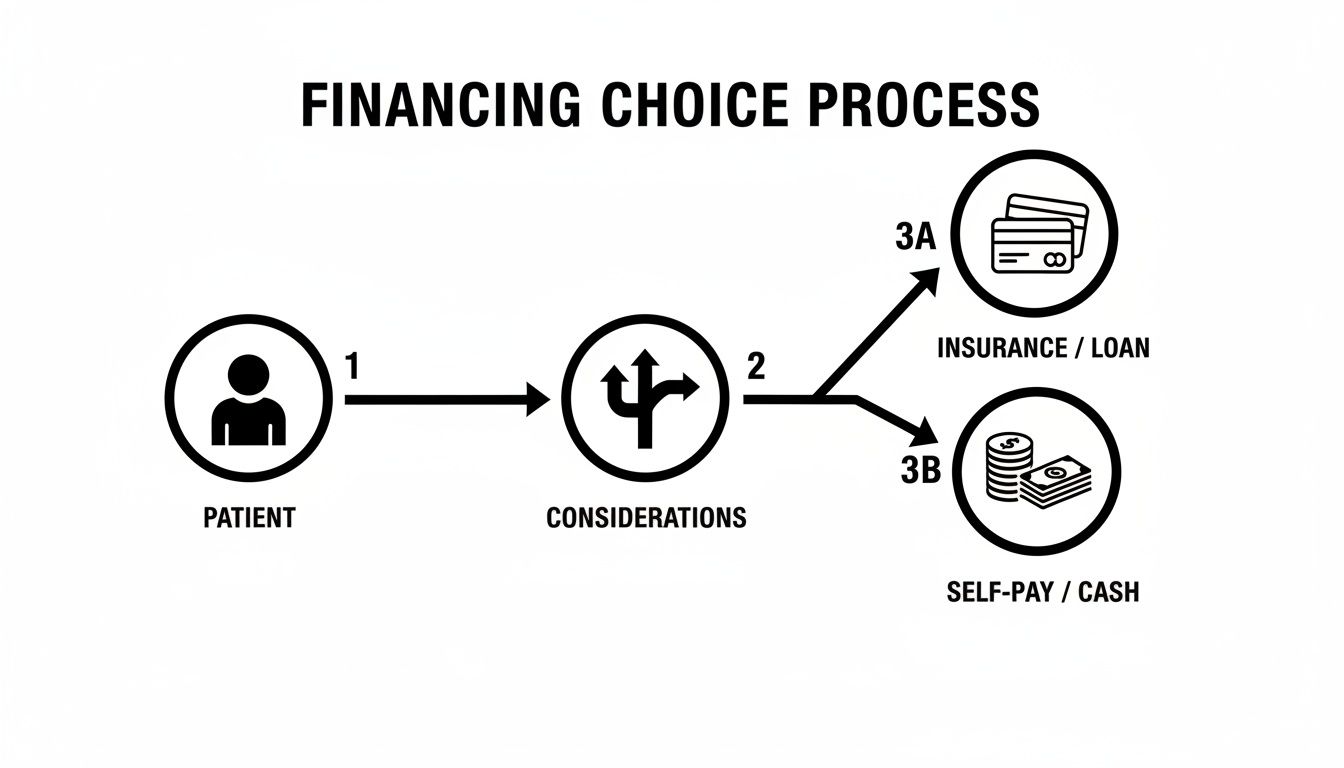
As the visual shows, the path you choose—which card, which loan—is a fork in the road that leads to very different financial destinations.
The Deferred Interest Trap Explained
The trap snaps shut the day your promotional period ends. If you have even one dollar of your original balance left, the lender can—and will—charge you all the interest that’s been piling up for the entire term. We're not talking about interest on the small remaining balance. This is retroactive interest on the full purchase price, going all the way back to day one.
A minor miscalculation can unleash hundreds, or even thousands, of dollars in unexpected charges. Your "interest-free" deal instantly becomes a high-interest headache. This isn't a rare occurrence, either. Studies have shown about a quarter of patients using these cards don't clear the balance in time, getting hit with massive retroactive interest charges.
The real danger of deferred interest is its all-or-nothing approach. A true 0% APR card is forgiving; if you have a little balance left, you just pay interest on that amount moving forward. A deferred interest card is not.
A Real-World Scenario
Let's break it down with a practical example. Imagine your labiaplasty costs $8,000, and you put it on a medical credit card offering "no interest if paid in full in 18 months." The card’s standard interest rate (APR) is a hefty 26.99%.
Scenario 1: You Pay It Off in Time
You stick to a strict budget, paying exactly $444.45 every month to clear the debt. You never miss a payment for all 18 months.
- Total Paid: $8,000
- Interest Paid: $0
- Outcome: Success! You used the financing exactly as planned and paid no interest.
Scenario 2: You Fall Just Short
Life happens. An unexpected car repair means you have to lower your payments for a few months. When the 18-month deadline hits, you still have a $100 balance left.
Here’s what happens next:
- Interest Calculation: The lender looks back at the original $8,000 and calculates 18 months of interest at 26.99% APR.
- Retroactive Charge: That accumulated interest—which could be over $3,200—is suddenly slammed onto your account.
- New Balance: Your tiny $100 balance just exploded to over $3,300.
That one small shortfall has now dramatically inflated the total cost of your procedure. This is why you must read the fine print and have an ironclad repayment plan before ever signing up for a deferred interest offer.
A Smart Strategy for Using a Credit Card for Surgery
Putting your surgery on a credit card is a major financial move, and success comes down to having a rock-solid plan. This isn't about just swiping the plastic; it's about treating the transaction with the seriousness it deserves. When you approach it strategically, you can transform a credit card from a risky option into a predictable tool for managing the cost.
The key is to completely shift your mindset. Don't think of this as revolving credit—think of it as a fixed-term loan you’ve given yourself. You set the rules, you calculate the payments, and you stick to a non-negotiable end date. This simple change in perspective is what helps you sidestep the common traps, like deferred interest penalties or balances that drag on for years at a high APR.

Step 1: Build an All-In Budget
Before you even think about applying for a card, you need to know the true, total cost of your procedure. The number on the surgeon’s initial quote is just the starting point. A complete budget is your best defense against unexpected costs popping up later.
Your goal is to map out every single potential expense to get a realistic final number. This is the figure you’ll have to finance—and, more importantly, the one you have to pay back.
Key Budgeting Categories:
- Surgeon's Fee: The main cost covering the surgeon's time and expertise.
- Facility Fee: This is for the use of the operating room, nurses, and staff.
- Anesthesia Fee: The charge for the anesthesiologist’s services.
- Post-Operative Care: Don’t forget prescriptions, special garments, and any follow-up visits.
- Contingency Fund: This is critical. Set aside an extra 10-15% for things you can’t predict, like needing extra recovery supplies or taking more time off work than planned.
Step 2: Calculate Your Must-Pay Monthly Amount
Okay, once you have your total cost and you know the length of your 0% APR promotional period, it's time for some simple but crucial math. You need to figure out the exact monthly payment that will clear the entire balance before any interest hits.
Let’s imagine your total, all-inclusive cost comes to $9,000, and you've found a card with an 18-month interest-free offer.
Calculation: $9,000 (Total Cost) ÷ 18 (Months) = $500 (Mandatory Monthly Payment)
That $500 isn't a suggestion; it's your new non-negotiable bill. It needs to be as important as your rent or mortgage payment. The best way to guarantee you stay on track is to set up automatic payments for that exact amount. Just paying the "minimum due" on your statement is a recipe for financial trouble.
Step 3: Read the Fine Print (Seriously)
That cardholder agreement is a legally binding contract, and the sneakiest risks are always buried in the fine print. Reading it isn’t just a good idea—it’s essential for protecting yourself. Pay extremely close attention to the terms governing your promotional deal.
- Promotional Period End Date: Find this date and circle it on your calendar. Know the exact day your 0% APR window slams shut.
- Deferred Interest Clause: Keep an eye out for phrases like "no interest if paid in full." This is a massive red flag for deferred interest. It means if even one penny is left on the balance after the promo period, they can charge you all the interest retroactively from day one.
- Standard APR: Find out what the interest rate skyrockets to after the promotional period ends. This is the rate that will be applied to any leftover balance.
- Late Fee Penalties: Some agreements are ruthless. A single late payment can void your entire promotional offer, triggering that high standard APR immediately.
By building a complete budget, calculating a fixed monthly payment, and understanding every word of your agreement, you take back control. This strategic approach ensures your cosmetic surgery credit card works for you, not against you, and prevents long-term financial stress.
Comparing Alternatives to Cosmetic Surgery Credit Cards
While a cosmetic surgery credit card is a fast and simple way to pay for your procedure, it’s definitely not your only choice. It's smart to weigh all the available avenues to find the right fit for your financial situation. Each option has its own rules, benefits, and potential downsides, offering different levels of cost, stability, and flexibility.
Think of it this way: you wouldn't choose a surgeon without doing your homework, right? You should give your payment method the same careful consideration. Making a thoughtful choice here ensures your financing plan fits your budget and won't cause stress long after your recovery is complete.
Personal Loans for Medical Expenses
A personal loan is one of the most common alternatives. You can think of it as the opposite of a credit card's revolving line of credit. With a personal loan, you borrow a specific lump sum from a bank, credit union, or online lender and pay it back in equal monthly installments over a set term, usually two to seven years.
The biggest advantage here is predictability. Personal loans almost always come with a fixed interest rate, meaning your payment never changes. This makes budgeting a breeze because you know exactly how much is due each month and the precise date your debt will be gone.
- Pros: Fixed interest rates and consistent monthly payments take the guesswork out of budgeting. You also avoid the nasty surprise of deferred interest penalties.
- Cons: The application process is more rigorous than a credit card and requires a hard credit inquiry. Approval isn’t a sure thing, especially if your credit score is on the lower side.
In-House Payment Plans from Your Surgeon
Some surgical practices offer their own in-house payment plans directly to patients, which is an appealing option because it cuts out the middleman. The financial arrangement stays between you and your provider’s office.
These plans can vary quite a bit. Some might be set up as a series of interest-free payments you make in the months leading up to your surgery date. Others may be short-term financing for a piece of the total cost. It never hurts to ask about this during your consultation. For a deeper look at this, check out our guide on cosmetic surgery payment plans.
By offering direct financing, clinics can make procedures more accessible, but be sure to get the terms in writing. Understand the payment schedule, any associated fees, and what happens if you miss a payment.
Health Savings Accounts (HSAs) and Flexible Spending Accounts (FSAs)
If your procedure has a clear medical justification, a Health Savings Account (HSA) or Flexible Spending Account (FSA) can be a fantastic, tax-advantaged way to pay. These accounts let you use pre-tax money for qualified medical expenses.
Unfortunately, purely cosmetic procedures, including most labiaplasties, typically don't qualify. However, if your surgery is deemed medically necessary—for example, to correct a functional problem causing chronic pain or irritation—you might be able to use these funds. Always confirm eligibility with your plan administrator and your surgeon before you move forward.
The Power of Saving and Paying in Cash
The most financially sound method is also the most straightforward: paying in cash. This route requires patience and discipline since you’ll need to save the full amount before you can schedule your surgery.
The payoff is huge—you'll have zero debt, zero interest payments, and zero financial stress after your procedure. You simply pay for the service and can focus 100% on your recovery. While financing is becoming more common, the debt-free path offers a peace of mind that's hard to beat. The trend toward credit is significant; in the US, with over 6.1 million aesthetic procedures in 2023, credit card payments far outpaced cash and checks in a review of over 11,000 transactions at one cosmetic center. You can find more details in this global survey on aesthetic procedures. By saving up, you completely sidestep the interest and fees that come with any form of financing.
Making Your Final Financing Decision with Confidence
Choosing how to pay for your surgery is a decision just as personal and important as choosing your surgeon. The right financial path lets you focus on your recovery and results—not on lingering debt or stress.
Whether you go with a general-purpose card that has a true 0% APR offer, a specialized medical card, or an alternative like a personal loan, the key is having a concrete plan to pay it back. This isn't a decision to make on the spot at the front desk. It needs careful thought and a full understanding of the terms you're agreeing to.
Your Final Checklist Before Signing
Before you commit to anything, run through these final checkpoints. A quick review can be the difference between a smooth financial journey and an expensive mistake.
- Have I read the entire agreement? Look closely at any clauses about deferred interest and the penalties for late payments. These are often buried in the fine print.
- Do I know my exact monthly payment? You absolutely must calculate the amount needed to pay off the balance before any promotional period ends. Don't just guess.
- Is this payment realistic for my budget? Stress-test your finances. Can you comfortably afford this payment every single month, even if an unexpected expense pops up?
A successful outcome is one where you feel great about your results and your finances long after you've recovered. The goal is peace of mind, both physically and financially.
Partnering with Your Provider
Use this guide to have an open, informed conversation with your surgeon's office about all potential costs. Ask about every single fee—from the facility to anesthesia—to make sure there are no surprises down the line.
When you select a financing option that truly fits your budget and offers total clarity, you empower yourself to move forward with confidence. Ultimately, the best cosmetic surgery credit cards or loans are the ones you can manage responsibly, allowing you to enjoy your results without a trace of financial regret.
Frequently Asked Questions About Financing Your Procedure
It’s completely normal to have questions when you’re figuring out how to pay for your surgery. Using credit cards or other financing options for cosmetic procedures can feel complicated, and you want to be sure you understand all the practical details.
Here are some straightforward answers to the most common questions we hear from patients. Getting these details sorted out ahead of time is the key to a smooth and stress-free financial journey.
What Happens If I Miss a Payment on a Medical Credit Card?
Missing a payment on a medical credit card, especially one with a promotional offer, can be a much bigger deal than missing one on a regular card. The consequences are often swift and expensive.
First, you’ll get hit with a late fee, usually somewhere between $25 and $40. But the real risk is that a single missed payment can instantly cancel your promotional financing deal.
If your "no interest" period gets terminated, the card issuer will start charging you their standard, sky-high APR (often 26.99% or more) on whatever balance is left. Even worse, if you have a deferred interest plan, they could charge you all the interest you would have paid from day one, adding a huge amount to your total debt.
Will Applying for a New Credit Card Hurt My Credit Score?
Yes, applying for any new line of credit will usually cause a small, temporary dip in your credit score. This happens because the lender does a "hard inquiry" (or "hard pull") on your credit report to see if you're a good candidate for the card.
For most people with a decent credit history, a single hard inquiry might only drop your score by a few points, and the impact usually fades within a few months. The real trouble comes when you apply for several cards in a short amount of time, which can look like a red flag to lenders and lower your score more significantly. It’s much smarter to do your homework, pick the best card for you, and just apply for that one.
Key Takeaway: A small, temporary dip in your score is normal and expected. Just avoid shotgunning multiple applications at once to keep the impact minimal.
Honestly, that small drop is often a worthwhile trade-off for locking in a 0% APR offer that could save you hundreds—or even thousands—of dollars in interest.
Can I Use Different Payment Methods for Surgeon and Facility Fees?
Absolutely. In fact, it’s very common for the surgeon's fee, the facility fee (for the operating room), and the anesthesiologist's fee to be billed as separate charges. This setup actually gives you more flexibility to use different payment methods for each.
For example, you could easily:
- Pay your surgeon's fee with a new 0% APR credit card to get that interest-free window.
- Cover the hospital or surgery center fee with money from your savings.
- Put the anesthesiologist’s bill on a different rewards card to earn some cash back.
This approach lets you optimize how you pay based on the size of each bill and the perks of each payment method. Just be sure to double-check with each provider’s billing department to confirm they accept your preferred form of payment.
Are There Financing Options for a Lower Credit Score?
Yes, you still have options even if your credit score isn't perfect. While you might not qualify for the very best 0% APR credit cards—which typically require a good-to-excellent score of 700 or higher—other doors are still open.
Medical credit cards like CareCredit, for instance, often have more relaxed approval criteria than the major banks. You can also look into personal loan companies that specialize in lending to people with fair credit. And don't forget to ask about in-house payment plans directly from your surgeon's office, as they sometimes offer more flexible terms. Just be prepared for higher interest rates, but know that options are definitely out there.
At Labiaplasty.com, our goal is to give you clear, reliable information so you feel confident at every stage of your journey—including the financial part. Explore our resources to make the best decisions for your procedure. Learn more at https://labiaplasty.com.
