
You may be reading this because something feels off, but you're not sure whether it's “serious enough” to bring up. Maybe exercise causes rubbing or pinching. Maybe tight clothing draws your attention to the area all day. Maybe nothing hurts, but you've spent years feeling self-conscious and wondering whether what you're seeing is normal.
Those questions are common. So is the uncertainty around what a labia surgery procedure involves.
Labiaplasty is personal, but it isn't obscure. The International Society of Aesthetic and Plastic Surgery reported 10,787 labiaplasty operations in the U.S. in 2017, a 217.3% increase from 2012, with 55.3% of patients ages 19 to 34 and 34.2% ages 35 to 50, according to ISAPS genital surgery statistics. That matters because it shows this is an established procedure, not a rare one.
Understanding the Labia Surgery Procedure
A labia surgery procedure, usually called labiaplasty, is surgery to reduce or reshape the labial tissue, most often the labia minora, which are the inner folds of tissue. Some patients seek it because tissue catches, twists, or rubs. Others want a different contour, less asymmetry, or less visible protrusion in fitted clothing.
That doesn't make the decision shallow. Function and appearance often overlap in this area. A person can feel physical discomfort and also want to feel more at ease with how their body looks.
Why people start researching it
Many patients don't begin with the word “labiaplasty.” They begin with a problem:
- Exercise irritation: running, cycling, yoga, or even walking can create rubbing or pulling
- Clothing discomfort: underwear, leggings, swimwear, or jeans may press on prominent tissue
- Intimacy concerns: some people report discomfort with certain movements or positions
- Self-consciousness: asymmetry or excess tissue may cause ongoing distress, even without pain
Those reasons are valid. What matters is whether your concern is consistent, meaningful to you, and realistic to address surgically.
What makes it a real medical decision
This isn't a spa treatment or a casual cosmetic add-on. It's surgery. It involves planning, technique selection, anesthesia decisions, wound healing, and the possibility of complications. It also requires clear consent and a surgeon who can explain not just what they can do, but why a specific approach fits your anatomy.
Practical rule: If a consultation feels rushed or the surgeon can't explain technique trade-offs in plain language, pause and get another opinion.
A good consultation should leave you feeling more informed, not pressured. You should understand what can improve, what can't, and what recovery is likely to feel like in real life.
What a Labia Surgery Procedure Can Address
The outer genital area has several parts, and patients often use one word to describe all of them. That's one reason consultations can feel confusing. When surgeons talk about the labia minora, labia majora, and sometimes the clitoral hood, they're trying to identify exactly where your concern is coming from.
The labia minora are the inner folds. The labia majora are the outer folds. The clitoral hood is the tissue over the clitoral area. A patient may think the issue is “large labia,” but on exam, the main concern might be asymmetry of the inner tissue, excess hooding, or prominence in a specific area.

Concerns the surgery may improve
A labia surgery procedure is usually intended to reduce excess tissue or reshape it in a way that better matches the patient's goals. In plain terms, it may help when tissue:
- Chafes during movement: friction during walking, workouts, or cycling can become a daily nuisance
- Twists or pulls: some patients describe a pinching sensation when sitting, crossing their legs, or during intercourse
- Feels visually prominent: this can matter in swimwear, leggings, or in a mirror
- Looks uneven: one side may extend more than the other, which can bother some patients aesthetically or physically
There isn't one “correct” look for vulvar anatomy. Normal anatomy varies widely. Surgery is usually considered when the variation causes symptoms or distress that doesn't feel manageable.
What surgery cannot do
Expectation-setting matters most here.
Labiaplasty doesn't change internal vaginal tightness. It doesn't solve every sexual concern. It also doesn't guarantee a perfectly symmetrical result, because the body itself isn't perfectly symmetrical and healing can influence the final contour.
It's better to think of the procedure as contouring and reduction, not transformation into an idealized template.
The best candidates usually have a specific problem they can describe clearly, not just a vague feeling that something is “wrong.”
Functional and aesthetic goals often overlap
Some patients come in saying, “It rubs when I run.” Others say, “I hate how it looks in certain clothing.” Both may end up wanting a similar operation, but the surgical plan can still differ depending on the anatomy involved and how much tissue should be preserved.
That distinction matters because a surgeon isn't just removing tissue. They're balancing comfort, appearance, wound tension, scar placement, and sensitivity.
Exploring Labiaplasty Surgical Techniques
Technique choice is one of the most important parts of the entire decision. Many websites mention that there are two main options, then stop there. That's not enough if you're trying to decide what's right for your body.
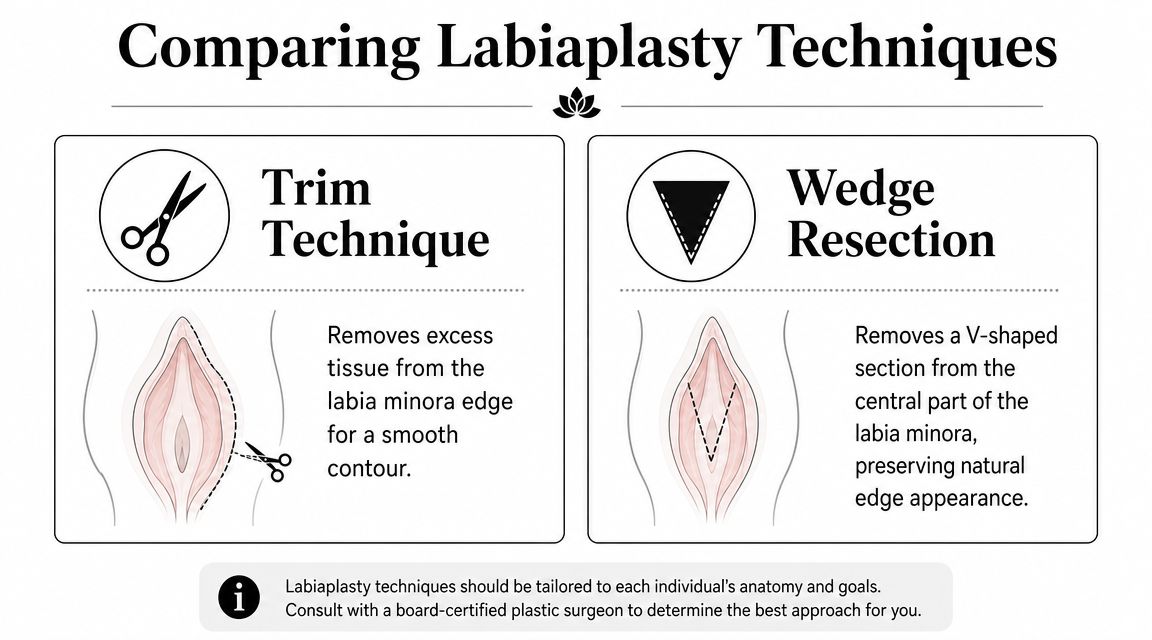
The two primary approaches are trim and wedge. The key difference is where the tissue is removed. The trim technique removes tissue along the free edge. The wedge technique removes a pie-shaped segment from the thickest portion and preserves the natural border, as described in this overview of labiaplasty techniques.
How trim works
With trim, the surgeon excises tissue along the outer edge of the labia minora and then closes the incision. This can create a smoother contour and can be straightforward when the edge itself is the part the patient wants reduced.
Trim may make sense when the border is prominent throughout its length, or when the patient wants a more direct reduction of the edge.
Possible trade-offs include:
- Edge removal: the natural wrinkled border is reduced or removed
- Contour control: this approach can simplify shaping in some anatomies
- Scar location: the incision sits along the edge rather than in the central tissue
How wedge works
With wedge, the surgeon removes a central wedge or pie-shaped segment from the thickest area, then brings the remaining edges together. The goal is to preserve the existing outer border so the labia keeps more of its natural edge appearance.
This may appeal to patients who care strongly about preserving the wrinkled border or who want a reduction that looks less like the edge was trimmed away.
Possible trade-offs include:
- Border preservation: a major reason some surgeons choose it
- Different tension pattern: the closure pulls tissue together in a central area
- Anatomy dependence: not every patient is a great wedge candidate
For a broader patient-friendly overview, you can review different labiaplasty techniques.
Trim vs. Wedge Labiaplasty At a Glance
| Attribute | Trim (Edge) Resection | Wedge Resection |
|---|---|---|
| Tissue removal location | Along the free edge | From the thickest central portion |
| Natural border preserved | Usually less so | More often preserved |
| Visual effect | Smoother edge contour | More natural edge appearance |
| Best fit | When the outer edge itself is the main concern | When preserving the border is a priority |
| Main trade-off | Removes the natural edge | Central closure tension may matter more |
The real decision isn't which is better
It's which is better for your anatomy and priorities.
If a patient says, “I mainly want the dark or thickened edge gone,” that may lead to one conversation. If she says, “I want reduction, but I don't want to lose the natural border,” that may lead to another. Surgeons also consider thickness, asymmetry pattern, tissue quality, and how much reduction is safe.
Ask your surgeon to draw where tissue will be removed. A simple sketch often makes the choice clearer than a verbal explanation.
Some patients also have related concerns in nearby tissue, such as excess hooding, but whether that should be addressed depends on careful assessment. It shouldn't be added automatically or pitched as routine.
The Patient Journey From Consultation to Surgery
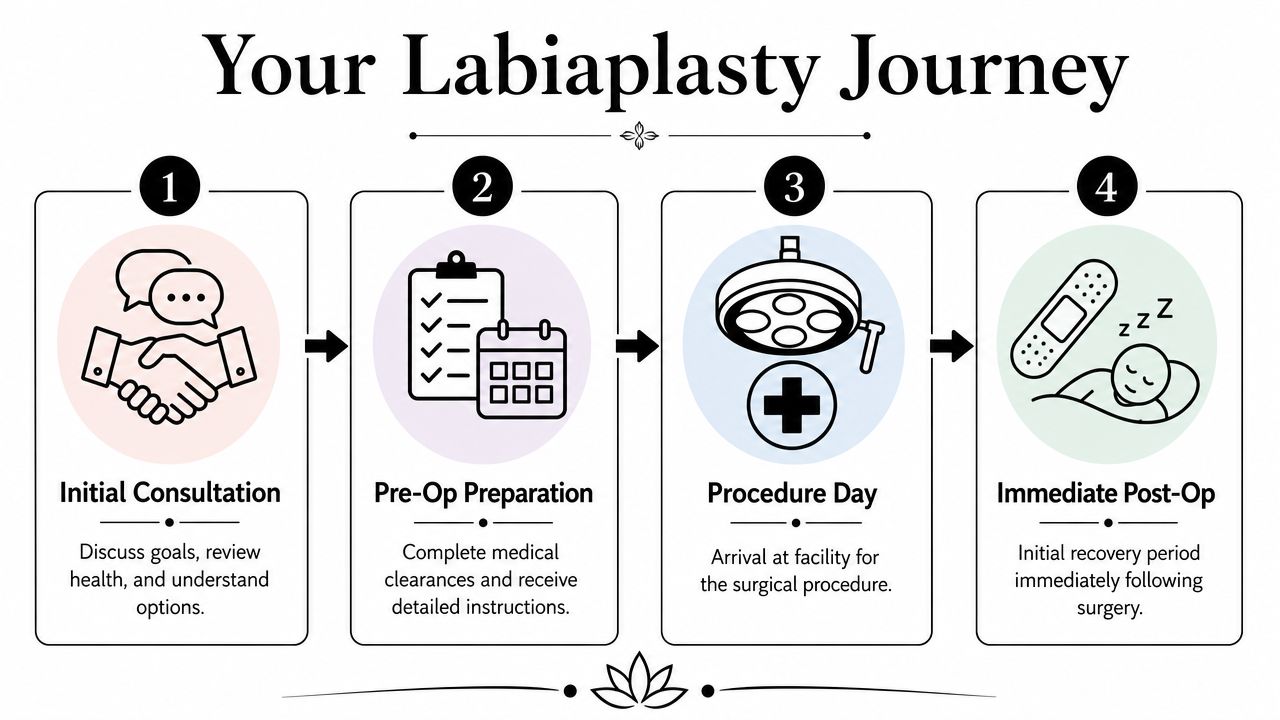
You book a consultation because the issue has been bothering you for a while, but the hardest part is often not the surgery itself. It is the uncertainty. Patients usually want to know what will happen first, what decisions get made before the operating room, and how much of the plan is adapted to their anatomy rather than treated like a standard template.
Labiaplasty is usually an outpatient procedure. It commonly takes about 1 to 2 hours, and minor wound issues such as small areas of incision separation are reported infrequently and often improve with conservative care, according to StatPearls on labiaplasty.
The consultation
A good consultation should feel less like a sales meeting and more like a planning session.
Your surgeon is trying to answer several different questions at once. What is bothering you physically? What appearance changes are you hoping for? Are you focused on reduction, symmetry, the edge itself, or a combination? Those details matter because they often shape the conversation about trim versus wedge, which is one of the biggest real decisions in this process.
It helps to be specific. Rubbing in workout clothes, pulling during intercourse, a longer side getting caught, or dislike of a darker or thicker edge all point to slightly different priorities. The surgeon should examine you respectfully, review your medical history, and explain which technique fits your anatomy and why another technique may be less ideal.
Ask for the plan in plain language. If the surgeon can draw the area to be removed and show you where the closure will sit, the decision usually becomes much clearer. A sketch often does more than a long verbal explanation because you can see the trade-off. One method may better remove a bothersome edge, while another may better preserve the natural border but place more tension in the center.
Planning before the operation
Once you decide to proceed, the next phase is preparation. In this phase, the surgical plan gets translated into practical steps.
You will usually receive instructions about medications to stop or continue, when to avoid food or drink if sedation or general anesthesia is planned, what to wear, and the need for a ride home. Your surgeon should also explain what type of anesthesia they use and why. Some cases are done with local anesthesia and sedation, while others are done under general anesthesia. The right choice depends on the extent of surgery, the surgeon's routine, and your comfort level.
This is also the time to ask recovery questions before you are stressed or rushed. For example, if your job requires long periods of sitting, if you care for small children, or if you exercise frequently, those details affect how you should prepare at home. A more detailed guide to the labiaplasty recovery process can help you plan ahead before surgery day arrives.
A short visual overview can help if you prefer seeing the sequence laid out clearly:
Procedure day
Surgery day is usually structured and quiet, not chaotic.
You will check in, review consent forms, and confirm the plan with the team. Many surgeons make markings before the procedure. That step matters because it connects the discussion from your consultation to the actual operation. It is the last moment to confirm that both of you mean the same thing by “smaller,” “more even,” or “preserve the edge.”
After anesthesia, the surgeon removes the planned tissue and closes the area carefully, often with absorbable sutures. Patients usually go home the same day rather than staying overnight.
The first hours after surgery
The immediate focus is simple. Rest, swelling control, and incision protection.
You will go home with instructions on cleaning the area, activity limits, and signs that justify a call to the office. The area often looks more swollen and uneven than patients expect in the first several hours. That early appearance can be misleading, like judging the final shape of a garment while the fabric is still bunched and pinned. It is much too early to assess the result.
One of the most helpful mindsets in the first day is patience. Try not to inspect the area repeatedly or compare it to your ideal result right away. At this stage, what matters most is following instructions and giving the tissue time to settle.
Labiaplasty Recovery Timeline and What to Expect
You may feel surprisingly comfortable one day, then more swollen after a longer walk or a full day sitting at work. That pattern worries many patients, but it is often part of normal healing. Recovery after labiaplasty is less like flipping a switch and more like watching swelling settle in stages.
The timeline also depends on the technique used. A trim and a wedge procedure can both heal well, but they do not always feel the same during recovery. A trim places the incision along the edge of the labia, so patients often focus on tenderness at that outer border early on. A wedge keeps the natural edge but places tension through a central closure, which can make surgeons especially cautious about friction, stretching, and anything that might stress that incision while it knits together. This is one reason recovery advice should match the operation you had, not just the word “labiaplasty.”
The first several days
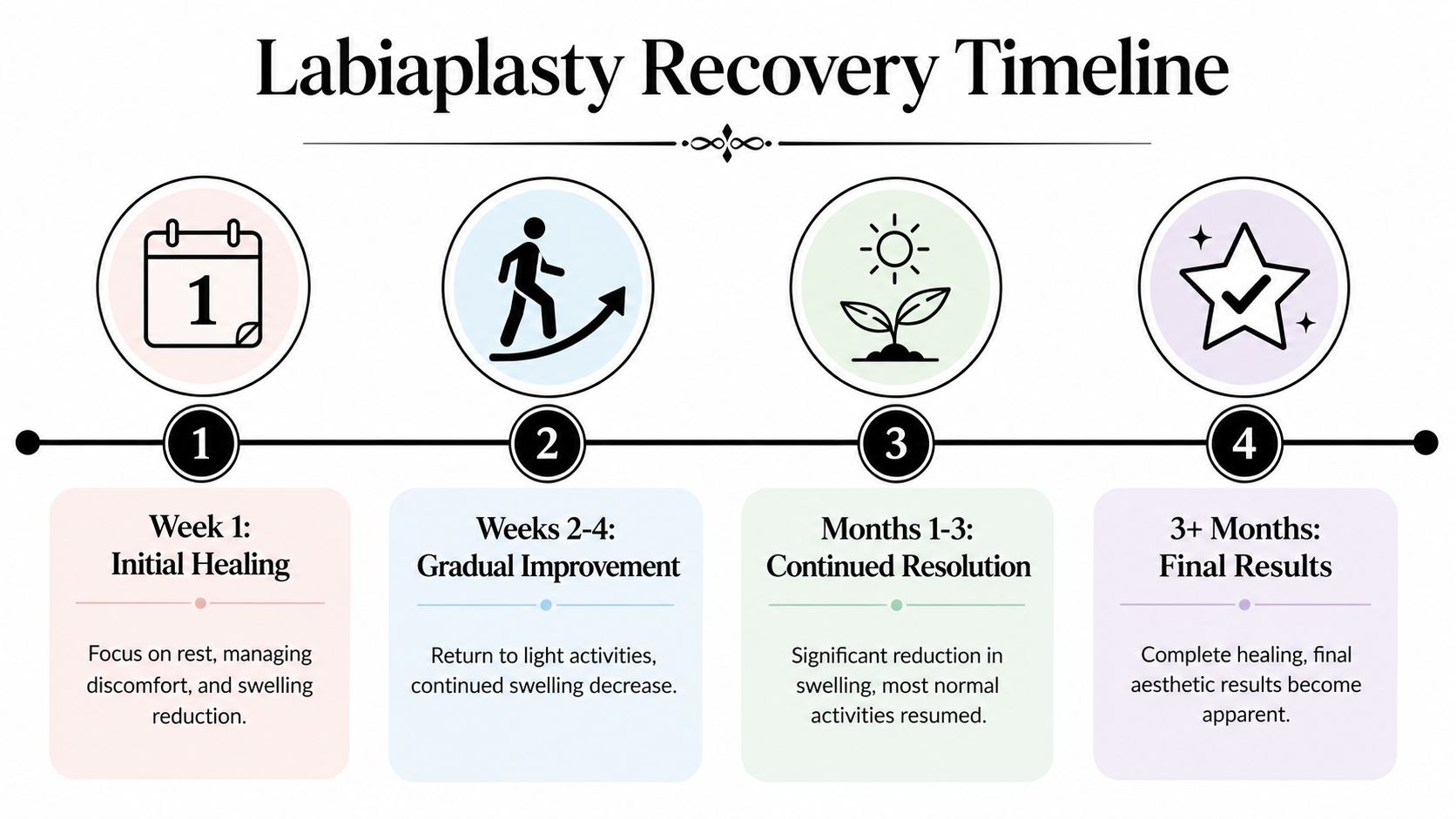
The early phase is usually the most intense for swelling, soreness, and bruising. The area can look puffier, firmer, and less even than many patients expected. Sitting may feel awkward. Urinating can sting for a short time. Looking in the mirror at this stage often creates more anxiety than useful information because the tissue has not settled yet.
Uneven swelling is common. One side may look larger or heal a little slower without that meaning the final result will be uneven.
A simple way to understand this phase is to picture fresh stitching in delicate fabric. The repair may be secure, but it does not tolerate rubbing, pressure, or repeated stretching very well yet. That is why rest, gentle hygiene, and following activity restrictions matter so much in the first week.
Weeks two through six
This period confuses patients more than the first few days. Pain often improves before healing is fully complete, so it is easy to feel “basically fine” and then do too much.
Sutures may still be dissolving. The tissue may feel firm, bumpy, itchy, or slightly numb in places. Those changes are often part of normal healing, not proof that something is wrong. Swelling also fades unevenly, so the contour can improve in small steps rather than all at once.
This is also where the trim-versus-wedge decision shows up in a practical way. After a trim, the edge may look more obviously swollen early, then gradually refine. After a wedge, the central closure may look quite good from the outside while still needing more time before it should handle friction or tension confidently. Neither pattern is automatically better. They are different trade-offs.
For a more detailed patient guide, this overview of the labiaplasty recovery process can help you plan aftercare, time away from work, and the return to exercise or sex.
Recovery is not only about when discomfort fades. It is also about when healing tissue is strong enough to handle pressure, movement, and friction without setting you back.
Months two through six
By this stage, the result usually starts to look more settled. Swelling continues to go down. Scar tissue softens. Sensation may keep improving gradually. The final shape is easier to judge now than it was in the first month, but small areas can still change.
Patients often find this part unexpectedly slow. Clothing may feel normal before exercise does. The area may look healed before it feels fully relaxed. A firm spot or mild sensitivity can linger longer than expected and still improve with time.
If your result seems to be improving in a slow, uneven way, that is usually less concerning than a result that is getting more painful, more swollen, or more separated.
When to contact your surgeon
Ask for clear instructions before surgery so you know what your surgeon wants to hear about. In general, call if pain, swelling, bleeding, or redness is worsening instead of gradually settling, or if you think part of the incision is pulling apart.
You do not need to sort out every symptom on your own. You need a surgeon who answers questions during recovery and treats follow-up care as part of the procedure, not an afterthought.
Risks, Costs, and Realistic Labiaplasty Outcomes
Every elective surgery conversation should include three sober questions. What can go wrong? What will this realistically achieve? What will I need to invest, financially and emotionally?
From a procedural standpoint, labiaplasty is usually an outpatient operation lasting 1 to 2 hours with dissolvable sutures. Recognized complications include wound separation, hematoma, scarring, asymmetry, under- or over-resection, and altered sensitivity, according to Nuffield Health's labiaplasty overview.
Risks that matter in real life
Complications don't have to be common to matter. Even a “minor” issue can feel major when it affects a sensitive area.
Important risks to discuss include:
- Wound separation: edges can pull apart during healing
- Scarring: all surgery creates scars, though their visibility and feel vary
- Asymmetry: perfect mirror-image healing isn't realistic
- Under- or over-resection: too little change may disappoint, too much can be difficult to correct
- Altered sensitivity: sensation may change temporarily or, less commonly, persistently
- Hematoma or swelling-related issues: bleeding under the tissue can complicate recovery
For a broader patient education page, you can review the risks of labiaplasty.
What about cost
Cost is an important part of the decision, but there's no verified price data provided here, so it's better to talk about what affects pricing rather than invent a range.
Fees often vary based on the surgeon's experience, location, anesthesia choice, surgical setting, and whether additional contouring is performed. The safest approach is to ask for a written quote that separates surgeon fees, facility costs, anesthesia, follow-up care, and any revision policy.
If a price seems unusually low, ask what's missing. Lower pricing sometimes reflects a different setting, less follow-up support, or a surgeon with less specific experience in genital surgery.
What a good result really means
A good result usually means the surgery met your main goal with a natural-looking contour and an uncomplicated healing course. It does not mean mathematical symmetry, a scar-free result, or a body part that looks identical to edited online images.
The most satisfied patients usually define success before surgery in plain language. “Less rubbing in workout clothes” is a better goal than “perfect.”
Before-and-after galleries can be useful, but only if you use them wisely. Look for consistency in style, not one standout result. Ask whether the surgeon's aesthetic matches what you want and whether their results look conservative, aggressive, or highly variable.
Your Next Steps and Choosing a Qualified Surgeon
If you're still interested after learning the trade-offs, that's a good sign. It means you're approaching the decision with open eyes rather than wishful thinking.
The surgeon matters as much as the procedure. Technique choice, tissue handling, closure design, and postoperative guidance all influence the final result. You want someone who performs genital surgery regularly and can explain their plan without evasive language or sales pressure.
Questions worth bringing to a consultation
Bring a written list. It's easy to forget important questions in the room.
- Which technique do you recommend for me, and why? Ask them to explain why trim or wedge suits your anatomy.
- What result should I realistically expect? Ask what improvement is likely, and what won't change.
- Where will the incisions be? This helps you understand scar placement and edge preservation.
- How do you manage complications if they happen? You're listening for a calm, direct answer.
- What does your recovery guidance look like? Detailed instructions usually reflect a thoughtful process.
- How often do you perform this surgery? Experience in this exact area matters.
- Can I see before-and-after photos of patients with anatomy similar to mine? That's more useful than generic galleries.
Signs of a better consultation
A strong surgeon doesn't just tell you they can do the operation. They show judgment.
Look for someone who:
- Listens carefully: they ask what bothers you functionally and aesthetically
- Explains trade-offs clearly: they don't present one method as magically best for everyone
- Talks openly about healing: they don't promise a quick, effortless recovery
- Respects boundaries: they don't pressure you into adding extra procedures
The right next step is a consultation with a qualified physician such as a board-certified plastic surgeon, cosmetic gynecologist, or urologist with clear experience in labiaplasty. You're not looking for the fastest yes. You're looking for the safest, most thoughtful plan.
If you want a neutral place to continue your research, Labiaplasty.com offers educational guidance on techniques, recovery, risks, photos, videos, and how to find experienced surgeons so you can go into consultations better prepared.
