

So, how long does labiaplasty take to heal? While you'll feel significantly better within the first week, the full healing journey unfolds in distinct stages. Most of the important restrictions are lifted around the six-week mark. However, the final, settled results—when every last bit of swelling has vanished and scars have matured—can take anywhere from six to twelve months to fully reveal themselves.
Your Labiaplasty Healing Journey: An Overview
Thinking about your recovery isn't about circling a single date on the calendar. It’s more helpful to understand the phases your body will naturally move through as it heals. Think of it like a garden taking root: the initial planting is quick, but the real strength and beauty develop quietly over the following weeks and months. This guide will walk you through each of those phases, giving you a clear roadmap of what to expect from day one to your final outcome.
While every patient's experience is unique, the labiaplasty healing process follows a predictable path backed by decades of surgical refinement. These key milestones provide a reliable framework for what to expect as your body repairs itself.
This timeline breaks down the key milestones in your surgical healing journey.
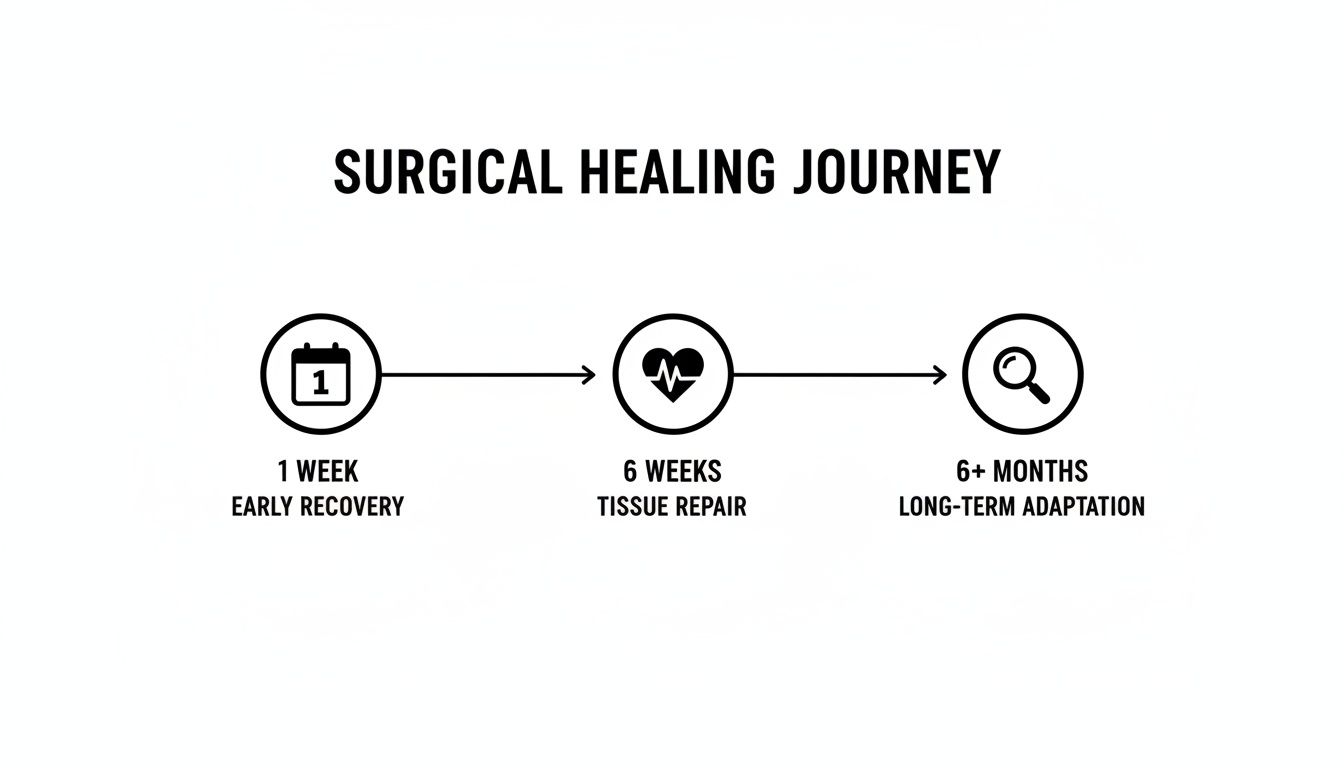
As you can see, the first week is all about initial recovery and rest. The six-week point signals a return to most of your normal activities, and the long-term phase is when the final refinements take shape.
For a quick reference, here’s a table summarizing what to expect during each phase.
Labiaplasty Healing At a Glance
| Recovery Phase | Typical Duration | Key Milestones and Symptoms | Activity Level |
|---|---|---|---|
| Early Recovery | Week 1 | Peak swelling, bruising, and discomfort. Focus on rest and gentle hygiene. | Strictly rest. Minimal walking. No lifting or strenuous activity. |
| Tissue Repair | Weeks 2-6 | Swelling and discomfort rapidly decrease. Incisions are closed but still delicate. | Return to desk work and light daily activities. No exercise or intimacy. |
| Functional Recovery | 6 Weeks | Initial healing is complete. Tissues have regained significant strength. | Most surgeons clear patients to resume all normal activities, including exercise and sex. |
| Long-Term Adaptation | 6-12+ Months | Residual swelling fully resolves. Scars soften, fade, and mature. | No restrictions. Final aesthetic results become apparent. |
This table provides a high-level view, but let’s break down what each of these milestones really feels like.
Understanding the Major Milestones
Your recovery can be broken down into a few critical timeframes. Knowing what happens during each one helps set realistic expectations and ensures you follow your surgeon's aftercare advice at just the right moments.
- The First Week: This is your most intensive period of rest. Swelling and discomfort will be at their peak, so your main job is to focus on gentle cleansing, icing, and minimizing all activity.
- Weeks Two to Six: You'll start feeling much more like yourself. Most patients are comfortable returning to desk work and light daily routines, but anything strenuous—especially exercise and intimacy—is still off-limits.
- The Six-Week Mark: This is a major milestone. By now, the initial healing is complete, and surgeons typically clear patients to resume all normal activities, including exercise and sexual intercourse.
The six-week milestone isn't arbitrary. It represents the point where the surgically repaired tissues have regained enough tensile strength to withstand the normal stresses of daily life and physical intimacy without compromising your results.
The Final Phase of Healing
Even after you get the green light at six weeks, your body is still working behind the scenes. From six weeks up to six months (and sometimes even a year), the last traces of swelling will slowly disappear, and scar tissue will continue to soften, flatten, and fade. The beautiful aesthetic results you see at the two-month mark will only continue to refine and look more natural over time.
This gradual process is exactly why surgeons advise waiting at least six months before assessing your final outcome. For a deeper dive into what to expect from the entire process, you might find it helpful to read The Ultimate Labiaplasty Guide.
The First Two Weeks: Your Immediate Recovery Guide
The first 14 days after your labiaplasty are the most critical part of your healing journey. This is when your body is doing its most intensive repair work, and your main job is to create the best possible environment for it to succeed. Think of this period like laying the foundation for a new house—getting it right from the start ensures a strong, beautiful result later on. Your focus will be on two key areas: managing symptoms and meticulous aftercare.
Swelling, bruising, and a general sense of discomfort are all completely normal and expected. These aren't signs of a problem; they are your body’s natural healing mechanisms kicking into high gear. Discomfort usually peaks within the first 48 to 72 hours and then begins to gradually fade.
Managing Discomfort and Swelling
Getting a handle on these initial symptoms is crucial for your comfort and can have a real impact on how smoothly you heal. Your surgeon will provide a personalized pain management plan, which is always your first line of defense.
Here are the essential tools for your immediate recovery:
- Prescribed Medication: Be sure to take your pain medication exactly as directed, even if you feel like the pain is manageable. Staying ahead of discomfort is far easier than trying to play catch-up once it becomes intense.
- Cold Compresses: Gently applying a cold pack wrapped in a clean, soft cloth for 15-20 minutes at a time can feel incredibly soothing. This helps constrict blood vessels, which in turn reduces both swelling and bruising. Plan on doing this several times a day for the first two or three days.
- Elevated Rest: When you’re resting, try propping your hips up slightly with pillows. This simple trick uses gravity to help drain fluid away from the surgical area, which does wonders for minimizing swelling.
Remember, swelling can sometimes be asymmetrical, meaning one side might look more swollen than the other. This is quite common and almost always resolves on its own as you continue to heal.
Essential Aftercare and Hygiene
Keeping the surgical area perfectly clean is non-negotiable. It’s the best way to prevent infection and make sure your incisions heal cleanly. Your surgeon’s instructions are your most important guide, but they will almost certainly include these core practices.
A peri bottle—a small squirt bottle—will become your best friend for a little while. After using the restroom, you’ll use it to gently rinse the area with warm water. Afterward, very gently pat the area dry with a fresh, soft towel or gauze. Avoid any rubbing at all costs.
You’ll also need to adjust a few daily habits to protect the delicate, healing tissues.
- Clothing: Stick to loose-fitting cotton underwear and baggy pants or skirts. Anything tight can cause friction and irritation, which will only slow down healing and increase your discomfort.
- Sitting: Try to avoid sitting directly on the surgical site. A donut pillow can be a real lifesaver, as it lets you sit without putting pressure right on the labia. When you can, reclining is even better than sitting fully upright.
- Activity: Your only job right now is to rest. Short, gentle walks to the bathroom are perfectly fine, but all other activities—including household chores and lifting anything heavier than a book—are off-limits.
Normal Sensations During Early Healing
As your body heals, you’re going to experience a range of new sensations. Itching and a feeling of tightness are two of the most common, and while they might be a little annoying, they are actually good signs. Itching tells you that nerve endings are regenerating and the skin is healing. The tightness is just a result of the initial swelling and the sutures holding the tissues in their new position.
It is absolutely critical that you resist the urge to scratch. Scratching can damage your stitches or introduce bacteria, leading to complications. If the itching becomes intense, a gentle cold compress can often provide immediate relief.
For a more detailed look at what to expect each day, our day-by-day labiaplasty recovery guide offers a deeper exploration of this critical phase. By carefully following these steps, you set the stage for a smooth and successful recovery.
Weeks Three to Six: Finding Your Rhythm Again
This stage in your labiaplasty healing is often the most rewarding. The most intense discomfort and swelling from the first two weeks start to subside, and you finally begin to feel more like yourself. While you can't see it, your body is still working hard beneath the surface to repair and strengthen the tissues.
Think of it like getting back on the main road after a long detour through slow city streets. The pace picks up, and your destination feels much closer. This period is the bridge between the intensive, early recovery phase and getting back to your normal life, but it’s important to navigate it carefully to avoid any bumps in the road.
During weeks three and four, most patients can start easing back into their daily routines. The keyword here is ease. Even if your incisions look good on the outside, they are still quite delicate.
Reintroducing Light Activities
As you start to feel better, you can gradually bring low-impact activities back into your life. How you handle this step plays a big role in your final outcome and how long your personal labiaplasty healing takes.
- Returning to Work: If you have a desk job, you’ll likely feel ready to go back to work during this time. Just be sure to use a donut pillow to keep direct pressure off the area, and get up to walk around for a few minutes every hour.
- Household Chores: Light tasks are usually fine now. Think folding laundry or preparing simple meals. You still need to avoid anything that requires heavy lifting, straining, or significant bending.
- Gentle Walks: Short, easy walks are fantastic for promoting good circulation, which is essential for healing. Listen to your body—don't push yourself or go for long hikes just yet.
It is absolutely critical to continue avoiding all strenuous activities. That means no running, cycling, heavy lifting, or high-impact workouts. These movements create friction and tension that can easily disrupt the delicate healing tissues and compromise your results.
Think of your healing incisions like a freshly glued seam on a delicate piece of silk. It might look solid, but it needs time to fully cure and gain its strength. Putting too much stress on it too soon can cause it to pull apart.
The Six-Week Milestone: What It Really Means
Reaching the six-week mark is a huge milestone in your labiaplasty recovery. For most women, this is when surgeons give the green light to resume all normal activities, including more intense exercise and, importantly, sexual intercourse.
This recommendation isn't arbitrary—it's based on the science of how our bodies heal. By six weeks, your incisions have regained a significant amount of their original tensile strength. This means the repaired tissue is finally strong enough to handle the friction and stretching that comes with exercise and intimacy without risking separation.
Waiting the full six weeks is vital for several key reasons:
- Prevents Wound Dehiscence: This is a complication where the incision edges separate, which would require medical intervention and set your healing back.
- Minimizes Scar Tissue: Allowing the area to heal without undue stress helps ensure your scars are as fine and discreet as possible.
- Ensures Comfort: Resuming certain activities, especially sex, too early can be painful and ultimately counterproductive to your recovery and long-term satisfaction.
While traditional surgery requires this patience, it’s worth noting that newer technologies are changing recovery expectations. Imagine getting back to your routine in just two weeks. For some patients, that's now a reality with innovative bipolar radiofrequency treatments instead of classic surgery. One study showed the average recovery for this approach was a swift 14 days, allowing a much faster return to normal function compared to the typical 30-45 days. You can discover more about these advancements and their healing timelines in this medical review.
Even once you get the all-clear at six weeks, it's wise to start slow. Your body is still putting the finishing touches on the healing process, so ease back into your fitness routine and listen for any signals of discomfort.
Six Weeks to Six Months: Seeing Your Final Results Take Shape
Once you hit the six-week mark, you've moved into the final, most subtle phase of healing. This period isn't so much about active recovery as it is about patience, letting your body handle the delicate finishing touches. Even though you’ve likely been cleared for all normal activities, the full story of your labiaplasty healing extends far beyond this initial milestone.
Think of it like a sculptor who has just finished carving a statue. The main form is there, but the real beauty emerges during the slow, careful process of sanding, smoothing, and polishing the stone. From six weeks to six months, your body is doing just that—refining the results to reveal their true, final shape.
This long-term maturation process involves two key elements that unfold gradually over several months.
The Scar Maturation Process
At six weeks, your incisions are healed and secure, but the scar tissue itself is still quite new. It's perfectly normal for it to look a bit pink or feel slightly raised at this point.
Over the next several months, this tissue undergoes a significant remodeling process. It will slowly soften, flatten out, and fade in color, eventually blending in much more seamlessly with the surrounding skin. This is a critical point: what you see at two months is not the final look. The aesthetics continue to improve noticeably as the scars mature.
Resolution of Final Swelling
Most of the obvious swelling vanishes within the first few weeks, but a very subtle, residual amount can hang around for much longer. This last bit of puffiness is often so minor that you might not even notice it day-to-day.
However, it can temporarily obscure the delicate new contours of your labia. It’s the slow disappearance of this last trace of swelling that truly reveals the ultimate definition and shape achieved from your procedure. This is precisely why surgeons emphasize that your true, final result is typically only visible after the 3-to-6-month mark.
Your body's final refinements are a testament to its natural healing intelligence. The changes between month two and month six can be surprisingly significant, which is why patience becomes your most important tool during this time.
Managing your expectations during this phase is key to your peace of mind. The high patient satisfaction rate for labiaplasty, which often exceeds 94%, is closely tied to understanding this complete timeline. While you're back to light activities in a week or two, the full recovery truly spans six months or more. Surgeons will always advise waiting at least this long before even considering revisions for minor asymmetry, as what you see at three months may still be influenced by subtle, uneven swelling.
When to Discuss Your Final Results
It’s completely natural to closely examine your results as you heal. You might notice small asymmetries or have questions about how things are settling. However, it's vital to wait until your body has finished this maturation process before making any final judgments.
Most surgeons won't consider a revision surgery until at least six months post-op, and for very good reasons:
- Tissue Stability: The tissues need to be fully settled, soft, and stable before any additional surgery can be performed safely and predictably.
- Complete Swelling Resolution: What might look like an asymmetry at three months could just be uneven swelling that resolves on its own by the six-month mark.
- Scar Maturity: Operating on immature, still-healing scar tissue can lead to poor healing and unpredictable results the second time around.
If you have concerns, keep an open line of communication with your surgeon. They can offer reassurance and monitor your progress. By understanding this final phase, you can appreciate the subtle, beautiful changes that continue to unfold long after your initial recovery is complete. Visualizing these outcomes can also be helpful; looking at a gallery of labiaplasty before and after photos can give you a realistic idea of how results settle over time.
Key Factors That Influence Your Healing Time
While we can map out a typical healing timeline, your personal journey will always be unique. The real answer to "how long does labiaplasty take to heal?" isn't a single number—it’s a range that depends on several crucial variables. Knowing what these are helps you set realistic expectations and gives you more control over your own recovery.
Think of it like this: your body's ability to heal is like planting a garden. The final result depends on the quality of the seeds (your overall health), the specific planting method used (the surgical technique), and how well you tend to it afterward (your diligence with aftercare). Each part is essential.
Surgical Technique and Its Impact
Not all labiaplasty procedures are the same. The specific technique your surgeon chooses is one of the biggest factors influencing your initial recovery, and the two most common methods have slightly different healing profiles.
- Trim Method: This is a very direct approach where the surgeon trims the excess tissue along the edge of the labia minora. While effective, it can sometimes lead to more noticeable and prolonged swelling along the incision line.
- Wedge Method: With this technique, the surgeon removes a V-shaped wedge of tissue and brings the remaining edges together. Many surgeons prefer this approach because it preserves the natural, pigmented border of the labia. For some patients, it can also lead to a faster resolution of swelling.
Your surgeon will recommend the best technique for your specific anatomy and goals. Don't hesitate to ask them during your consultation why they favor a particular method and what its healing process typically looks like.
Your Personal Health Profile
Your body’s overall health provides the foundation for your entire healing process. A healthy body is simply better prepared to manage the stress of surgery and repair itself efficiently. Certain health factors and lifestyle choices can significantly speed up—or slow down—your recovery.
Good nutrition, for example, is non-negotiable. Your body needs a steady supply of protein, vitamins, and minerals to build new tissue and ward off infection. Staying hydrated is just as important for helping your cells function at their best.
Your commitment to your health before and after surgery is one of the most powerful tools you have. Simple choices, like eating a balanced diet and avoiding smoking, can make a measurable difference in how quickly and beautifully you heal.
On the flip side, some factors can throw major roadblocks in your body’s way.
- Smoking and Nicotine Use: This is one of the biggest obstacles to a smooth recovery. Nicotine constricts blood vessels, drastically reducing the flow of oxygen and essential nutrients to healing tissues. This can cause significant delays in wound healing and raises the risk of complications.
- Pre-existing Health Conditions: Any condition that impacts your immune or circulatory systems, like diabetes, can also slow down the healing process.
How Different Factors Impact Your Labiaplasty Recovery
Your healing timeline isn't set in stone. Many elements, from the surgical approach to your daily habits, can shift the outcome. Understanding these factors helps you and your surgeon create a recovery plan that's truly tailored to you.
The table below breaks down how different variables can either help or hinder your healing.
| Factor | Positive Impact (Faster Healing) | Negative Impact (Slower Healing) |
|---|---|---|
| Surgical Technique | A technique well-suited to your anatomy (e.g., Wedge for preserving natural edges, Trim for less incision tension). | An approach that puts unnecessary tension on the closure or compromises blood supply. |
| Patient Health | Excellent nutrition, proper hydration, and a strong immune system provide the building blocks for repair. | Poor nutrition, dehydration, or unmanaged conditions like diabetes slow down cellular repair. |
| Smoking/Nicotine | Being a non-smoker allows for optimal blood flow, delivering oxygen and nutrients to the surgical site. | Nicotine constricts blood vessels, starving tissues of oxygen and significantly delaying healing. |
| Aftercare Diligence | Strictly following all post-op instructions for rest, hygiene, and activity restrictions. | Ignoring instructions, returning to strenuous activity too soon, or poor hygiene. |
| Surgeon's Skill | An experienced surgeon uses refined techniques that minimize tissue trauma and promote clean healing. | Rough tissue handling or imprecise techniques can lead to more swelling and a higher complication risk. |
| Activity Level | Adhering to rest periods and gradually reintroducing activity as advised by your surgeon. | Too much movement, friction, or pressure on the area too early can cause wound separation or irritation. |
Ultimately, a successful recovery is a partnership between you and your surgeon. Your surgeon provides the expert technique, while you provide the healthy foundation and diligent aftercare needed for the best possible result.
The Critical Role of Aftercare Compliance
Finally, how closely you follow your surgeon's post-operative instructions is an absolute deal-breaker. These aren't just suggestions; they are a carefully designed protocol to protect your results and ensure you heal properly.
Ignoring advice to rest, jumping back into strenuous activity too soon, or slacking on hygiene can easily cause complications like infections, wound separation (dehiscence), or severe swelling. Any of these issues will set your recovery back. Your surgeon's plan is your roadmap to a smooth result—following it is the surest way to get there.
Your Labiaplasty Recovery Questions Answered
As you navigate your recovery, it’s completely normal for specific questions to pop up. This final section is designed to be your quick-reference guide, answering the most common concerns patients have during the labiaplasty healing process. Think of it as a helpful FAQ to give you peace of mind and reinforce what you can expect as you heal.
We’ve pulled together the questions we hear most often to provide clear, straightforward advice for the real-life situations you might encounter.
When Can I Go Back to Work After Labiaplasty?
The right time to return to work depends almost entirely on what you do for a living. The answer is very different for someone with a desk job versus a physically demanding role.
If you have an office job or work remotely, you’ll likely feel ready to return within 3 to 7 days. The key is to make yourself comfortable—using a donut pillow is a must to avoid putting direct pressure on your incisions. It’s also important to get up and walk around for a few minutes every hour to keep your circulation moving.
On the other hand, if your job requires heavy lifting, constant movement, or long hours on your feet, you need to plan for more downtime. It’s smart to schedule at least 2 to 3 weeks off. Rushing back into a physically active job is a recipe for increased swelling and tension on your stitches, which can seriously delay healing.
Always talk through your specific job duties with your surgeon. They’ll give you a personalized timeline based on your unique procedure and daily physical demands.
Is Itching a Normal Part of Labiaplasty Healing?
Yes, absolutely. While it can be incredibly annoying, itching is a very common—and completely normal—part of the healing journey. It's actually a good sign that your body is busy repairing itself.
The itching sensation usually kicks in as your incisions heal and the tiny nerve endings in the tissue start to regenerate. You’ll probably notice it most during the first one to two weeks.
It is absolutely critical to resist the urge to scratch. Scratching can damage the delicate sutures, introduce bacteria, and lead to complications like an infection or poor scarring.
To manage the itch, your surgeon will give you specific aftercare instructions. Following your cleaning routine with a peri bottle and gently patting the area dry is key. They might also suggest applying a prescribed antibiotic ointment, which can soothe the skin and keep it protected. If it gets particularly bad, a gentle, cloth-wrapped cold compress can also offer some temporary relief.
How Long Will the Swelling Last After Labiaplasty?
Swelling is your body's natural response to surgery, and you can expect it to be most noticeable during the first 1 to 2 weeks. During this time, the area will be quite puffy, and it’s common for the swelling to look a little uneven from one side to the other.
You'll see a dramatic improvement by the six-week mark, when the vast majority of the swelling has gone down. At this point, you'll have a very good idea of what your final result will look like. However, a small amount of subtle, residual swelling is known to stick around for a while longer.
This last bit of swelling can last for 3 to 6 months, and you might notice it fluctuates a little with your menstrual cycle or after a busy day. Your final, fully refined result will only be visible once every last bit of this swelling has resolved. This is why surgeons always advise waiting up to six months before assessing the final aesthetic outcome.
Here’s a quick breakdown of what to expect:
- Weeks 1-2: Peak swelling. Manage this with rest and cold compresses.
- Weeks 3-6: Significant reduction. The area will look much more refined.
- Months 3-6: The last of the subtle swelling disappears, revealing your final results.
Using cold compresses exactly as directed in the first 48-72 hours is one of the best things you can do to control that initial swelling and bruising.
What Are the Signs of a Complication During Recovery?
Complications are rare, especially when you follow your post-op instructions to the letter, but it’s crucial to know the warning signs. Catching a potential issue early is the key to managing it effectively.
You should call your surgeon’s office immediately if you experience any of these symptoms:
- Severe or Worsening Pain: Pain that isn’t touched by your prescribed medication or seems to be getting worse instead of better.
- Excessive Bleeding: Any bleeding that soaks through your dressings or sanitary pads in a short amount of time.
- Signs of Infection: Look for a foul-smelling discharge, pus coming from the incisions, spreading redness, or if the area feels warm or hard to the touch.
- Fever: A temperature over 101°F (38.3°C) can signal a body-wide infection.
- Wound Separation (Dehiscence): If you notice any of your stitches have come apart and the incision edges are no longer together.
These symptoms could point to an infection, a hematoma (a collection of blood under the skin), or a problem with wound healing. Your surgical team is there to help, so never hesitate to reach out if you’re worried about anything during your recovery.
At Labiaplasty.com, we are dedicated to providing clear, reliable information to empower you on your surgical journey. From understanding recovery timelines to finding a qualified surgeon in your area, our resources are designed to help you make confident and informed decisions. Explore our comprehensive guides and doctor directory at https://labiaplasty.com.
