
You may be looking into a vaginal rejuvenation laser because something feels different than it used to. Dryness after menopause. Less friction or support after childbirth. Discomfort with sex. A sense that your body changed, and you want to know whether there's a treatment that's effective without jumping straight to surgery.
That's a reasonable place to start. Patients often arrive after reading polished clinic pages that promise tightening, better intimacy, bladder support, and fast recovery. The problem is that laser treatment sits in a gray zone between meaningful symptom relief for some people and overpromising marketing for many others. The right question isn't whether a vaginal rejuvenation laser exists. It's whether it matches your anatomy, symptoms, goals, and tolerance for repeat treatment.
Considering Vaginal Laser Rejuvenation
Patients who ask about laser treatment aren't chasing a trend. They're trying to solve a real quality-of-life problem. Common concerns include vaginal dryness, irritation, painful intercourse, reduced sensation, and a feeling of looseness after delivery or aging.
A vaginal rejuvenation laser is one possible tool. It isn't the only tool, and it shouldn't be presented as a universal fix. Depending on the problem, the better option may be pelvic floor therapy, hormone treatment, surgery, watchful waiting, or sometimes no procedure at all.
The first question to ask
Before booking anything, define the main problem in plain language:
- Dryness and irritation: Symptoms often overlap with menopausal tissue change.
- Pain with intercourse: The cause may be tissue thinning, pelvic floor spasm, scar sensitivity, or several issues together.
- Vaginal laxity: Severity matters. Mild laxity and moderate laxity are not the same problem.
- Urinary leakage: Leakage with coughing or exercise may not improve just because tissue is heated.
If you're also comparing office treatments with nonprocedural ideas, it helps to understand the gap between supervised care and consumer solutions. This overview of at-home vaginal rejuvenation options can help frame why professional evaluation still matters.
A good consultation should narrow the problem before it recommends a procedure.
What realistic patients do differently
The patients who make the best decisions usually do three things. They separate symptom relief from cosmetic language. They ask whether the treatment is meant to improve tissue health, address laxity, or both. And they ask what happens if laser doesn't work well enough.
That last question matters. If a treatment only helps a little, or only for a while, you should know that before you start. Vaginal laser treatment can be useful in selected patients, but it works best when expectations are specific and candidacy is tight.
How Vaginal Lasers Stimulate Tissue Renewal
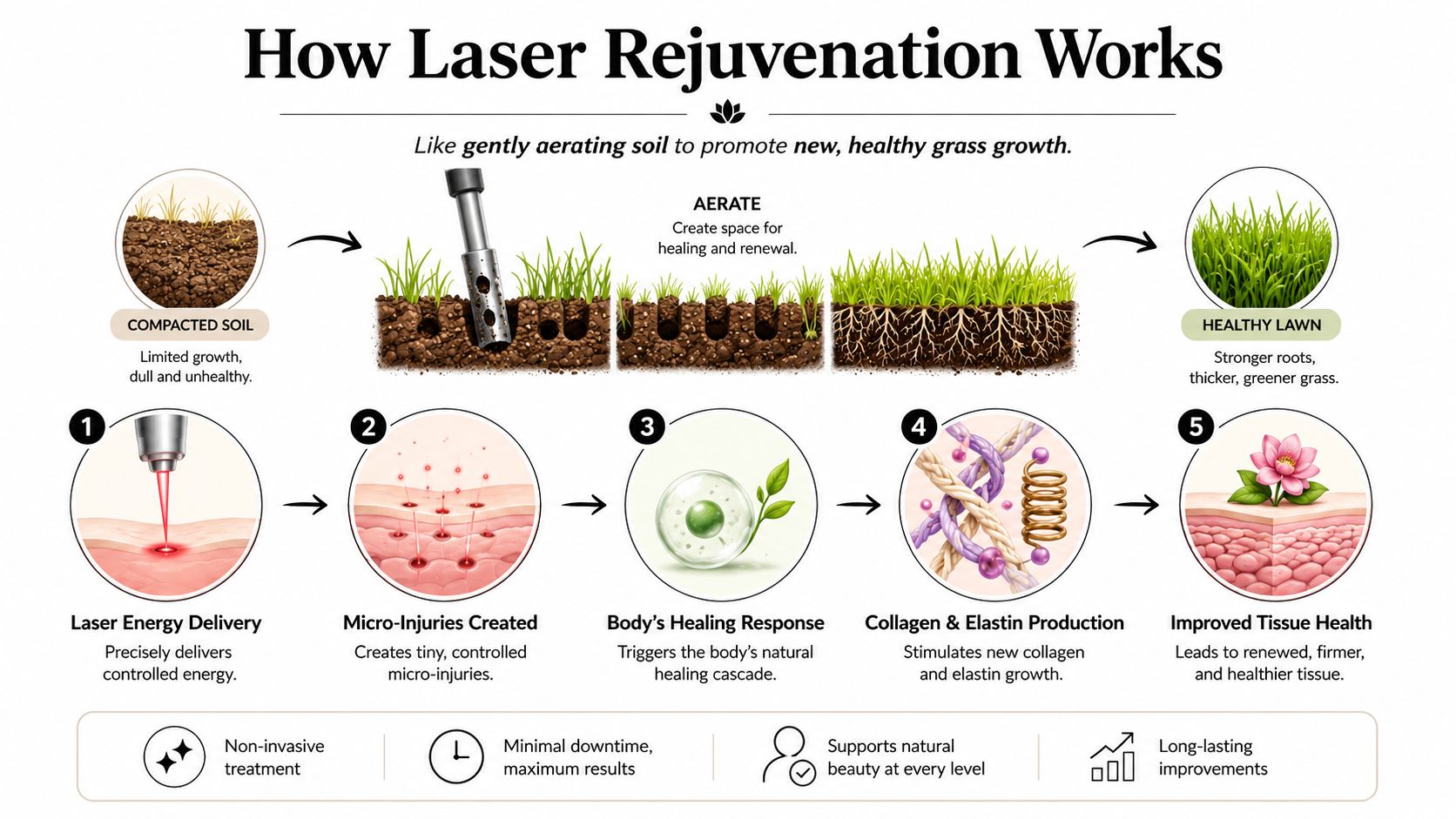
Vaginal laser treatment works by creating controlled thermal injury in the superficial tissue lining. The goal is to trigger a healing response that may support collagen remodeling, improve blood flow, and increase tissue hydration over time, rather than produce immediate mechanical tightening, as described in this review of vaginal laser mechanisms and treatment protocols.
How the repair process actually works
A lawn aeration comparison is useful here. The benefit does not come from flattening or stretching tissue. It comes from creating small, measured zones of injury that prompt repair.
That repair process takes time. After treatment, the body responds with inflammation, healing, and gradual remodeling. In the right patient, that may translate into tissue that feels less fragile, somewhat better lubricated, and more resilient.
Results are rarely immediate. Patients who expect a same-day change are often misunderstanding what the treatment is designed to do.
Why treatments are usually done in a series
Most protocols use a series of sessions spaced several weeks apart because tissue remodeling is gradual. In practice, I tell patients to judge the result after the full course and follow-up period, not after one appointment.
That matters for candidacy. Someone with mild symptoms related to tissue thinning may notice incremental improvement over time. Someone expecting a major tightening effect from one visit is likely to be disappointed.
Practical rule: If a provider presents laser as an “instant tightening” treatment, the mechanism is being overstated.
CO2 and Er:YAG in patient-friendly terms
Patients usually hear about fractional CO2 and Er:YAG lasers. Both are used to stimulate tissue renewal, but they differ in how energy is absorbed and how much heat is delivered to tissue.
A simple clinical summary:
- Fractional CO2: Usually associated with a stronger thermal effect and a more aggressive treatment profile.
- Er:YAG: Often used with a more superficial or lower-heat profile, depending on settings.
Those differences matter, but the device alone does not determine the outcome. Settings, technique, treatment density, and patient tissue quality all affect both benefit and risk. Over-treatment can increase the chance of pain, spotting, discharge, delayed healing, or mucosal injury.
This is also where patient selection becomes more important than branding. A laser may help a patient with menopausal tissue change or mild irritation related to atrophy. It is much less likely to correct significant vaginal laxity, pelvic floor weakness, prolapse, or symptoms that really call for surgery or another diagnosis-specific treatment.
Evaluating the Evidence for Vaginal Laser Therapy
Laser treatment is marketed for a wide range of concerns. The most common are genitourinary syndrome of menopause, vaginal dryness, painful sex, and mild urinary complaints. The challenge is that marketing language often treats these as one category, when they are clinically different problems with different causes.
What made the field controversial
A major turning point came in 2018, when the FDA warned that the safety and effectiveness of devices marketed for vaginal “rejuvenation” had not been established and cited reports of burns, dyspareunia, and chronic pain. The warning also reflected concern that companies were marketing these devices for cosmetic and menopausal indications without approval. By 2021, controversy remained because one double-blinded, sham-controlled randomized trial in 90 women found that fractional CO2 laser treatment did not improve GSM symptoms more than sham treatment over 12 months, as summarized in this commentary on the evidence and FDA warning.
That doesn't mean every patient gets no benefit. It means the evidence base is mixed, and strong claims need restraint.
Where patients can get misled
Some clinic pages merge several ideas into one sales message:
- dryness relief
- improved lubrication
- better sexual function
- tighter tissue
- less urinary leakage
- long-lasting results
Those are not interchangeable outcomes. A person with tissue thinning after menopause is different from a person with moderate structural laxity after childbirth. A patient with pelvic floor weakness is different from a patient whose main complaint is friction loss. One procedure may help one symptom and do very little for another.
What a careful reading of the evidence suggests
The fairest conclusion is this:
| Symptom area | What to keep in mind |
|---|---|
| Dryness and irritation | Some patients report improvement, but durability and ideal candidates remain unsettled. |
| Pain with intercourse | Pain has many causes. Laser won't reliably fix pain driven by pelvic floor tension, scar tenderness, or unrelated vulvar disorders. |
| Urinary leakage | Improvement isn't guaranteed, especially if the main issue is support rather than tissue quality. |
| Laxity | Severity matters. Mild concerns and moderate concerns shouldn't be lumped together. |
Patients do best when the consultation identifies one primary goal instead of promising improvement across everything at once.
If a clinic can't explain where the evidence is uncertain, that's a problem. A responsible recommendation should include the possibility that your symptoms may improve only partially, temporarily, or not at all.
Your Treatment Journey Step by Step
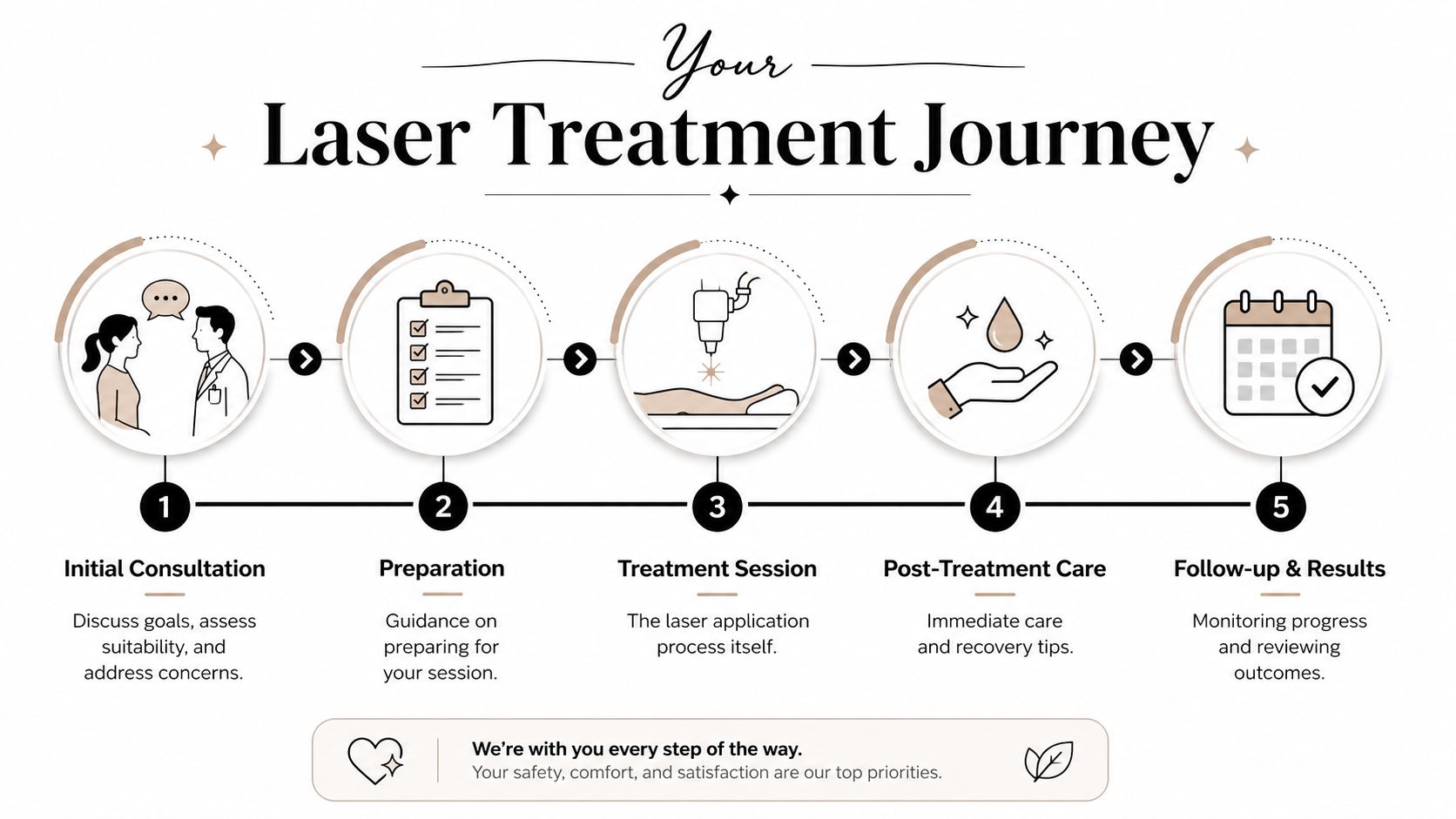
The experience is usually straightforward in the office, but the decision-making around it should be careful. A good treatment course starts with diagnosis, not scheduling.
The consultation
At the first visit, the most important part isn't the device. It's the exam and discussion. Your clinician should ask what changed, when it changed, whether symptoms are internal or external, and whether your goals are comfort, function, appearance, or all three.
Questions worth asking include:
- What problem are you treating? Dryness, GSM symptoms, laxity, irritation, or something else?
- Why laser instead of another option? The answer should be specific.
- What result would count as success? Less pain, better lubrication, more support, improved intercourse, or a modest change in sensation?
- What if I'm not a good candidate? You want a real answer, not a sales close.
Later in the process, many patients find it helpful to watch a physician explanation of a treatment visit and discussion points:
The treatment day
The procedure is usually performed in the office. Most patients describe pressure, warmth, or a prickly internal sensation rather than a major recovery event. The exact feel depends on the device, settings, anatomy, and whether the treatment is internal, external, or both.
The session itself is only one part of the process. Since treatment is commonly done as a series, the first appointment is the beginning of a course, not the full result.
The first days and weeks
Typical aftercare is conservative. Patients are often told to avoid friction and irritation while tissue settles. Exact restrictions vary by clinician and device, so the office instructions matter more than generic online advice.
A simple timeline often looks like this:
- First 24 hours: Mild sensitivity, warmth, spotting, or discharge can occur.
- First week: Individuals typically resume normal daily activity, but internal friction is usually limited for a period recommended by the treating physician.
- Following weeks: Changes, if they occur, tend to build gradually as tissue remodeling progresses.
Recovery is usually easier than surgery, but “easy recovery” doesn't mean “no aftercare.”
Laser Rejuvenation vs Surgical and Other Options
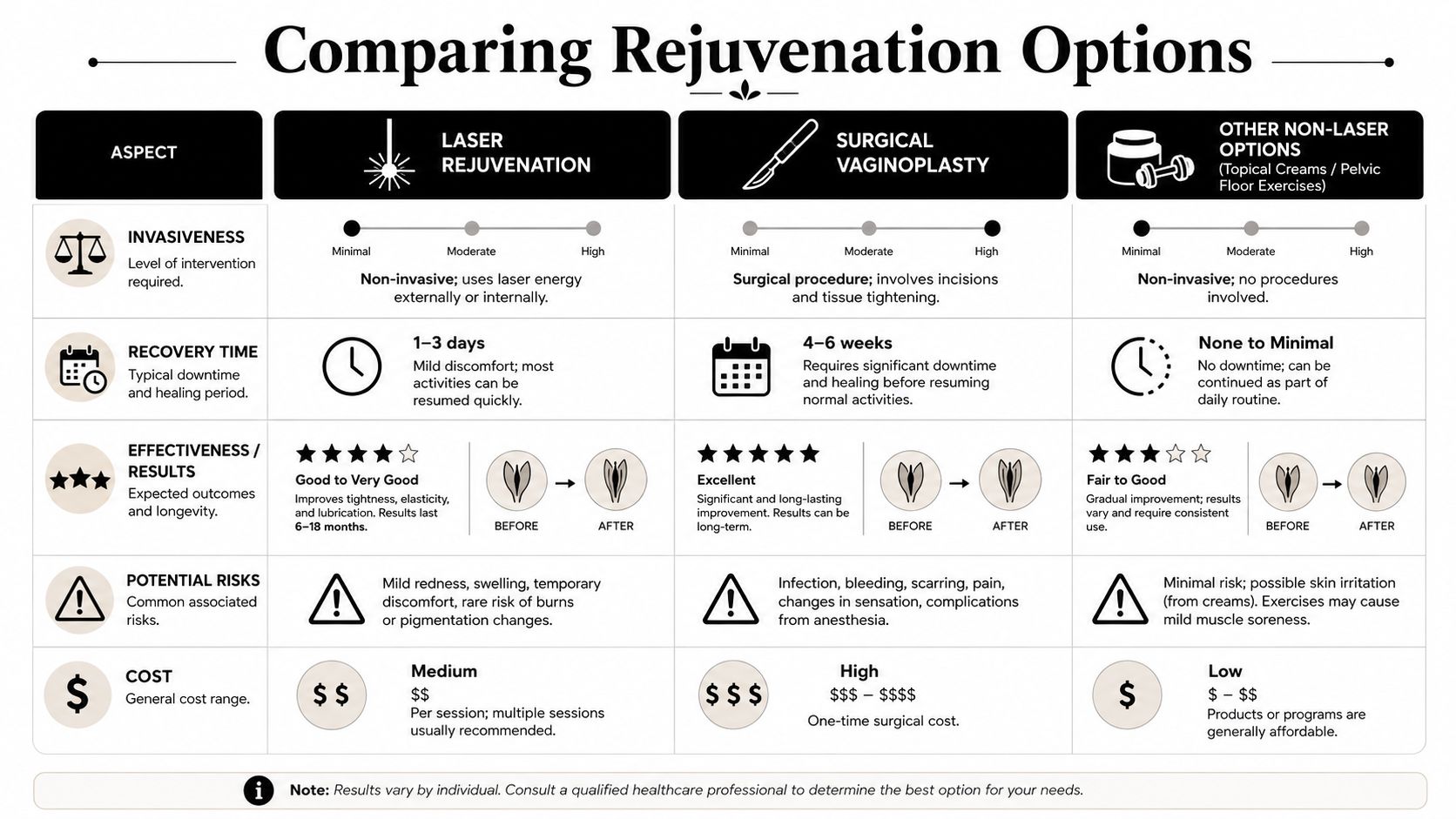
The biggest mistake I see is comparing every treatment to the word “rejuvenation” instead of comparing treatments to the actual problem. Laser, vaginoplasty, pelvic floor therapy, and nonprocedural care each solve different things.
When laser makes sense
Laser is usually most appealing to patients who want an in-office option with limited downtime and who understand that results may be modest and may require repeat treatment. It tends to fit best when the concern is tissue quality or mild laxity rather than significant structural looseness.
That distinction matters. A clinical study found that CO2 laser improved sexual function scores in women with light-degree vaginal laxity, while vaginoplasty produced a larger improvement in women with moderate-degree laxity, suggesting that treatment should be matched to severity, as reported in this clinical comparison of CO2 laser and vaginoplasty.
When surgery is the better answer
Surgery is more invasive, but it can be more appropriate when the issue is structural. If the vaginal canal feels substantially widened, if tissue support is the true concern, or if the patient wants a stronger and more durable anatomic change, a surgeon may recommend vaginoplasty rather than office-based laser treatment.
That doesn't make surgery “better” in every case. It makes it more effective for the right case.
A useful side-by-side discussion appears in this guide on labiaplasty vs laser vaginal rejuvenation, especially for patients trying to separate internal functional concerns from external appearance goals.
Other options patients should consider
Not every symptom needs energy-based treatment. Depending on the complaint, alternatives may include:
- Pelvic floor physical therapy: Often more relevant when pressure, weakness, or intercourse pain relates to muscle dysfunction.
- Hormonal management: Often part of the conversation when menopausal tissue change is central.
- Observation: Sometimes the symptom is mild enough that a procedure isn't worth it.
- External surgery such as labiaplasty: Relevant when the concern is the labia, not the vaginal canal.
Here's the practical framework I use:
| If your main issue is | Usually worth discussing first |
|---|---|
| Mild internal tissue change | Laser or other conservative treatment |
| Moderate structural laxity | Surgical evaluation |
| Pain with sex | Full diagnosis before any procedure |
| Bladder leakage | Cause-specific workup, not assumptions |
| External appearance | Procedure options focused on the vulva, not the vaginal canal |
The best treatment is the one that matches the mechanism of the problem. That sounds obvious, but it's exactly where marketing often goes off track.
Understanding Risks Costs and Provider Qualifications
Patients usually focus first on whether laser works. The smarter question is broader: Is the likely benefit worth the medical risk, financial cost, and effort of repeat care in my case?

The documented risks
Adverse events are not just theoretical. An ICS 2025 abstract reported both clinical outcome data and a review of reported harms. In that review, burns occurred in 47% of cases (86 reports), scars in 38% (71), pigmentation changes in 24% (43), and disfigurement in 16% (29), according to the ICS abstract on diode laser outcomes and adverse-event review.
Those figures don't tell you how often a carefully selected patient in an expert practice will have a complication. They do tell you that complications can be serious enough to deserve a real informed-consent discussion.
Clinical bottom line: If a provider minimizes burns, scarring, or pigment change as if they're irrelevant, keep looking.
The cost question patients forget to ask
Cost isn't just the first session. It's the full plan. Since laser treatment is commonly offered in a series and many practices discuss maintenance, the relevant number is your likely total commitment over time.
Because pricing varies widely by region, device, and practice, the most useful approach is to ask for a written quote that separates consultation fees, each treatment session, any bundled pricing, and follow-up costs. If you want a practical overview of what contributes to pricing, this guide on vaginal rejuvenation cost is a helpful starting point.
How to vet the person holding the laser
Use your consultation to evaluate judgment, not bedside charm alone.
- Ask about candidacy standards: A strong provider should tell you who is not a good candidate.
- Ask which device they use and why: The answer should focus on tissue goals and safety, not branding.
- Ask how they handle complications: Every real practice should have a clear plan.
- Ask what result is realistic for your symptom: Vague promises are a warning sign.
- Ask whether surgery or another treatment would fit better: You want honesty more than enthusiasm.
The right clinician won't sell laser as a replacement for every other treatment. They'll tell you where it fits, and where it doesn't.
Frequently Asked Questions About Laser Treatments
Does the procedure hurt
A common scenario in consultation is a patient asking whether this will feel like a Pap test, a waxing appointment, or something more intense. The honest answer is that comfort varies. Internal treatment is often described as heat, pressure, or a prickling sensation rather than sharp pain, while external treatment can feel more sensitive because the tissue is thinner and more exposed.
Ask how the office handles pain control before you book. Some practices use topical anesthetic, some adjust settings conservatively, and some rely on the treatment being brief. That matters, especially if you have vulvar sensitivity, pelvic pain, or anxiety with exams.
Are results permanent
Usually, no. Tissue response can improve symptoms for a period of time, but laser treatment does not stop aging, menopause, childbirth-related change, or underlying pelvic floor problems. Cleveland Clinic notes that claims of permanent results from laser or radiofrequency treatment often lack solid scientific support, and repeat treatment is commonly discussed in practice, as explained in this Cleveland Clinic overview of energy-based treatments and vaginal rejuvenation.
This is one of the biggest candidacy questions. A patient seeking modest symptom improvement may accept a temporary result. A patient who wants a durable structural change usually needs a different conversation, often about surgery rather than laser.
Can laser replace vaginoplasty
Laser can be reasonable for selected patients with mild symptoms, especially if the goal is improvement in dryness, irritation, or a limited sense of laxity. It does not tighten deeper supportive structures the way a well-planned vaginoplasty can.
That distinction matters. If the concern is clear postpartum stretching, widened introital opening, or more significant looseness during intercourse, surgery is often the more predictable option. Laser is better viewed as a symptom-based treatment, not a substitute for every anatomic problem.
What about future childbirth
Future vaginal delivery can change the tissues again, so timing matters. If someone plans more pregnancies soon, I usually want the treatment plan to match that reality rather than pretend the result will be unaffected.
For a patient considering surgery for meaningful laxity, waiting until childbearing is complete often makes sense. For a patient bothered more by dryness or irritation than by structural change, a nonsurgical option may still be reasonable if she understands the limits.
Are at-home devices a substitute
In my view, no. The main issue is not just device strength. It is the lack of diagnosis.
Symptoms that patients describe as “looseness” or “rejuvenation concerns” may relate to genitourinary syndrome of menopause, pelvic floor dysfunction, scar tenderness, prolapse, infection, or skin disease. An office evaluation should sort that out first. A home device cannot tell you whether laser is appropriate, unlikely to help, or potentially the wrong treatment entirely.
If you're sorting through surgical and nonsurgical options and want a clearer starting point, Labiaplasty.com offers practical educational resources on candidacy, recovery, costs, videos, and provider research so you can go into a consultation better prepared.
