
You're probably here because you're trying to make sense of two competing feelings at once. One is hope. You want relief from discomfort, irritation, self-consciousness, or a shape that's been bothering you for years. The other is concern. You know this is surgery on sensitive tissue, and you want a clear answer to a hard question: what are the risks of labiaplasty?
That's the right question to ask.
In consultation, many patients tell me they've already read broad reassurance online, but what they still want is context. They don't just want to hear that a procedure is “safe.” They want to know what can go wrong, which problems are temporary, which problems can last, and how to tell the difference between a reasonable risk and a preventable one.
That mindset helps you.
The risks of labiaplasty shouldn't be used to frighten you away from a procedure that may improve comfort or quality of life. They should be used to sharpen your decision-making. The best consultations aren't built on sales language. They're built on anatomy, technique, healing, and honest trade-offs. If you understand those trade-offs, you're far more likely to choose well, prepare well, and recover well.
Navigating Hope and Concern in Your Labiaplasty Journey
A patient researching labiaplasty is rarely making a casual decision. Usually, she has already spent time adjusting clothing, avoiding certain workouts, changing how she sits on a bike seat, or wondering whether what she's experiencing is “serious enough” to justify surgery. Sometimes the concern is mostly functional. Sometimes it's aesthetic. Often, it's both.
That mix matters because motivation doesn't erase risk.
A thoughtful decision starts with a simple shift. Instead of asking, “Is labiaplasty risky?” ask, “Which risks matter most in my anatomy, my goals, and the technique being proposed?” That question is much more useful. It turns a vague fear into a concrete discussion.
The safest patient isn't the one who finds the most comforting website. It's the one who asks the most specific questions.
Many people also feel embarrassed bringing up this area of the body in detail. That's understandable, but it can work against you. Labiaplasty is one of those procedures where small technical choices can have a large effect on contour, healing tension, scar position, and sensation. If you stay vague because the topic feels intimate, your consultation may stay vague too.
What a good risk discussion should feel like
A high-quality consultation usually leaves you with more clarity, not more pressure. You should come away understanding:
- Which problem is being treated: irritation, tissue excess, asymmetry, appearance, or a combination.
- Which tissue will be removed or preserved: especially around edges, folds, and nearby sensory structures.
- What the main trade-offs are: scar placement, shape change, healing pattern, and the possibility of revision.
- What your surgeon is watching for: bleeding, wound separation, asymmetry, over-resection, and sensory change.
If that level of detail is missing, the conversation probably isn't detailed enough yet.
Why risk literacy matters
Patients sometimes think informed consent is just a form they sign. It isn't. It's a process of understanding what you're accepting and why. In labiaplasty, that means knowing that the important complications usually aren't dramatic medical emergencies. More often, they involve healing problems, contour problems, function problems, or dissatisfaction that leads to revision.
Those outcomes are still significant. They affect comfort, sexual function, appearance, and peace of mind.
The Full Spectrum of Medical and Surgical Risks
A common consultation scenario goes like this. A patient says, “I know every surgery has risks, but what are the specific ones here?” That is the right question. With labiaplasty, the meaningful risks are usually tied to bleeding, healing, tissue removal, scar placement, and how precisely the operation fits your anatomy.
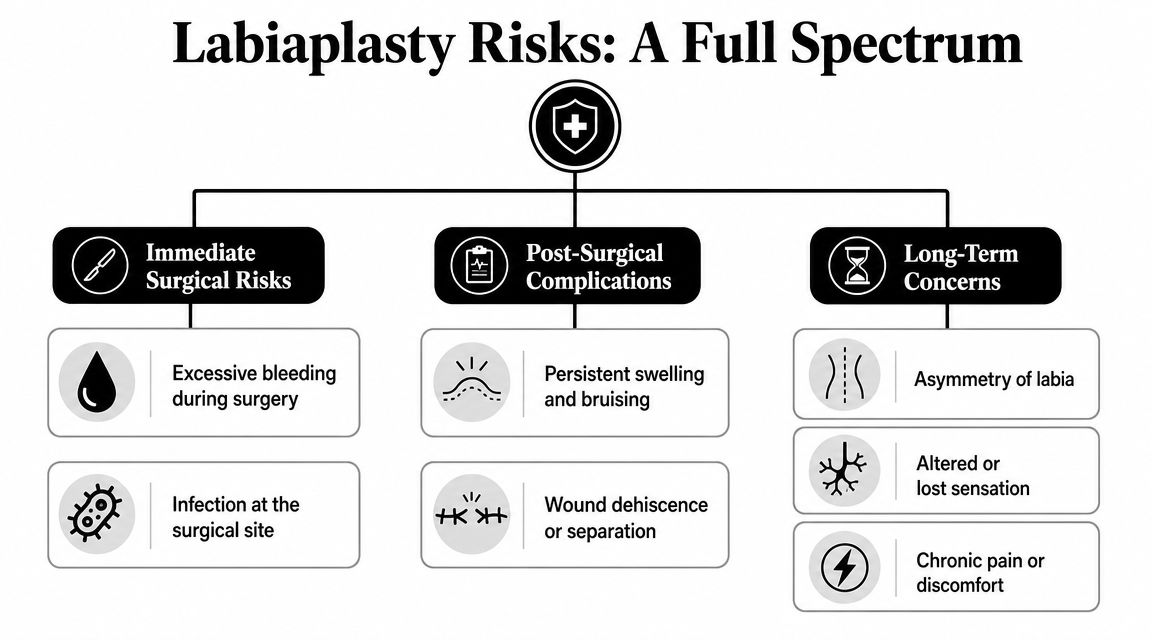
I find it most useful to organize these risks into three buckets: what can happen during or right after surgery, what can go wrong during healing, and what may persist after healing is complete. That framework helps patients ask better questions and helps surgeons explain trade-offs in a concrete way.
Immediate surgical risks
The American Society of Plastic Surgeons lists bleeding, hematoma, infection, and over-resection among the main concerns on the American Society of Plastic Surgeons labiaplasty page. Those are not interchangeable problems. Each points to a different part of surgical planning and technique.
A hematoma is a collection of blood under the skin. In this area, even a modest hematoma can create pressure, pain, and significant swelling because the tissue is delicate and vascular. Some resolve with observation. Others need prompt treatment.
Technique matters here. A patient considering surgery should ask what the surgeon does to control bleeding, how they close the incision, and what signs after surgery would make them worry about a hematoma rather than routine swelling.
The NHS also lists bleeding, infection, scarring, reduced genital sensitivity, blood clots, and anesthetic allergy on its NHS guidance on labiaplasty. Those broader surgical risks are uncommon, but they still belong in a serious consent discussion.
Post-surgical healing complications
Many of the problems that lead to stress after labiaplasty are healing problems, not operating room emergencies. The pattern I want patients to understand is simple. This area deals with moisture, friction from clothing, movement, and tension across a small incision line. Even a well-performed procedure can heal imperfectly.
One of the most important terms to know is dehiscence, which means wound separation. That can be minor, with only a small edge opening, or more significant. In either case, it can affect contour, prolong healing, and increase the chance of a noticeable scar.
Other healing issues include:
- Infection, which may show up as increasing pain, redness, drainage, odor, or swelling that is getting worse instead of better
- Delayed healing, where the tissue remains raw, fragile, or slow to close
- Persistent or uneven swelling, which can hide the final contour for longer than expected or signal a developing problem
- Scar irregularity, including thickening, notching, widening, or visible distortion along the edge
This is also where technique-specific risk assessment becomes useful. If a surgeon recommends a trim approach, ask where the scar will sit and how they reduce the chance of edge irregularity. If they recommend a wedge or more complex reduction, ask how they protect blood supply to the tissue and what their wound separation rate is in that technique. Patients do not need to know every technical detail. They should know enough to connect the chosen method to the likely failure points.
Practical rule: Call your surgeon if recovery stops following a steady trend toward improvement. Worsening pain, increasing asymmetry, fresh bleeding, pus, fever, or a wound that appears to be opening should not be written off as “normal healing.”
Long-term concerns
The longer-term risks are often the ones patients care about most because they affect comfort, appearance, and daily life after the swelling is gone. The Australian Society of Plastic Surgeons highlights hemorrhage or hematoma, infection, wound problems, asymmetry, scarring, altered sensation, and the possibility of revision on its labiaplasty procedure overview.
For risk discussions, I suggest patients separate long-term concerns into three questions.
First, Was the right amount of tissue removed? Too little can leave the original problem largely unchanged. Too much can create tightness, dryness, visible distortion, or exposure of tissue that was previously protected.
Second, Did the tissue heal in the intended shape? A technically sound plan can still end with asymmetry, notching, or scar pull if healing is uneven.
Third, Has function been preserved? That includes comfort in clothing, exercise, sexual activity, and ordinary daily movement. Functional and sensory issues deserve their own discussion, but they start with the surgical decisions made here.
A good consultation should connect each risk to a practical question:
- What complication is most associated with the technique you recommend?
- How do you try to prevent over-resection?
- What does normal healing look like at one week, one month, and three months?
- At what point would you consider a problem to be a complication rather than routine recovery?
- How often do your patients need revision, and for what reasons?
That is how patients should think about risk in labiaplasty. Not as a vague warning, but as a series of specific trade-offs tied to anatomy, technique, healing conditions, and surgeon judgment.
Understanding Functional and Sensory Complications
For many patients, the most important risk isn't bleeding or bruising. It's whether the surgery could change how the area feels.

That concern is valid. Specialty guidance and clinical reviews note possible nerve damage, persistent vulvodynia, pain with sex, and reduced sensitivity. One review cited fewer than 5% of patients with pain or dyspareunia by postoperative day 28, but also noted that about 7% needed minor revisions, which shows that early improvement doesn't erase all longer-term risk, according to the patient guidance from Your Pelvic Floor.
Why sensation can change
The tissue involved in labiaplasty is delicate, mobile, and highly innervated. Sensation can change for different reasons:
- Direct nerve irritation or injury: even careful surgery occurs near sensory pathways.
- Scar tension: a tight or contracting scar can pull on tissue and change how it feels.
- Adhesion or notching: irregular healing can create mechanical discomfort with movement or sex.
- Over-resection: when too much tissue is removed, loss of protective tissue can translate into dryness, tenderness, or friction-related pain.
Patients often think of sensation change as numbness alone. In practice, it can go in either direction. Some patients experience reduced sensitivity. Others develop hypersensitivity, tenderness, or pain with friction.
Function matters as much as appearance
The risks of labiaplasty can extend beyond cosmetic concerns. If the final contour looks smaller but the tissue feels tight, dry, or painful, the operation hasn't served the patient well.
A useful way to think about this is that surgery changes both shape and mechanics. The tissue has to rest, move, stretch, and tolerate contact after it heals. A technically acceptable result on a photograph may still be a poor functional result if scar position or tissue loss creates discomfort.
Ask your surgeon specifically how the planned technique protects tissue, avoids excessive tension, and accounts for sensation. If the answer stays generic, keep asking.
Questions worth asking on this topic
Bring these into your consultation:
- What structures are you trying to preserve in my case?
- How do you avoid over-resection?
- If I develop pain with sex or persistent tenderness, how would that be evaluated and treated?
- What is your threshold for recommending revision versus waiting for scar maturation?
Those questions usually produce more useful answers than “Will I lose sensation?” because they force the discussion toward anatomy and decision-making, not reassurance alone.
Cosmetic Outcomes and The Risk of Revision Surgery
Even when surgery heals without infection or wound separation, a patient can still be unhappy with the result. That's an important distinction. In labiaplasty, a result may be medically uncomplicated but aesthetically or functionally disappointing.
A 2024 long-term outcomes study covering 748 patients found the most commonly reported complications were postoperative asymmetry in 45 patients (6.02%), scarring in 14 patients (1.87%), and revisional surgery in 42 patients (5.61%), according to the PubMed-indexed long-term study. Those numbers matter because they reflect real-world outcomes over time, not just a list of theoretical possibilities.
What patients usually mean by a “bad result”
Most dissatisfaction falls into a few recognizable categories. Some are subtle. Some are difficult to correct.
| Cosmetic Risk | Description | Potential Contributing Factors |
|---|---|---|
| Asymmetry | One side heals differently or appears smaller, longer, or more contoured than the other | Uneven tissue removal, pre-existing asymmetry, healing differences, swelling pattern |
| Visible scarring | Scar line is noticeable, thickened, or placed in a visually prominent area | Incision choice, tension, individual scar response, wound separation |
| Irregular edge or notching | The labial border looks scalloped, stepped, or disrupted | Closure tension, healing irregularity, edge design |
| Over-resection | Too much tissue is removed, sometimes creating tightness or an unnatural look | Aggressive reduction, poor planning, attempt to chase perfect symmetry |
| Under-correction | Tissue remains more prominent than the patient expected | Conservative resection, mismatch between goals and surgical plan |
Revision is its own procedure
Revision surgery isn't just a “touch-up.” It often means operating on tissue that has already been altered and scarred. That usually makes planning more restrictive. There may be less tissue available, less flexibility in scar placement, and less predictability in healing.
The emotional cost can be significant too. Patients often enter a revision process more anxious than they were the first time. They may also be trying to solve two problems at once: the original concern and the consequences of the first procedure.
If you're trying to understand what corrective surgery may involve, this overview of revision labiaplasty and common surgery issues is a useful starting point.
The risk that deserves the most respect
In my view, over-resection is the cosmetic risk patients should discuss most carefully. Asymmetry can sometimes be adjusted. Scar irregularities may soften. But once too much tissue has been removed, restoration is much harder.
That's why a conservative, anatomy-based plan often serves patients better than a plan built around a highly edited aesthetic ideal. In this procedure, “smaller” is not automatically “better.”
How You Can Actively Reduce Labiaplasty Risks
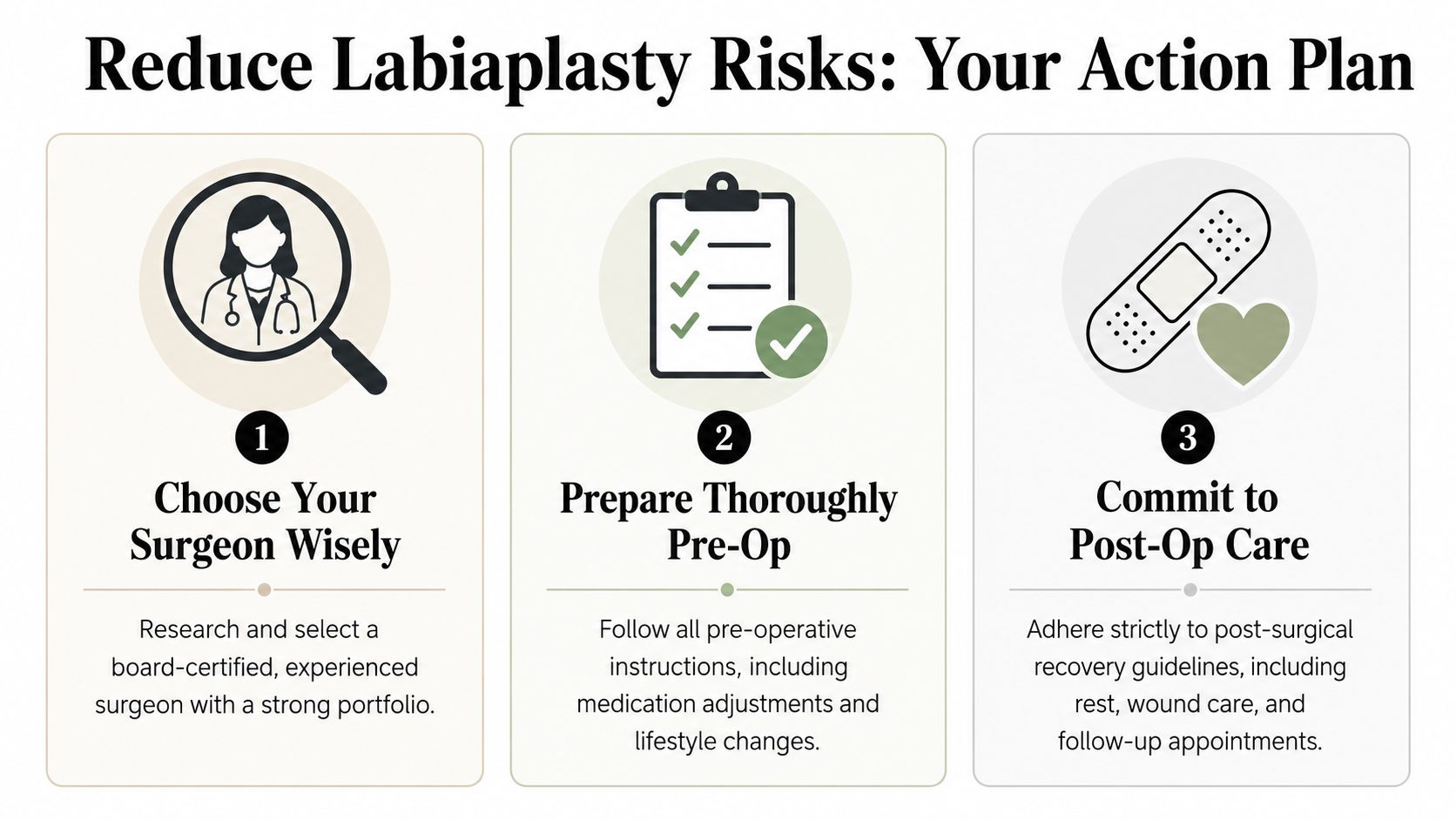
A safer labiaplasty usually starts before anyone enters the operating room. I tell patients to judge risk in three parts: who is operating, how the plan fits their anatomy, and whether they can realistically follow the recovery rules that protect healing.
Choose the surgeon based on judgment and planning
Good outcomes are tied to decision-making as much as technical skill. The right surgeon should be able to examine your anatomy, explain what bothers you functionally or cosmetically, and translate that into a measured surgical plan.
Look for concrete signs of good process:
- Relevant certification and training: the surgeon should be properly qualified for aesthetic genital surgery in your region.
- Procedure-specific experience: regular experience with labiaplasty matters more than broad cosmetic experience alone.
- Before-and-after photos that match your anatomy: not just narrow examples of one “ideal” result.
- A clear complication and revision policy: ask how healing problems, asymmetry, or wound separation are handled if they occur.
- Willingness to say no: a careful surgeon will decline surgery, or recommend a more conservative plan, when the requested change creates too much functional or aesthetic risk.
A practical research tool can help you compare options. Labiaplasty.com's surgeon directory and educational resources can help patients organize consultations and ask better questions.
Ask the surgeon to connect technique to risk
Patients reduce risk when they stop treating labiaplasty as one generic operation. Trim, wedge, and other reduction patterns create different scar locations, different tension patterns, and different trade-offs in healing.
A useful consultation sounds like this:
- Which technique fits my anatomy, and why?
- What problem are you trying to avoid with that choice?
- Where will closure be under the most tension?
- What is the main downside of your recommended method in my case?
- How do you decide how much tissue to leave behind?
Those answers matter because complications are often technique-linked. A closure under more tension may carry a higher risk of separation. A more aggressive reduction may lower the margin for error if swelling, scar contracture, or dryness becomes an issue later. A surgeon should be able to explain those trade-offs in plain language, not hide behind general reassurance.
Be honest about your part in recovery
Some patients are excellent surgical candidates on paper but poor candidates in practice because their schedule, caregiving demands, travel plans, exercise routine, or smoking history make recovery harder. That is not a moral failing. It is a risk factor, and it should be discussed directly.
The basics are simple, but they matter:
- Review medications and supplements carefully before surgery. Follow instructions on what to stop and what to continue.
- Plan for reduced activity. Friction, exercise, sex, and early stretching can stress a fresh closure.
- Keep the area clean and dry as instructed. This matters in a warm, moist area where irritation can escalate quickly.
- Attend follow-up visits and report changes early. Small concerns are easier to treat than delayed problems.
For patients who want practical aftercare guidance, this article on post-surgical infection prevention after labiaplasty explains the wound-care habits that support cleaner healing.
Use a simple self-check before booking
Before you schedule surgery, ask yourself three questions.
Do I understand the specific complication risks for my anatomy and the proposed technique?
Do I know what the first two weeks of recovery will require from me?
If a small imperfection remains, am I still choosing surgery for the right reasons?
Patients who can answer those questions clearly usually make steadier decisions. That lowers risk in a very practical way.
Your Consultation Checklist and Surgeon Red Flags
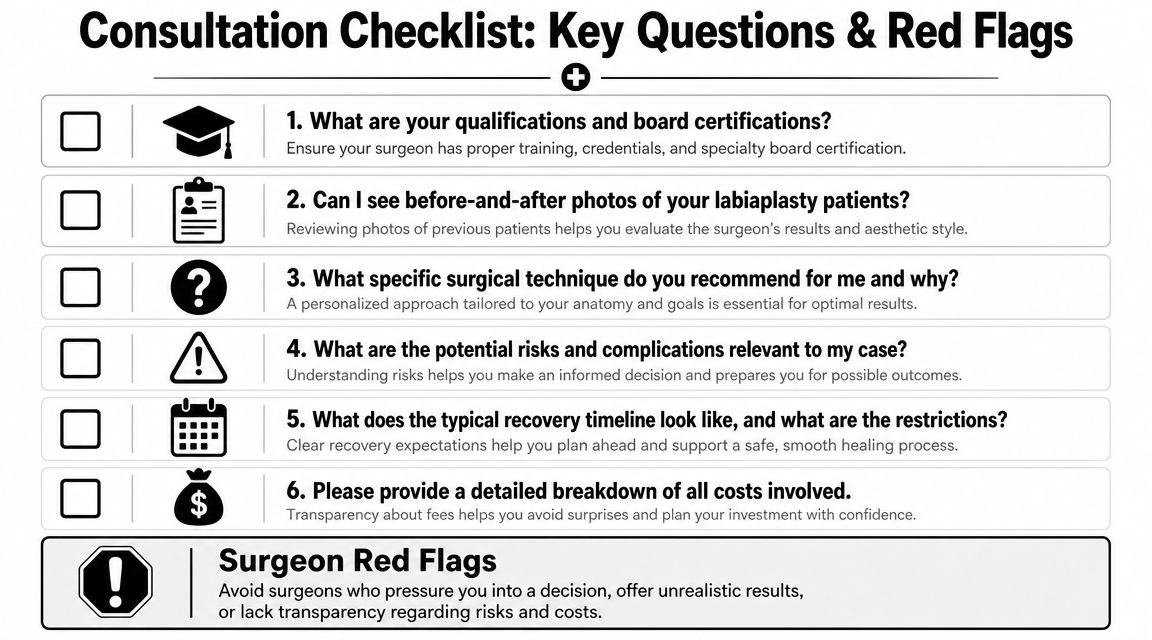
A strong consultation should feel like a two-way evaluation. The surgeon is assessing whether you're a good candidate. You're assessing whether this surgeon is the right person to operate on you.
Keep this video in mind before you book or attend appointments:
Questions that produce useful answers
Take screenshots. Write the answers down. Compare them across consultations.
- What are your qualifications and board certifications for this type of surgery?
- Which technique do you recommend for my anatomy, and why not the alternatives?
- What are the main complications you think are most relevant in my case?
- How do you avoid removing too much tissue?
- Can I see before-and-after photos of patients with anatomy similar to mine?
- What does your follow-up schedule look like if I have a healing problem or concern about asymmetry?
- How do you handle revision requests?
- What costs are included, and what costs would be separate if a complication or revision occurred?
For more on vetting credentials and experience, this guide on how to choose the best labiaplasty surgeon is worth reviewing before your visit.
Red flags I'd take seriously
Some warning signs are more telling than any brochure:
- Pressure to book quickly: surgery should tolerate thoughtful consideration.
- Dismissive language about risk: especially comments like “nothing ever goes wrong.”
- No meaningful technique discussion: if every patient gets the same approach, that's a problem.
- Unrealistic promises of perfect symmetry: human tissue doesn't work that way.
- No revision framework: if the surgeon gets vague when you ask about unsatisfactory outcomes, notice that.
- Poor communication around recovery: patients need a real plan, not generic reassurance.
If a surgeon acts annoyed by careful questions, imagine how difficult that office may be when you need help after surgery.
Frequently Asked Questions About Labiaplasty Safety
What's the difference between normal swelling and a true complication
A common post-op scenario is this: the first few days feel swollen, tender, and uneven, and patients worry that something has gone wrong. In many cases, that pattern is part of normal healing.
What concerns me more is a change in direction. Swelling that keeps increasing instead of settling, pain that becomes sharp or severe after initial improvement, marked one-sided fullness, wound separation, foul drainage, or fever deserve a call to your surgeon. Patients do better when they report concerns early rather than waiting to see if things declare themselves.
Can smoking really affect the risks of labiaplasty that much
Yes.
Healing depends on blood flow and oxygen delivery to delicate tissue. Smoking and nicotine exposure can interfere with both, which raises the risk of delayed healing, wound breakdown, and less favorable scars. If I am assessing risk with a patient, this is one of the clearest modifiable factors to address before surgery.
Will I still be able to have children naturally after labiaplasty
Labiaplasty involves external vulvar tissue. It does not affect the uterus, ovaries, or fertility.
The better consultation question is whether surgery fits your timing. If pregnancy is likely in the near future, ask how childbirth and tissue stretching could affect the result and whether waiting would make more sense for you.
Is it possible to eliminate all risk
No. The goal is to reduce risk in a thoughtful way and to choose a technique that fits your anatomy and priorities.
Some trade-offs are technique-specific. Wedge resections can preserve the natural edge, but they also place tension across a closure line that can separate or heal unpredictably in some patients. More extensive reduction patterns may address several concerns at once, but broader surgery can mean more healing variables and a higher chance that a second procedure is needed. That is the core of the safety discussion.
Is labiaplasty “worth it” if revision is sometimes needed
That depends on what problem you are trying to solve. A patient with daily irritation in clothing, discomfort during exercise, or persistent pulling symptoms may judge the trade-off differently than someone seeking a subtle cosmetic change.
I encourage patients to ask themselves three questions: What bothers me most now? What improvement would feel meaningful? What downside would I find hard to accept if healing is slower, asymmetry remains, or revision becomes necessary? Clear answers make better decisions.
What's the single most important mindset to bring into consultation
Ask the surgeon to connect your goals, your anatomy, and the exact technique they recommend.
If that explanation is vague, keep asking. You should be able to understand why a trim, wedge, or another approach was chosen for you, what specific complication concerns come with that plan, and what the backup plan would be if healing is uneven. A safe consultation is not just reassurance. It is a clear discussion of choices, trade-offs, and follow-up.
Labiaplasty.com offers general educational material that some patients use while preparing questions, but it should not replace a detailed discussion with the surgeon who would be operating on you.
