
You change into workout leggings, start your day, and within an hour you’re shifting in your seat, tugging at fabric, and wondering why such a small area can become so distracting. By the time you walk the dog, finish a spin class, or have sex later that evening, the irritation has turned into burning, stinging, or that raw rubbed feeling that’s hard to ignore and even harder to explain.
Many patients describe chafing of the labia as a private nuisance they feel they should just manage. They try different underwear, looser pants, detergent changes, shaving less, shaving more, powders, creams, and awkward mid-day adjustments. What makes this especially frustrating is that the discomfort often affects more than skin. It changes behavior. People skip workouts, avoid certain clothes, and feel self-conscious during intimacy. The emotional impact matters. A recent rise in fitness activity after the pandemic was associated with a 25% increase in chafing reports among active women in OB-GYN surveys, and that same discussion notes how chronic labial chafing can lead women to avoid activities they enjoy and feel more self-conscious in intimate situations (Ubie Health on labial discomfort and chafing).
This isn’t vanity. It’s a quality-of-life issue.
Introduction The Unspoken Discomfort of Labial Chafing
Labial chafing happens when the delicate skin of the vulva, especially the labia minora or labia majora, is repeatedly exposed to friction, pressure, moisture, or irritation. Sometimes the cause is simple, like heat, sweat, and tight clothing. Sometimes the issue is anatomical, with labial tissue rubbing against thighs, underwear, or itself during movement.
I see a common pattern in patients who finally bring this up. They don’t come in because of one bad day. They come in after months or years of managing around the problem. They’ve stopped biking. They only wear certain underwear. They avoid fitted exercise clothes. They dread long walks, long drives, and sex when the area is already irritated.
Chafing of the labia is common, but that doesn’t make it normal for you to live with if it keeps interrupting your day.
The key is to figure out what’s driving the symptoms. Friction alone can do it. So can fragile menopausal tissue, contact irritation, recurrent infections, skin disease, or excess labial tissue that creates a constant rubbing problem. The right treatment depends on the right diagnosis.
Understanding the Root Causes of Labial Irritation
Chafing of the labia is usually mechanical at first. Skin rubs against skin, clothing, or pressure points during movement. Then moisture, heat, and inflammation make the area more vulnerable, so the next episode starts faster and feels worse.
Vulvar pruritus, which many women experience as itching, burning, or chafing in the labial area, affects 5% to 10% of the general female population in countries such as Germany and the US. Menopause also plays a major role. Genitourinary syndrome of menopause affects 50% to 70% of women, and 63% report labial itching or burning related to tissue changes (PMC review on vulvar pruritus and vulvar disorders).

Anatomy can be the main driver
For some women, the issue is labial hypertrophy, meaning the labia minora are longer, fuller, or more asymmetrical in a way that creates repeated friction. That doesn’t mean the anatomy is abnormal in a harmful sense. It means the anatomy is functionally bothersome.
If tissue protrudes and folds during walking, cycling, or exercise, the rubbing becomes predictable. The problem isn’t that movement is wrong. The problem is that movement keeps forcing delicate tissue through the same friction cycle.
If you want a fuller explanation of how this develops, labial hypertrophy causes and contributing factors are worth understanding before you decide how to treat it.
Sweat, fabric, and pressure make friction worse
Even when anatomy starts the problem, daily conditions often amplify it:
- Tight leggings or underwear can pin tissue into one position and increase rubbing with each step.
- Seams and rough fabrics act like repeated low-grade abrasion.
- Sweat and trapped moisture soften the skin, so the surface breaks down more easily.
- Cycling, running, horseback riding, and long walks create the kind of repetitive motion that turns mild irritation into ongoing pain.
Patients often tell me, “It feels fine when I get dressed, and then halfway through the day it starts.” That timing makes sense. Chafing builds with repetition.
Hormonal change can make tissue fragile
Hormones affect how vulvar tissue tolerates friction. During menopause, the skin and mucosa can become thinner, drier, and less elastic. The same amount of pressure from underwear or exercise that once felt like nothing can start causing a burning or scraping sensation.
This is why treatment has to match the cause. A person with dry, irritated menopausal tissue may improve with vulvar skin care and hormone-focused treatment. A person whose labia repeatedly twist and rub during movement may need a more structural solution.
Clinical insight: If symptoms happen mainly with motion, clothing pressure, or exercise, friction is usually central. If symptoms also show up at rest, at night, or with obvious skin changes, I start thinking more broadly.
Recognizing Symptoms and Their Impact on Daily Life
The symptoms of chafing of the labia aren’t always dramatic on day one. Often they start as a subtle hot, rubbing sensation. Then the area becomes tender, stingy in the shower, and uncomfortable when you sit a certain way or put on fitted clothes.

What patients commonly feel
Typical symptoms include:
- Burning or stinging during walking, workouts, or sex
- Redness and tenderness after activity
- Rawness when wiping or showering
- Swelling or puffiness by the end of the day
- Pinching or pulling when tissue catches in clothing
- A constant need to adjust underwear, leggings, or the labia themselves
In more persistent cases, the skin may look rubbed, shiny, or mildly broken down. Some women describe the sensation as a paper cut. Others say it feels like a seam is scraping the same spot over and over.
When one labium is longer or shaped differently than the other, symptoms can also be one-sided. That’s one reason some people search for help after noticing that uneven labia can cause pain and irritation, not just a cosmetic difference.
The disruption goes beyond the skin
Labial chafing changes routines in quiet ways. A patient may stop wearing jeans, avoid spin bikes, skip long walks, or choose swimsuits based on whether they’ll feel exposed or uncomfortable. Another may still exercise, but only after applying ointment, changing underwear, and planning around soreness later.
Those workarounds are common, but they can become exhausting.
Some of the most affected patients aren’t the ones with the worst exam findings. They’re the ones who have built their day around not aggravating the area.
That’s where the psychological effect shows up. A condition that seems minor from the outside can create constant vigilance. You think about what to wear, how long you’ll be active, whether sex will hurt, and whether you’ll need to excuse yourself to adjust.
A short discussion may help put these symptoms in context:
Signs that it’s becoming a chronic problem
I start thinking of chafing as a chronic quality-of-life issue when a patient tells me any of the following:
- Exercise has become conditional. She can do it only with elaborate preparation, or not at all.
- Clothing choices are narrowing. Comfort, not preference, drives every decision.
- Intimacy feels tense. Not necessarily because of severe pain, but because she expects pulling, friction, or soreness afterward.
- The area never fully settles down. There’s temporary improvement, then the next flare starts with normal activity.
At that point, symptom relief matters, but so does finding the underlying reason the cycle keeps repeating.
Effective Prevention and Non-Surgical Treatments
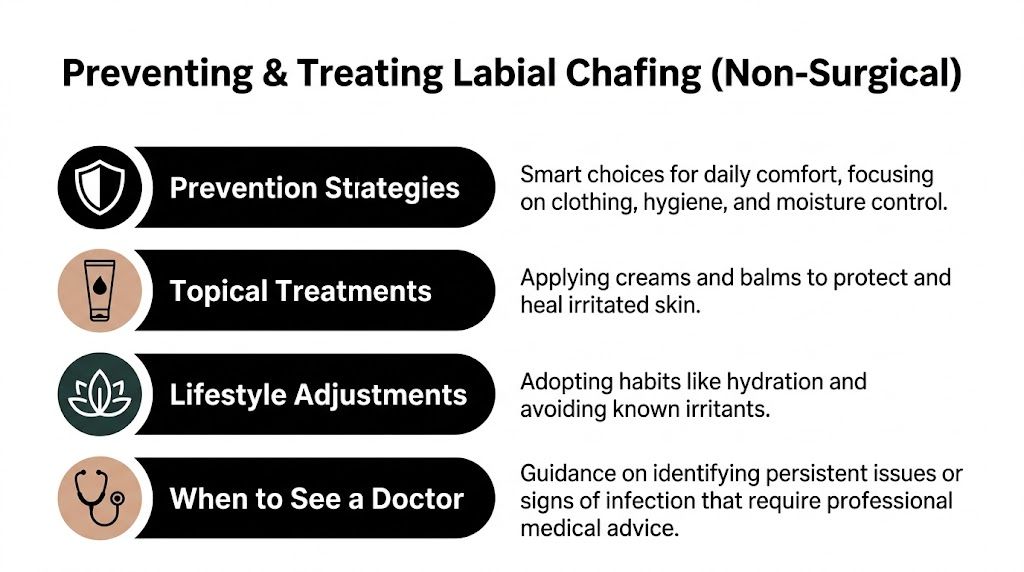
Conservative care is the right starting point for many patients with labial chafing. It lowers irritation, helps the skin recover, and often clarifies the pattern. If symptoms settle with a few practical changes, the problem may be driven mainly by sweat, fabric, pressure, or repetitive motion. If symptoms improve only briefly and return with running, cycling, fitted clothing, or intercourse, anatomy may be a larger part of the problem.
That distinction matters emotionally as well as physically. Patients often feel relieved when they realize they are not "failing" basic self-care. Sometimes they are doing everything right and still dealing with tissue that repeatedly gets pulled, compressed, or rubbed.
What usually helps first
The best first-line plan is simple and consistent. Reduce friction. Reduce moisture. Remove irritants. Protect the skin before activity rather than trying to rescue it afterward.
For mild or situational chafing, that approach is often enough. For patients with more prominent labia minora, it may still help, but the benefit is sometimes partial because creams and clothing changes cannot change how the tissue moves.
Build a low-friction routine
Try one routine for two to four weeks instead of changing products every few days.
- Choose underwear carefully. Smooth, moisture-wicking fabrics usually work better than lace, rough seams, or underwear that shifts during exercise. Some patients prefer athletic styles. Others do better with soft microfiber for daily wear.
- Apply a barrier before activity. Petroleum jelly, Aquaphor Healing Ointment, or an anti-chafe balm such as Body Glide can reduce rubbing during walking, running, cycling, or long work shifts.
- Get out of wet clothing promptly. Sweat and trapped moisture soften the skin and make friction more damaging.
- Clean the vulva gently. Use lukewarm water. If a cleanser is needed, keep it mild and use it only externally.
- Dry with care. Pat the area dry with a soft towel. Rubbing can worsen tenderness, especially during a flare.
- Reconsider hair removal if shaving makes things worse. Short stubble can increase friction for some patients, while others feel better with trimmed hair. This is individual.
Match the treatment to the trigger
One reason patients get stuck is that they use the same remedy for every type of discomfort.
Before exercise:
Use a barrier product and wear clothing that does not compress or trap the labia in a painful position.
After exercise or a long day on your feet:
Cool compresses, loose clothing, and a bland ointment usually calm the area better than repeated washing.
At night:
Reduce pressure and heat. Loose cotton shorts or sleeping without tight underwear can help the skin settle.
During sex:
If friction or pulling is part of the problem, a simple lubricant is often more useful than fragranced "feminine" products. If intercourse causes lingering soreness afterward, that is worth paying attention to.
Practical rule: If a product stings, burns, or leaves the skin feeling hotter, stop using it.
Comparing Non-Surgical Chafing Solutions
| Solution Type | How It Works | Best For | Limitations |
|---|---|---|---|
| Smooth moisture-wicking underwear | Lowers fabric friction and helps move sweat away from skin | Daily wear, workouts, hot weather | Won’t fix tissue that still rubs or folds despite better fabric |
| Barrier ointments and anti-chafe balms | Creates a protective layer between tissue and clothing | Running, walking, cycling, long workdays | Can feel messy, must be reapplied, may not help enough with larger labia |
| Loose clothing and activity modification | Reduces compression and repetitive rubbing | Flares, recovery days, symptom control | Hard to sustain if it limits exercise, wardrobe, or lifestyle |
| Gentle vulvar skin care | Removes irritants like fragrance, harsh soap, and over-cleansing | Sensitive skin, dermatitis overlap, post-flare care | Helps irritation but doesn’t address structural friction |
| Lubricants during sex | Reduces friction and pulling during intimacy | Intercourse-related soreness or tissue dragging | Only helps during intimacy, not day-to-day symptoms |
| Ice packs or cool compresses | Calms inflammation after a flare | Acute burning, swelling, tenderness | Temporary relief only |
| Medical evaluation for persistent symptoms | Identifies infection, skin disease, or anatomical causes | Recurrent, unexplained, or worsening irritation | Requires exam and may lead to treatment beyond self-care |
What tends to backfire
I see the same missteps often in clinic.
- Scented wipes, sprays, and washes can irritate already sensitive vulvar skin.
- Repeated antifungal treatment can delay the right diagnosis if the problem is friction, contact irritation, or a skin condition.
- Daily panty liners or rough pads may trap heat and add another source of rubbing.
- Constant washing often leaves the skin more inflamed, not cleaner.
- Pushing through pain usually prolongs the cycle. Patients then start avoiding exercise, intimacy, or certain clothes, which affects confidence as much as comfort.
Non-surgical treatment has real value. It can reduce flares, protect the skin, and show whether the problem is manageable with habit changes alone. When these measures help only partly, that is useful information, not a personal failure.
When to See a Doctor Distinguishing Chafing from Other Conditions
Not every irritated vulva is a friction problem. Patients often get stuck because symptoms overlap, and many people assume the cause must be hygiene, sweat, sex, or recurrent yeast. That assumption can delay the right diagnosis.
Globally, 20% to 30% of women experience recurrent vulvar irritation that is misattributed to hygiene, when the cause may be an infection or dermatosis. In up to 40% of chronic cases where anatomical labial hypertrophy mimics infection symptoms, biopsies show no pathogens (Medical News Today on irritated vulva and overlapping causes).
Chafing versus infection or skin disease
Simple chafing usually follows friction. It worsens with walking, exercise, heat, or tight clothes. It often improves with rest, gentle care, and reducing rubbing.
Other conditions can look similar at first:
- Yeast infection may cause intense itching, irritation, and tenderness, but often includes internal vaginal symptoms as well.
- Bacterial vaginosis usually has a different pattern, with discharge or odor being more prominent than pure rubbing discomfort.
- Contact dermatitis often appears after a new detergent, pad, wipe, lubricant, shaving product, or topical medication.
- Vulvar dermatoses such as lichen sclerosus, psoriasis, or lichen planus can cause itching, burning, color change, fragility, or cracking.
- STIs may present with sores, lesions, focal pain, or unusual discharge, depending on the cause.
Red flags that need medical evaluation
Make an appointment promptly if you notice any of these:
- Unusual discharge that’s new, persistent, or accompanied by odor
- Open sores, blisters, or ulcers
- Bleeding from the skin
- Pain that seems out of proportion to visible rubbing
- Symptoms that occur even without activity
- White patches, thickened skin, or recurring fissures
- Repeated “yeast infections” that don’t respond to treatment
- Burning with urination because urine touches raw or inflamed skin
If symptoms keep coming back despite good skin care and friction control, don’t assume you’re missing a better cream. You may need a better diagnosis.
What a proper evaluation usually involves
A vulvar exam is usually straightforward. The goal is to answer a few practical questions: Is the tissue inflamed because of friction, infected, hormonally fragile, or affected by a skin condition? Is there excess tissue creating recurrent mechanical irritation? Does one side catch or pull more than the other? Are there signs that point away from chafing?
Depending on symptoms, a clinician may do:
- A visual exam of the vulva and surrounding skin
- Vaginal testing or swabs if infection is possible
- Review of products and habits such as detergents, pads, soaps, lubricants, and shaving
- Occasional biopsy if a chronic skin disorder is suspected
That evaluation is the difference between temporary guessing and a targeted plan.
Is Labiaplasty a Permanent Solution for Chronic Chafing
A common consultation goes like this: a patient has already changed underwear, stopped wearing certain workout leggings, used barrier ointments, and planned her day around what will rub less. She is not looking for a cosmetic fix. She wants to walk, exercise, and have sex without the tissue catching, pulling, or becoming raw. That distinction matters.
Labiaplasty can be a lasting solution when chronic chafing is caused by excess labial tissue creating repeated mechanical friction. It does not treat every cause of vulvar irritation. It helps the patients whose anatomy is the reason symptoms keep returning.
What the procedure actually does
A labiaplasty reduces and reshapes the labia minora so there is less tissue to fold, twist, tug, or rub during daily activity. The functional goal is straightforward. Reduce the repetitive contact that keeps inflaming the skin.
If you’re new to the procedure, what a labiaplasty is and how it’s performed is a useful place to start.
Technique matters. Some patients are better served by a trim approach, while others are better served by a wedge resection. The choice depends on where the friction occurs, how much tissue is involved, natural asymmetry, tissue quality, and the importance of preserving contour and sensation. Good planning is individualized. A templated operation is not good enough for functional symptoms.
Who is most likely to benefit
The strongest candidates usually describe a very specific pattern. Symptoms are triggered by motion or pressure, not random flare-ups. The tissue may catch in underwear, pull during intercourse, rub during runs or long walks, or become sore after cycling and other seated exercise. Many women also describe a second burden that is easy to underestimate. They start avoiding certain clothes, changing how they sit, skipping workouts, or feeling self-conscious with a partner because they are bracing for discomfort.
That combination of physical friction and mental preoccupation is often what brings someone to surgery. The problem is not only pain. It is the steady way pain starts dictating choices.
A good candidate generally has these features:
- The symptoms are mechanical and repeatable. The same activities cause the same rubbing or pulling.
- Conservative treatment has already been tried. Skin protection, clothing changes, and friction control did not provide reliable relief.
- The goal is functional improvement. The patient wants less irritation and less interference with daily life.
- The diagnosis is reasonably clear. Other causes of vulvar symptoms have already been considered.
- Expectations are realistic. Surgery can improve comfort, but it will not create perfect symmetry or prevent every future vulvar problem.
Expected results and realistic trade-offs
For the right patient, improvement is often durable because the operation changes the structure causing the friction. If the problem is excess tissue rubbing with activity, reducing that tissue can reduce the trigger itself. That is why many patients report meaningful relief once healing is complete.
Still, permanence has limits. Bodies change. Weight fluctuations, childbirth, aging, hormonal changes, scar behavior, and baseline skin sensitivity can all affect how the area feels over time. Surgery also does not protect against problems unrelated to anatomy, such as contact dermatitis, infection, low-estrogen tissue changes, or chronic vulvar skin disease.
Recovery also requires honest planning. Swelling is expected early on, and the tissue often looks more uneven before it settles. Exercise, intercourse, and any activity that creates friction have to wait until healing is far enough along. Patients who do best are usually the ones who treat recovery like any other surgical recovery, not like a minor inconvenience.
Questions worth asking in consultation
Before choosing surgery, ask questions that clarify cause, benefit, and trade-offs:
- Do my symptoms fit an anatomic problem, or could something else be contributing?
- Which part of the labia is causing the rubbing?
- What technique do you recommend for my anatomy, and why?
- What is the recovery timeline for work, exercise, and sex in my case?
- What are the risks, including asymmetry, scarring, over-resection, or persistent sensitivity?
- What result would you consider a success for function, not just appearance?
A good consultation should leave you with a clear diagnosis and a realistic sense of what surgery can and cannot improve. That clarity often reduces anxiety on its own. When patients understand whether the problem is friction from anatomy, rather than a rash, infection, or skin disorder that keeps being mislabeled, they can make a much more informed decision about whether labiaplasty is the right next step.
Conclusion Taking the Next Step Toward Comfort and Confidence
Chafing of the labia can start as a minor annoyance and become a problem that shapes how you move, dress, exercise, and feel in intimate settings. That progression is common, and it deserves to be taken seriously.
The right next step depends on the cause. Some women improve with better friction control, gentler skin care, and changes in clothing or activity. Others need an evaluation because the symptoms overlap with infection, dermatitis, menopause-related tissue change, or a vulvar skin disorder. And for patients whose symptoms are driven by excess labial tissue, labiaplasty can be a durable, function-focused solution.
What matters most is not guessing for another year.
If your symptoms keep returning, if you’ve started avoiding activities, or if intimacy has become stressful because of pulling, rubbing, or soreness, it’s time for a proper medical assessment. Relief usually starts with a clear diagnosis. Once you know whether the issue is skin, hormones, infection, or anatomy, the treatment path becomes much more straightforward.
You shouldn’t have to organize your life around avoiding friction.
If you’re researching treatment options and want a reliable place to learn more, Labiaplasty.com offers practical educational information on candidacy, surgical approaches, recovery, risks, and how to prepare for a consultation. It’s a useful starting point if you’re trying to understand whether persistent labial chafing may have an anatomical cause and what questions to ask before seeing a qualified surgeon.
